Gallery: WildlifePosted July 13, 2014241 views4 comments
2014:05:03
D800
80-400mm @ 400mm
1/800 sec, f/9
Mode: Av
Metering: Spot
ISO: 400
White balance: Auto
Comments
4 comments
Comment posted by Jerry Austin on July 13, 2014 at 3:18 PM
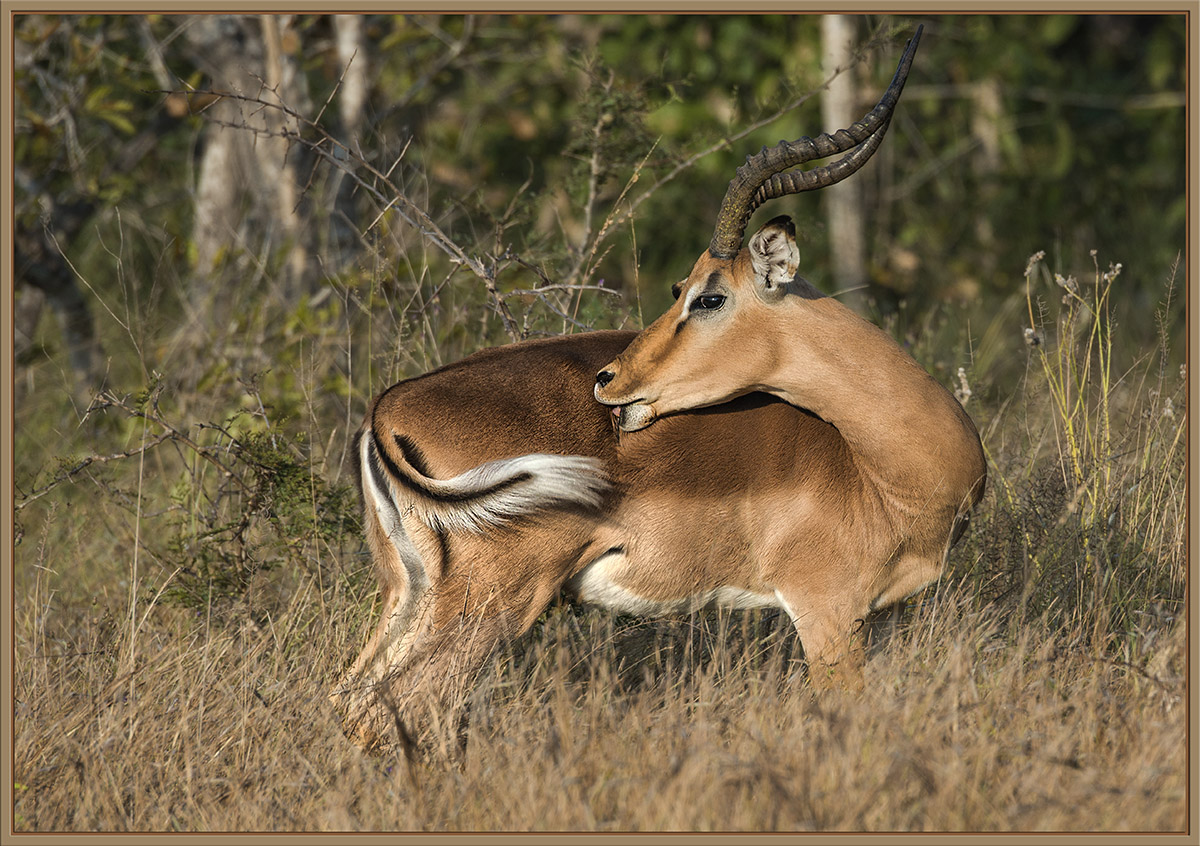
Wow Sandy, this is really nice. The colors are rich and the background habitat is perfect. My only nit is a desire for a bit more room on top. What sub-species of impala is this? This guy looks different from the impalas I encountered in Tanzania.
Registered on January 6, 2012, 651 Posts, 3448 Comments
Comment posted by SandyRichardsBrown on July 13, 2014 at 3:56 PM
I don't know!
From the Net:
"Up to six subspecies have been described, although only two are usually recognized, supported by mitochondrial DNA analysis.[2][8] These are the common (A. m. melampus) and the black-faced (A. m. petersi) impala. While the former is abundant throughout southern and eastern Africa, the latter is restricted to southwestern Africa.[9] Both subspecies show much genetic differentiation, and no hybrids are known. "
Registered on November 24, 2003, 3937 Posts, 12909 Comments
Comment posted by Gary Gulash on July 13, 2014 at 5:31 PM
I agree with Jerry, very nice. I too really like the rich coloration of the impala and the excellent habitat. The posture of the impala's body adds that extra flare that really makes it for me.
Registered on January 28, 2005, 879 Posts, 12098 Comments
Comment posted by Lon Sharp on July 14, 2014 at 9:58 AM
Exposure looks fine. I agree with wishing for a bit more space. The hair texture on the back part s of the impala feel overly sharpened to me...somewhat "crispy."
Registered on December 9, 2007, 258 Posts, 9892 Comments

Comments
4 commentsFrom the Net:
"Up to six subspecies have been described, although only two are usually recognized, supported by mitochondrial DNA analysis.[2][8] These are the common (A. m. melampus) and the black-faced (A. m. petersi) impala. While the former is abundant throughout southern and eastern Africa, the latter is restricted to southwestern Africa.[9] Both subspecies show much genetic differentiation, and no hybrids are known. "