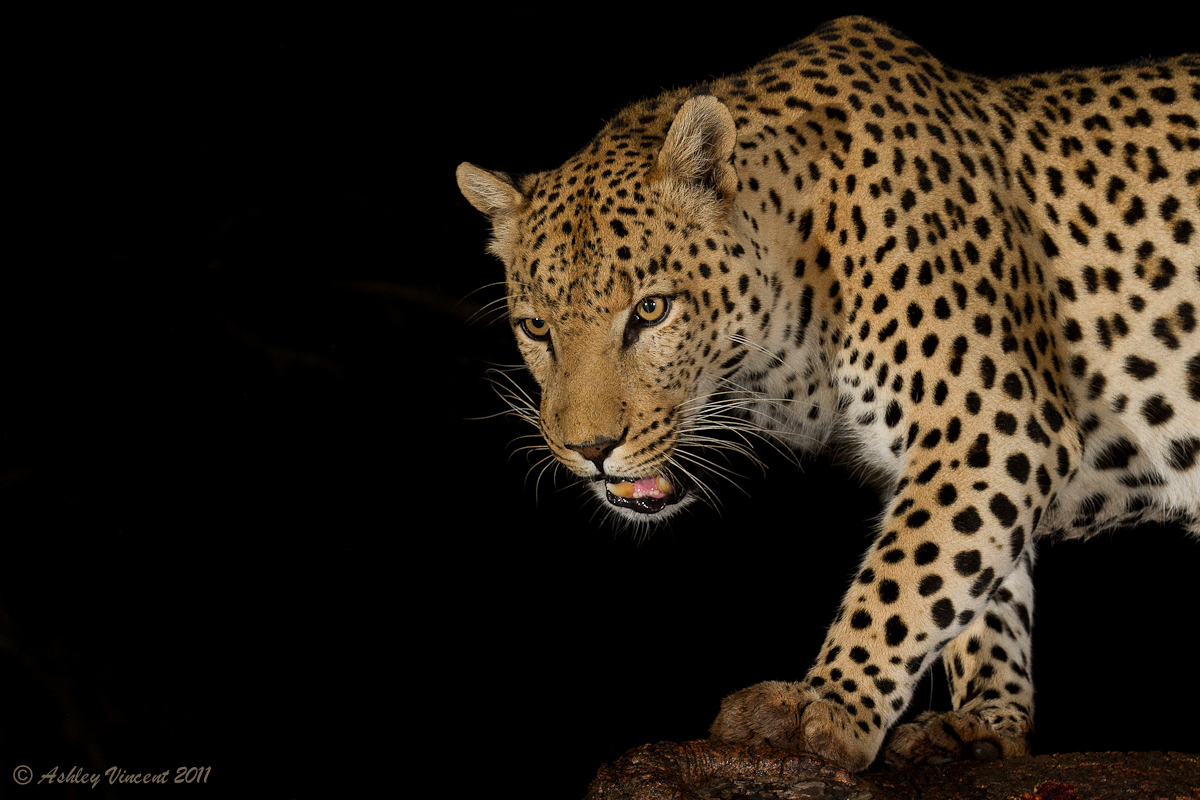
Nocturnal Predator
by Ashley Vincent
Canon EOS 7D, EF 7-200mm f/2.8L IS USM MK II + 1.4x Extender MK III @ 150mm, Manual: f/8 (1/100 sec), 0 EV, ISO 800, Duel-Flash Setup, Handheld, JPEG from RAW, Cropped About 5% from Full Frame
As some of you may recall, last month I set off for an African adventure: two weeks in South Africa followed by another five days in Madagascar. Returning exhausted yet safely on September 6th I immediately set to work on ruthlessly deleting the unacceptable from the more than 8,500 images I came back with, then selecting and processing the best of the best.
Although I still have more to get through and process, with now over 100 new pictures added to my portfolio I'm ready to begin showing some of them to you.
I'd also like to take this opportunity to offer my sincere thanks once again to Stu (Porter – WILD4 African Photographic Safaris), who is one of the friends I made here on the NPN and the person who helped me plan and organise my time in South Africa. Had it not been for his experience, recommendations and advice, as well as his support and that of his family, there's no doubt in my mind that I would have returned with far fewer captivating images to add to my collection.
Although we only had the first 24 hours together (Stu left the next day to lead a photo trip in Kenya) he was able to offer me some useful photographic advice and helped me get the first great shots of this trip by use of his duel-flash setup to capture images of a (captive) Leopard in a tree, one of which you see here above.
I'm also very thankful to Stu's wife Justyna, who was a major help in organizing accommodation in both camps I stayed at in Kruger National Park, and always responded to my (many!) emails in a friendly, professional, and timely manner whenever Stu was unavailable.
Likewise, I'm extremely grateful to John and Ann (Stu's parents), who were my private guides for the duration of my stay in Kruger and both of them, figuratively and literally, went beyond the extra mile to help find the best locations and situation possible for the subjects I was most interested in shooting; I'd actually only arranged for John to be my guide, but Ann joined us everyday (pretty much 12 hours everyday!) in a separate vehicle to drive ahead as our scout and frequently reported new sightings back to us over the two-way radio.
While of course I was far from idle, I truly believe that much of the credit to whatever pleasing images I came back with from South Africa is largely due to the WILD4 Team (AKA the Porter family) and, as such, it's my great pleasure to highly recommend them to anyone interested in a truly wonderful African photographic safari experience!
As to this first photo you see here: Thanks to Stu's excellent suggestion, the first half of my time in SA was spent at the Big Cat Reserve, Limpopo, which is a private reserve in the northernmost province of South Africa.
Most of the cats you'll see me post up here from my trip were photographed there. The Big Cat Reserve was set up about 30 years ago with the principal aim of bringing in, nurturing, and, where possible, reintroducing orphaned animals into the wild. Being that many of the cats were orphaned at birth, or at least at a very young age, they have been hand-raised, which in some cases means they've become very at ease around humans, both handlers as well as visitors.
As you might imagine, some people may not enjoy this experience too much, as for them this sort of close contact doesn't have the same feel as seeing animals completely in the wild. For me though, as a photographer looking to build up a unique portfolio, it was a dream opportunity!
As it happens, had I not met Stu and, instead, followed through on my original plan of spending the entire two weeks in Kruger, based on the sparse sightings I had (through no fault of my guides, more a case of Nature's design!), I would surely have returned home in tears: During the eight days we were in Kruger National Park we only had one Cheetah sighting (amazing and wonderful as that was) and one of a Leopard on my second to last day, which had many elements one prays for (in a tree, leaping up to and walking along branches, with a kill, eating, resting, yawning, moving the Impala, etc.) yet with the one main exception of conducive light ;^.
Anyhow, this post is probably long enough as is, so I'll save more details for upcoming posts ;^)
Great to be back and hope you enjoy this and the other photos to follow :^)

Comments
16 commentsHonestly I have to say that this image give me a feeling of being shot in a studio.
But like it a lot the way you captured it anyway.
Thx
Jef
Hussain: Here's the link to Stu's website: http://www.wild4photographicsafaris.com
I believe he's currently leading another photography trip somewhere in the Kruger right now, but chances are that if you send him an email his wife Justyna will get back to you pretty quick and Stu will follow up soon as he's back again. I'm sure you'll be happy with the feedback and attention you receive, and I'm equally sure that you'll be at least as pleased as I am next year when you've returned from your successful photography trip with Stu. All the best :^)
Looking forward to your upcoming posts
Did you happen to stay at Satara and/or find the scops owls living there? That was one of my highlights in Kruger.
Max
Max: There's a possibility that we may have made a pitstop at Satara, as I do recall hearing the name, but the camps I stayed at were first Pretoriouskop followed by Skukuza. In Pretoriouskop we could hear Owls hooting throughout the night and up to first light, but I never caught sight of one. However, while staying at the Big Cat Reserve before I got to Kruger I did get to see, and photograph, two separate species, the Pearl-Spotted Owlet and what I believe is an African Scops Owl, but I could be wrong on the latter's ID.
We actually found it in it's nest and returned on several occasions at different times of the day. Problem was that it was pretty hunkered down most of the time, and when we could see it's head invariably it's eye's were only partially open or fully closed, in addition to which there were too many small distractions by way of twigs to make for a pleasing shot. I kept a few for reference purposes, but I don't feel they're worthy of adding to my portfolio or making a post of in the Avian gallery. Having said that, I'll post the best image I have here so you can perhaps confirm whether or not it is in fact a Scops Owl.
Carol: Real pleased you like this one and good point re adding a little more space along the upper edge of the frame, thanks :^)
Vincent: If I was fortunate enough to live in Botswana and have the luxury of time and, thereby, numerous sightings and encounters, surely I too would also feel they same way as you inasmuch as having a much stronger preference for shooting only animals I find in the wild over those found in captivity. To put things in perspective though, I live all the way over here in Thailand with plans of making part of my income from selling prints of wildlife images from a portfolio I've had just about a year to put together, and I feel the photos that will likely be the most popular sellers are those that are not only compelling but have a degree of immediate high impact on the viewer, this also happens to be the sort of image that holds most appeal for me.
Being that I only had a window of two weeks to capture as many shots of this sort in SA, I opted for mostly captive (or in some cases semi-captive) shots to ensure that the financial investment of this trip (which was considerable) had a certain amount of insurance, as it were, included. Only time will tell whether this pans out for me the way I'm envisaging it will, but looking at the number of images of cats in captivity that I'm most happiest with, I feel I made the right decision.
Hopefully when viewing some of the others I'll be posting up here in days and weeks ahead, you'll be able to nudge aside enough of your reservations about the subjects having been shot in captivity to be able to find something pleasing about at least some of them simply for the portrayal of a truly magnificent animal ;^)
Max
This might sound paradoxical but i think its too well done
In all honesty, I have to agree with Jef Oonk in that it looks like it was shot in a studio. Was the animal in an enclosure, behind glass or in a tree in a free-to-roam camp?
To me, and I'm calling it as I see it (and believe you will appreciate my directness), it almost looks like a 'stuffed' leopard (having seen some leopards prepared by taxidermists). By that I am by NO means saying you DID photograph a stuffed animal
Sorry if I came across too blunt
Having had more time to think on the main observation that Jef, Vincent, Anand, and now you made, the more I look at this picture (and others I have of the same shoot) I'm inclined to agree that there does appear to be something a little artificial about these images. Thing is, as I think you already know, my goal is to eventually make something of an income by the sale of my prints, and the market I'm aiming at is not so much experienced photographers (let alone professional photographers!) like you guys, but somewhat less discerning people who simply appreciate a striking, stunning, or otherwise captivating and compelling image that they'd like to adorn their wall.
Would it be a good candidate to win a competition? I seriously doubt it. Then again, that was never my intention; I'll be more than happy to sell a few prints to whoever likes it enough to splash out some cash ;^)
In answer to your question: There are two fairly large (i.e. much larger than you'd likely find at most zoos) enclosures at this reserve that accommodate three Leopards; a male and a female in one, and a solitary - and very grumpy! - male in the other. If they choose not to be seen, their enclosures are in fact large enough for them to not make an appearance, though more often than not curiosity (which in this case doesn't result in an untimely demise!) brings them to the fence - or up a tree in close proximity - to check out any visitors.