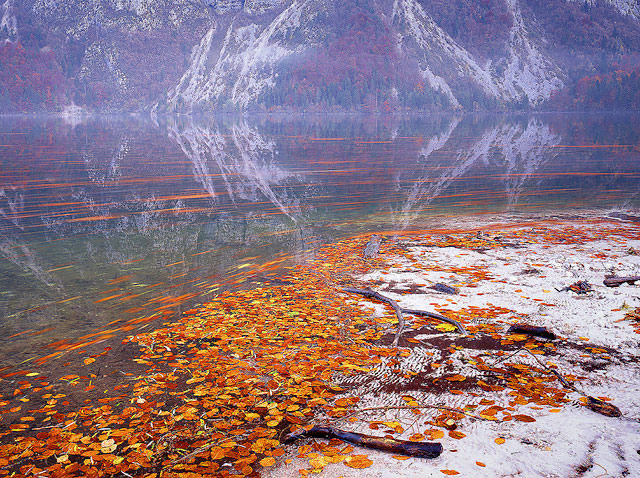
I posted a shot from that scene weeks ago and in some comments you (the viewers) wondered (or suspected

) if it was a double exposure. past weekend we had a big exhibition (9000 viewers on 2 days) and the print was shown in 60x40" size and AGAIN some people said it's impossible to have such a good reflection in a long exposure! It bothered me after reading it in NPN comments and still does. now we got a different version here, maybe it's more obvious it's NOT a double exp.
besides: Triglav National Park, slovenia.
Toyo Field 45 AII, 75mm, 1 min exp. Velvia 50 (the colors in that post have suffered a bit, I guess, from compression)
Verena

Comments
36 comments(the colors here match the original slide better than the those in the post above...)
verena
verena
I personally didn't question the process of how the shot you originally posted was created. I've seen situations simular to this on the many rivers and lakes where I live (though on a much smaller scale), where the same concept could be applied. The thing that struck me about the shot when I first saw it, that made it so special, is that it portrays a common subject in a non conventional way. In essence, you're showing many people a way of seeing something that they normally wouldn't even consider. This is really a gift to the viewer. It's easy enough to construct images in a conventional way that can relate a sense of place...showing somebody a new way of seeing something however, is much more difficult and far less common. For me, your first posting (the second one shown here, also referred to as the "old" version) works better simply because you give less context. It's visually and intellectually intriguing. The concern of believability is good to a point, but I think there's times to let it go, especially when the integrity of your work can say something about an image that may deviate from the "normal" way of rendering something. I don't think you have anything to worry about.
Best regards and carry on the good work.
Joel, first, thank you, second, thank you!
One point in posting this, was indeed to show how a landscape photo, of a fairly large scale-content (half of the lakes surface) can be shot in an abstract way, so people start wondering what they actually look at. too often it's a concept only applied to macro photography. (although, of course, it's not often possible..) but it motivates (I hope) to keep an eye (or two) open for sg like it. so we didn't want to think anybody we applied some tricks here..
thanks again!
verena
georg
Guy
Ed
Ed, I think 4 minutes, or sg. like that.
verena
- Dan
Jose
This is just amazing.It compares equally with an image I saw at Nature's Best Photographer of the Year when the exhibition came to Seattle last summer. I couldn't take my eyes off it. Same with this. It's a masterpiece in ONE shot.
Congratulations on the well deserved EP for this image.
Sandy
Congrats for beeing selected as the second place in the earth sea&sky category! I was very surprised - I was one of the 9000 visitors - I am the guy that talked quite a bit with you, Verena, about taking pictures in the "lobau", hidden places such as the wild wine and getting started as landscape photographer as soon as possible.
Servus,
Dietrich
I prefer the 2nd shot for its uniformity but both are superb. How did you get such a slow exposure in what seems like quite bright light? Or was it dark? Maybe the use of a ND filter?