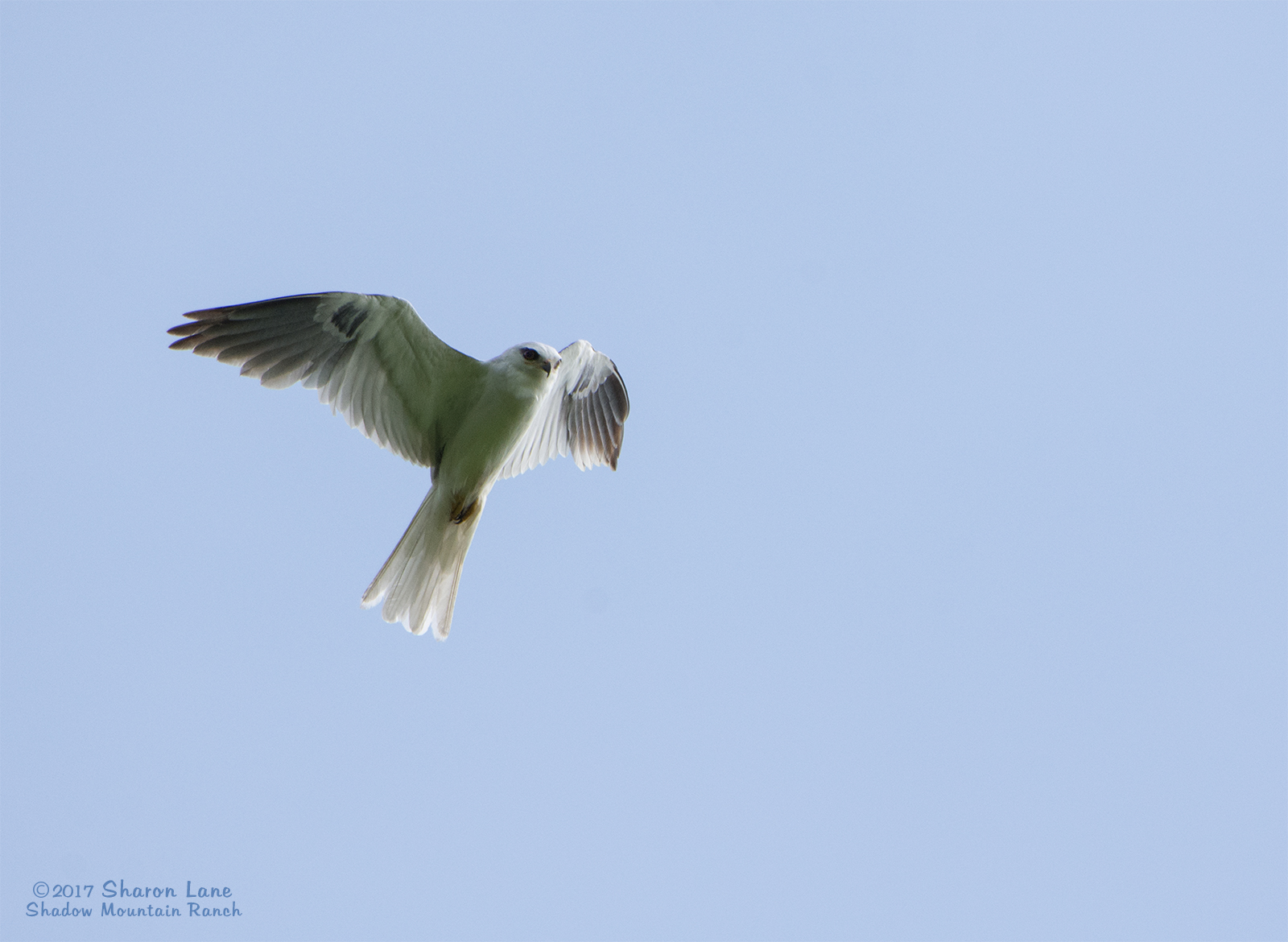
This is the female of the White-tailed Kite pair that have decided to nest on the ranch (Shadow Mountain Ranch). The WTKI is not rare for this region but is uncommon and there is no nesting record. I have been documenting the event with photos and notes. The female is less skittish than the male. The process from their first arrival, to courting, nest building and now incubation is fascinating. I cannot see into the nest as it is in the top of a Cedar Elm. Within the next 3 weeks the eggs should hatch and will hopefully be able to see the parents feeding. Anyone care to see 800+ photos of the same 2 birds

??
The photo: the only processing I performed was cropping and I did lighten her right eye.
Please all c and c is welcome and please comment on my camera settings. I have a new (for me) camera and brand new lens and I haven't finished the manuals.
Thanks!
Nikon D7200
Tamron 150-600mm G2 f/5.0-6.3
Aperture Priority
ISO 800 f/8 1/2000s 1.00eV 600mm

Comments
9 commentsI don't know the geography of your ranch, but if you anticipate getting shots with something other than the sky as bg, you might want to try setting the camera for manual exposure. If you set it so the prevailing light is just short of blowing whites, the the bird will still remain properly exposed when the bg changes from sky to tree. Anything white works for test shots and it doesn't take long until you pretty much know what settings to use and you'll just need a shot or two to get it where you want it.
I really envy you your new tenant.
I agree with Dennis's suggestions for comp and subject brightness. Perhaps some additional contrast to help pull the subject from the sky..............................Jim
Thanks for the comments, I will re-do the photo and repost. And work on getting a better handle on the exposure.
Most of the photos are with the sky bg and this has always been a weakness in my skills. Good incentive to hone them.
Thanks again.
I edit in Photoshop 6.
I have at least 1000 images of a pair of kites near where I was in California. Kites are tough to get - so much in the details - pleasing wing position, decent light, behavior, and - most importantly - catching the marvelous red eyes. My "keeper" rate was about 1 in 80. Thank God for the "delete" button.
They do amazing mid-air transfers from dad to mom of the voles they eat, when bringing them to the chicks in the nest. If you can get a good shot of that, you'll be smiling for a week.
Your image here is a nice one. techs look good. The re-post is better. The shadow/highlight slider can be helpful in lightening under-wing shadows.
Good luck! Just park yourself in good place for a few hours in bright overcast light and snap away.
Sandy
David - the Tamron 150-600mm G2 is great and takes fantastic photos (in spite of this photographer). I was set to buy the first version and at naturalist convention found out about the G2. Glad I waited. This photo was taken handheld.
Sandy - thanks for the advice about waiting until after Christmas for a used camera. Keh had the Nikon D7200 at a really good price with less than 5000 actuations.
Thanks again to all for your c and c's.