Buffalo at Night
by Max Waugh
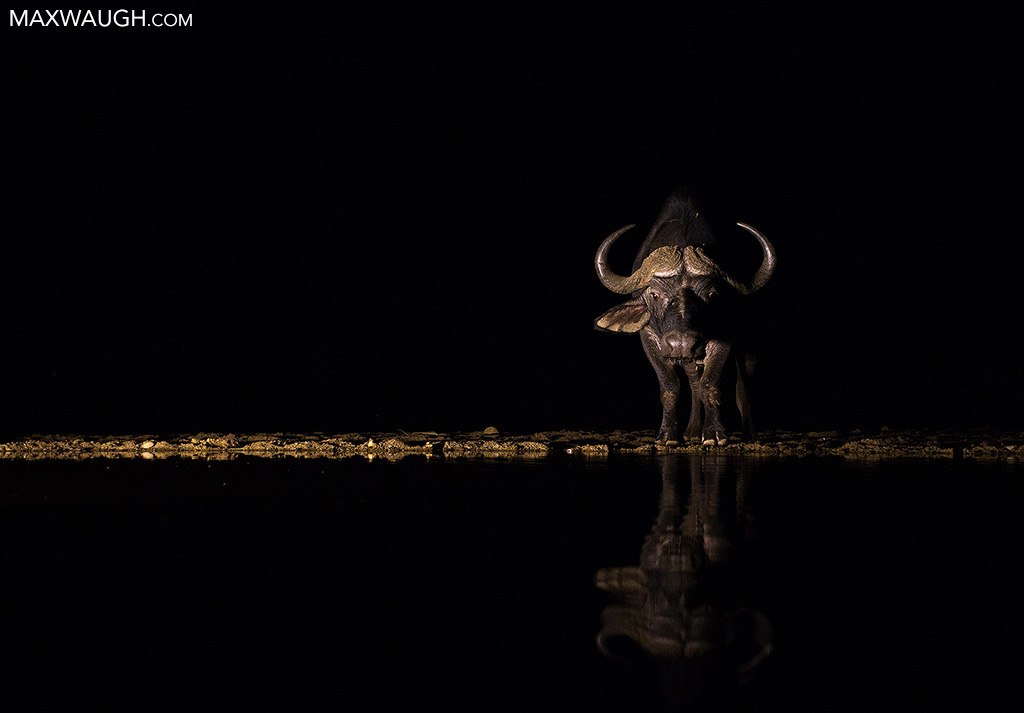
While visiting Zimanga Game Reserve in South Africa last year as part of a scouting trip, I stayed in their overnight hide to see what sort of nocturnal visitors might come for a drink at the watering hole. In general, the action was fairly quiet, but I did have a few lone Cape buffalo show up earlier in the night. I opted for some side lighting (one can control the exterior lights from inside the hide) with this guy as he slaked his thirst.
Canon 1DX
Canon 24-70mm
ISO 2000
1/60th
f/2.8
Max

Comments
15 commentsTFS
Steve
I think this quite effective, but a do question the set up at Zimanga, is it really WILDLIFE photography when everything is put in place just for photography, air conditioned hides might be nice but it is hardly the correct experience.
Very Moody and Intriguing composition that delivers great results regardless of the shooting experience. Very enjoyable composition with simple elements all perfectly place in the frame. I am seeing white specs that I would consider cloning out that may have to do with shooting thru glass. Two on the Subject's back, one to the right of the subject in the shore line and several to the left in the water. As mentioned, the side lighting was an excellent choice.
Well done as always . . .
I'm not sure the type of hide being used means this is any more or less "legitimate" than, say, the hole that a Japanese photographer lived in for nine months while trying to photograph a Siberian tiger. Obviously, what this type of setup does create is the chance to take artistic license. Rather than just shooting subjects at close range in natural light, it becomes a pseudo outdoor studio setup, as you inferred... but that's not necessarily much different than employing flash in the field to create more dramatic colors and lighting, or slowing the shutter speed to create a motion blur. It's definitely where wildlife photography starts to bleed more into the artistic side of the medium. Obviously, for each of us that type of experience or the resulting image appeals at different levels. I personally don't prefer hide photography, but I do enjoy branching out sometimes and getting creative, whether it's blurring subjects, converting to monochrome in post, or on a rare occasion using artificial light to create a different look. I think every photographer's individual artistic sensibilities mean there will be an endless variety of opinions and preferences on how to go about shooting. From that perspective, wildlife photography as art is something different from the basic ethical arguments in our field.
Mike, regarding the white specs, I'm guessing it's just bits of detritus on the buffalo and the ground that are reflecting harshly in the light, more than shooting through the glass (which certainly made things challenging). If I were preparing this for an artistic print, it would probably be worth cloning as you mentioned.
Max
The negative space is working so well here!
Jagdeep Rajput
Hisham.
My real bug about this sort of facility, is that it is not"real" and makes things too easy.
Not to say that I would not use something a little similar, as after all all wildlife parks are largely artificial (fences, waterholes hides etc.)
I just prefer being out where you have no guarantees.
Love this one...works so well for me. If it was mine I'd be tempted to crop off a little of the foreground (I think you can get closer to the faint reflection without harming the image). But that's just a personal preference issue. Super shot.
I find your response to Ken quite interesting. I like how you distinguished the "wildlife art" vs. "documentary shot" dichotomy from ethical arguments (because they are certainly not the same thing). I too like to get creative with my wildlife photography, and also prefer to avoid the use of blinds and artificial lighting. But getting creative in no way implies a drift away from ethical standards that we'd like all wildlife photographers to live within (for me the prime ethical directive is simple: Do nothing intentional to manipulate the behaviour of the subject for the purpose of photography, and that includes no baiting, no luring with sounds, no little clicks or whistles to get the subject to look at you, etc.).
Cheers...
Brad
Whereas, in discussing artistic interpretation and use of lighting, flash and other techniques to create something more than just a "natural/documentary" look in a photo, distinctions between what's "right" or "better" are much more ambiguous and depend a lot on the individual tastes of the viewer.
Obviously, a photographer can get "artistic" without drifting from his or her code of ethics regarding the treatment of their subject... I think they're two separate considerations.
Max
We're totally on the same page...I think the creative vs. documentary "axis" is completely independent of the ethical standards issue - that's what I was saying in my previous comment. You can violate ethical standards with "documentary shots" just as easily as you can with more "creative" shots (or, adhere to strong ethical standards on creative or documentary shots). And, in my view (and I think yours) it's a lot easier to draw hard and fast lines on ethical issues than it is on creative issues, which reside so much more in the realm of personal preference.
I know nothing about the set up at this overnight hide and thus can make no comment whatsoever about any ethical issues that may or may not exist there. It doesn't tend to be the kind of thing I enjoy (being in a blind), but that's just a statement about the type of wildlife experience I like and has nothing to do with ethics.
Cheers...
Brad
Having been there, albeit prior to the construction of this overnight hide, I can vouch for the ethical intent behind the choices Charl and the Senekal family make, and their conservation-oriented hearts. I think he will be the first to state outright that of course not every wildlife photographer would prefer the kind of experience and images they can offer, and that is okay with him.
I too prefer being out there with the wind and smell of the bush in my face, but that does lead to a specific kind of image and style and the odd hide session can help you break out of that mould.