
by Brad Hill
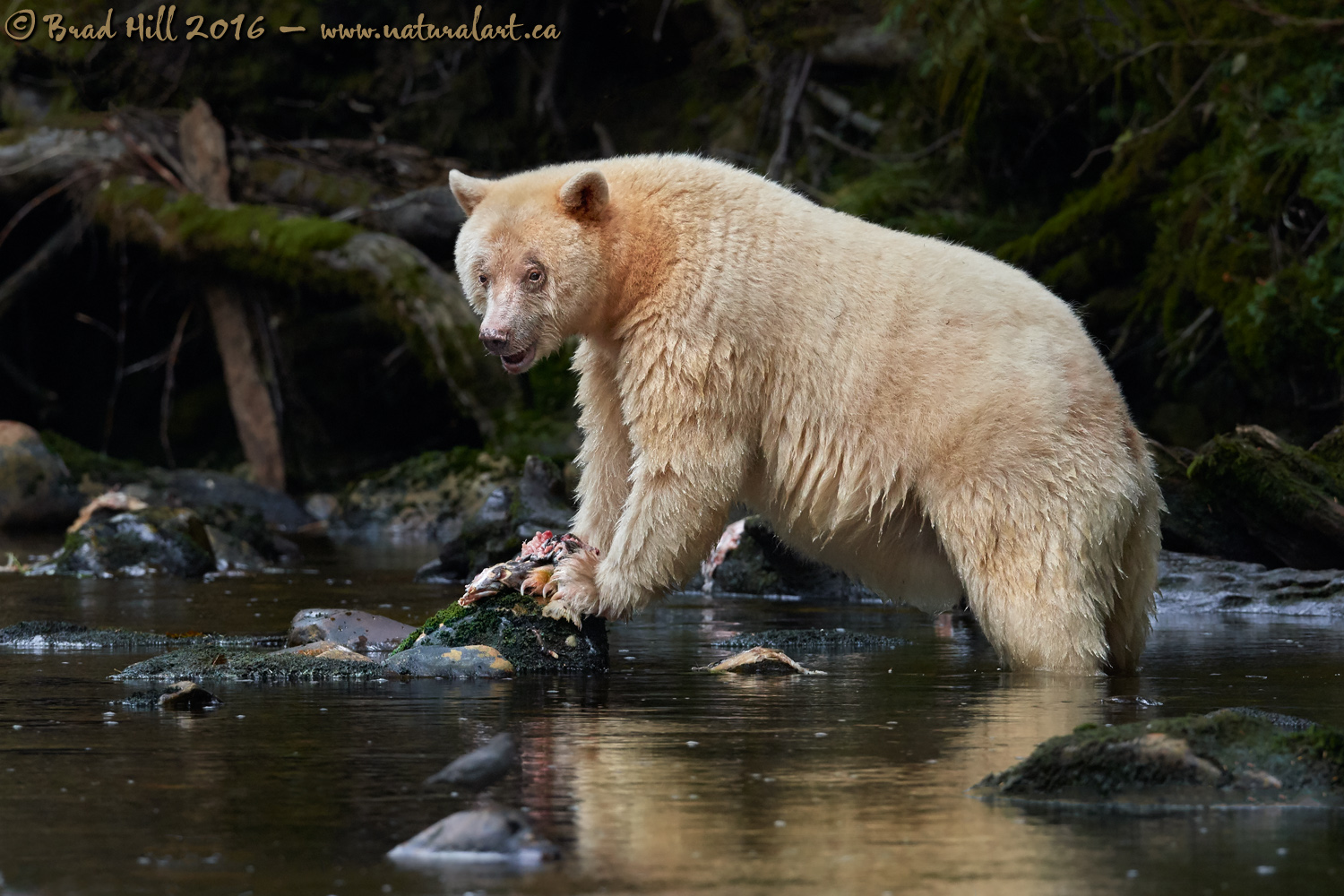
There's no other animal more emblematic of the Great Bear Rainforest than the rare Spirit Bear. Depending on which source you believe, there's only somewhere between 250 to 400 of these bears in existence, and the vast majority of them are found on a handful of islands on BC's central-northern coast. Spirit Bears are simply black bears with a white coat (that is produced by a recessive form of one of the genes associated with coat colour). Why 15-20% of the black bears in one region of BC are white and virtually no other ones on the planet are is still only poorly understood.
This particular Spirit Bear is a female and is about 15 years old. She's had at least 3 sets of cubs (most of which were black in colour) that we know about. In this shot she's enjoying a sushi dinner consisting mostly of freshly caught (as in VERY freshly caught!) pink salmon. Her big belly is indication that she's has a quite successful fishing season leading into hibernation, which is a very good thing. She MAY be pregnant, but because black bears (and, of course, Spirit Bears) exhibit delayed implantation of the embryo into the placenta, there's no relationship right now between the size of belly and her pregnancy status. However, if she IS pregnant, then her storage of a lot of energy (that fat!) bodes well for the survival of those cubs after they are born during winter.
Subject: Spirit Bear (Ursus americanus kermodei) enjoying a salmon meal
Location: Great Bear Rainforest, northern BC coast, Canada
Camera: Nikon D500
Lens: Nikkor 500 f4E VR. Hand-held. VR on and in "Sport" mode.
Exposure: 1/400s @ f6.3; ISO 1800. -0.67 stop compensation from matrix-metered exposure setting.
Crop: Minor crop (less than 15% crop for compositional purposes)
A whote lot more info about this shot - including a 2400 pixel version it - can be found on my website using the link immediately below.
http://www.naturalart.ca/galleries/latest/detail_6.html
Comments and critiques welcomed - probably best to view the larger version prior to doing so!
Cheers...
Brad
PS: Like all wildlife images on my website and that I post on NPN, the subject is fully wild and completely unconstrained. Besides the potential impact of my presence, nothing has been done to intentionally alter or affect the ongoing behavior of the subject and, of course, there has been no use of any form of bait or other form of wildlife attractants (including vocalizations).
Comments
9 commentsThis is indeed a truly Outstanding image in all respects with great commentary as per usual.
Well done . . .
Agree that it is one of your best Spirit Bears.
Sure hope to see them one day.
Sandy
Cheers! Tom
She gave you a beautiful pose for this one. The eyes are particularly good
Thanks for the feedback - no argument that she gave me a good pose to work with!
Tom - you say: "However a large proportion of the Grizzly Bears that I have seen along the crest of the Northern Alaska Range and even down into the Talkeetnas are this light in color"
Yes, grizzlies have a tremendous range of coat colours that continuously grade from near black to various reds and light blond - I've seen lots of blond ones myself. But the situation with Spirit Bears is qualitatively different - it's an "all-or-none" expression of a recessive gene - if a bear has one dominant black version of the gene and one recessive white version of the gene the bear is black (not gray!) and a carrier of the recessive gene. The only way you get a pure white bear is that it must have two recessive white genes. The uniqueness of the situation - and the rarity of the white bears - has been formally acknowledged by the BC Gov't and they are afforded full protection - they can't be legally hunted or harassed in any way. Unfortunately (and with some short-sightedness), any black-coloured black bear in the region CAN be hunted, and they are often carriers of the recessive gene (with enough hunting it is theoretically possible to completely remove the recessive gene from the area - and all the white bears - without ever shooting a single white bear...but via "over-harvesting" the black-coloured carriers, i.e., the heterozygotes).
BTW: This older bear has a slight orange-ish tint to it (e.g., see the neck region) - this is caused by a harmless fungus that lives in the hair and tends to accumulate with age. Any young bear - or older bear without the fungus - is snow white (whiter than any adult polar bear I've seen).