
by Mark Seaver
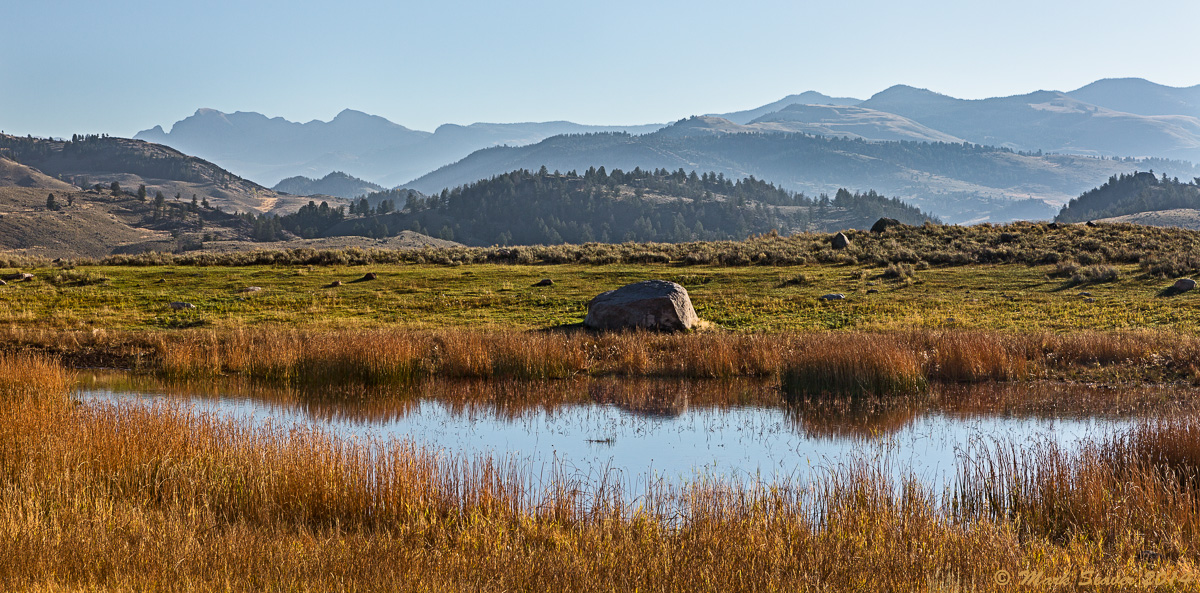
As I went through my files looking for possible images for this week's challenge, I was having a very hard time. (How ironic that it was my suggestion... ) I finally realized that the problem was trying to find a picture that showed lots of life at a habitat edge. Then it slowly dawned on me that a few of my landscape images stood out (at least for me) because of the multiple habitat zones, as seen in this pano crop. In this case, the main edges are water to wetland (reeds), wetland to grass, grass to sage, sage to forest, and finally forest to high mountains. The view is an early spring look at one of the kettle lakes in an area of Yellowstone that the locals call Little America (between the Yellowstone river crossing and the Lamar river crossing). The lakes form in places where large chunks of glacial ice fell off as the glacier retreated. (5D3, 24-70, tripod and polarizer...I'm travelling so I don't have access to the other camera settings)
Comments
5 commentsAs you say, lots of habitat edges in this scene and as your challenge suggest, most of the activity will be happening around these edges. A nice panorama that has lots of depth (and it's not always easy to show depth in a panorama). Good start to your challenge, Mark!
Ditto what Gary has said! And if this isn't a prime example the WC this go around, I don't what is..
Excellent work Mark!
Great depth on this one, Mark. This makes for an ideal habitat transition or "edge" type scene. Also, an excellent example for a wetlands or riparian type environment too. I'm glad you left a bit of FG landmass in front of the small lake area, it makes for a good spot to take it all in from........
one habitat edges right into another right through the image
Hi Mark I see habitat edges galore, and fine color in this delightful landscape. perfect for the theme ,

Albert Darmo
Canada