
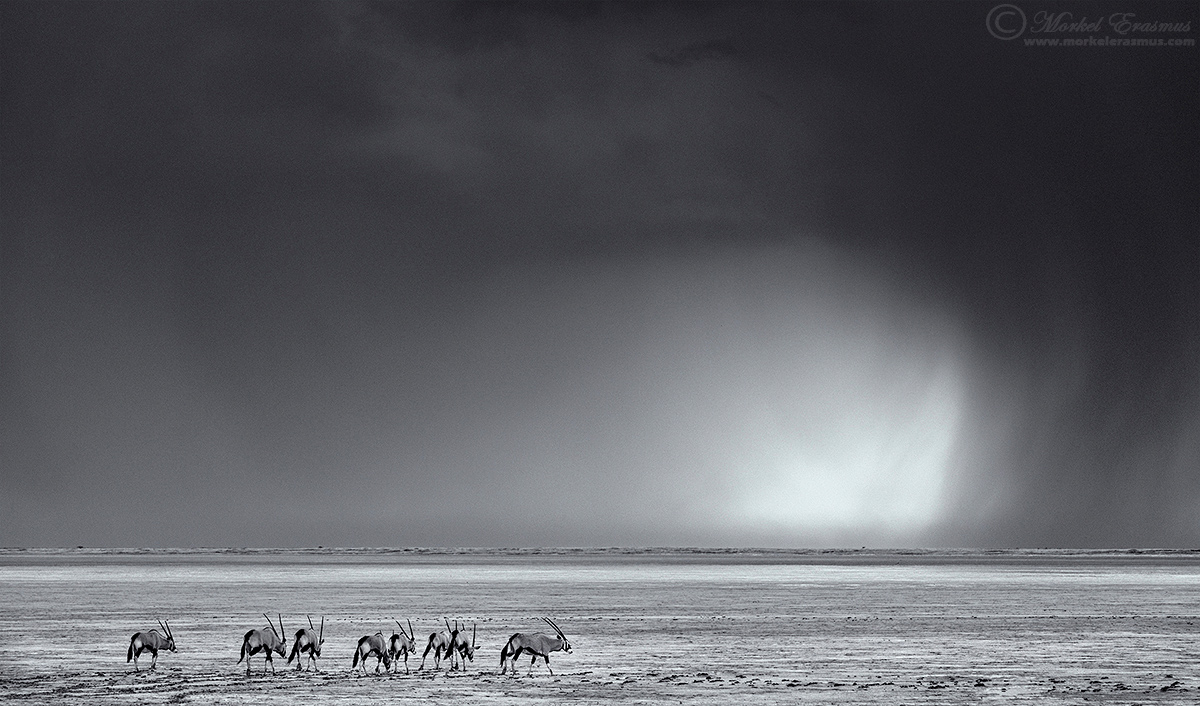
By now, if you've followed my work for some time, you would know that I have this sort of fetish for contextual atmospheric wildlife photos taken with shorter focal lengths. I simply love the scenery of Africa too much to resort to frame-filling portraits in the majority of my image-making.
This photo shows a herd of desert-hardened Oryx, also called Gemsbok, moving across the barren Etosha salt pan as the first summer rains roll in from the distance. Etosha is a hot, harsh and unforgiving land for most of the year. However, towards the end of November a transformation happens - clouds start to form, moisture is tangible in the air, and storms start to build across the endless horizon. Water comes to this land, much needed sustenance, preserving life and keeping this fragile ecosystem in the right balance.
Techs:
Nikon D800
Nikkor 70-200mm f2.8 VR-II @ 175mm
Circular Polariser
f8.0 | 1/400 SS | ISO-900
Grain is intentional - this is processed for my limited edition monochrome print range
Comments
14 commentsAnother stunner, Morkel...this one goes to the top shelf, joining many other masterpieces from you. Beautiful work of art.
Morkel, I think the contextual approach to this image works quite well as an excellent example of showing wildlife in their environment. Nice work!
The vortex that seems to be forming out there really gives this a great mood. Looks great in monochrome, of course.
Max
Love it Morkel! Very nicely executed. Though works well in B&W, but I wonder there must be interesting colours too !?!
Jagdeep Rajput
Morkel: this is a fabulous capture of the animals in their environment with B/W being the perfect choice for this rendering. Congrats!! Richard
Thanks folks!
I figured the request for a colour version would come up - here it is...
EPIC!!! Enough said.
Fantastic shot Morkel! Black and white is definitely the way to go - so much more dramatic.
HI Morkel
My vote is for the black & white.
Peter
Great animalscape; you've really captured the harshness of the environemt these animals live in. Both images are nice but the B&W is more dramatic in my opinion.
This is a great photo Morkel! Not only is it well-composed and processed, but it tells a great story of the changing of seasons and how much it means to these animals.
I like things about both versions: the starkness and drama of the b&w, and the complementary earth tones of the color version.
Out of this world image, Morkel! The B&W is the clear winner here.
A real dandy! Prefer the B&W as posted...
Thanks so much, folks!!