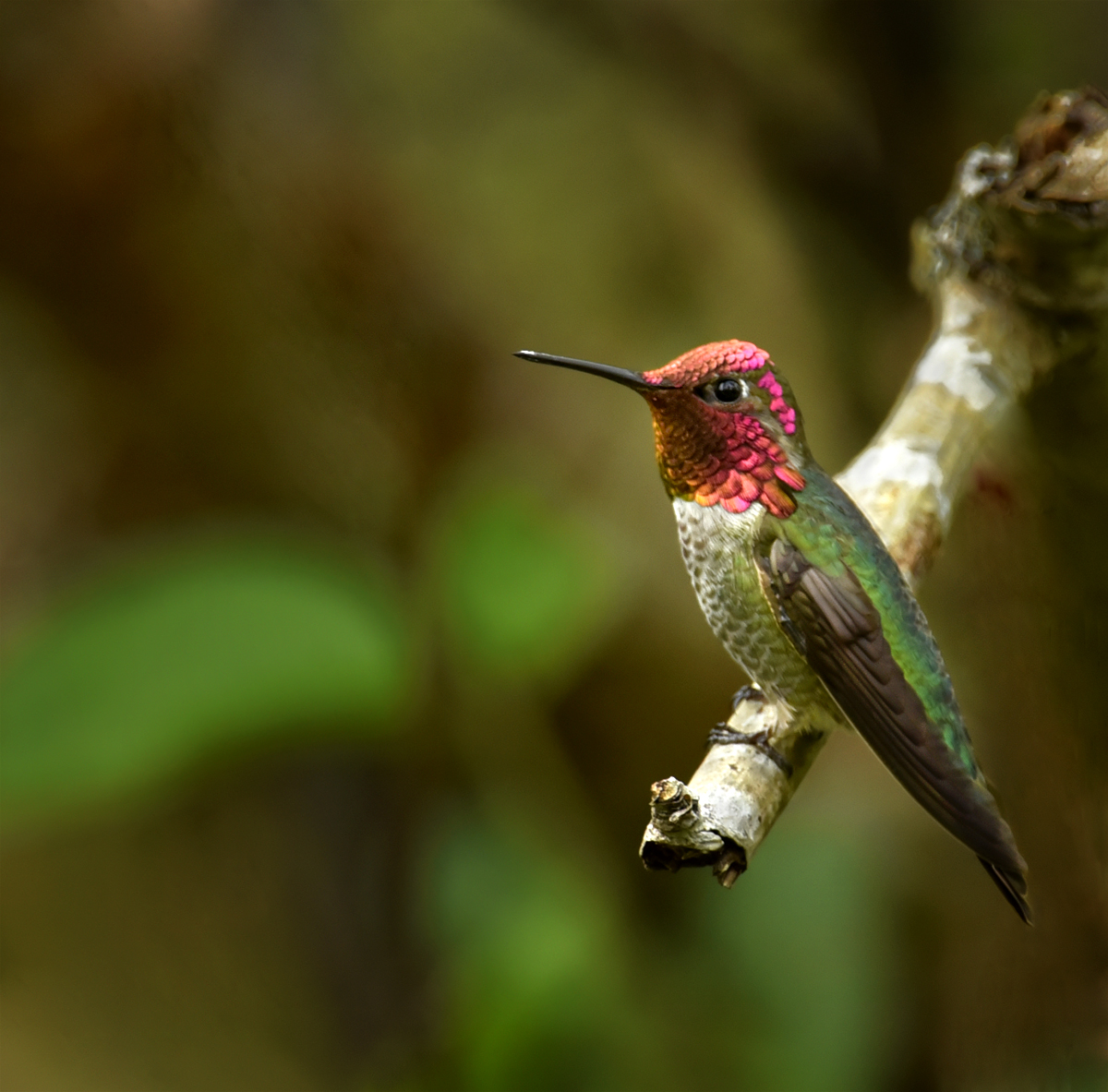
Anna's Iridescence
by Catherine Reilly
In woodlands along the shoreline of Puget Sound, a moment of sunlight through the canopy coincided exactly with a moment of quiet perching to reveal the elegance of the Anna's Hummingbird.
D750, 200-400/4 +1.7TC @ 400 (680mm focal length), monopod; f8, 1/250, ISO 1000, 50% crop. Processing in Ps 5.5 and NIK.
Thanks for viewing and commenting.

Comments
8 commentsHi Catherine,
The hummingbird is fairly sharp and positioned well in the frame. The BG is a little busy with those bright patches and you might want to tone those down a little bit. I like the hummingbird which steals the show in the scene.....................................Jim
Hi Catherine:
A beautiful little Anna's with some very nice light. The moment must have been very special.
I wish the hummer was a bit sharper. Even at a 50% crop, I would expect more details in the plumage.
Looks like the perch (behind the hummer) was bright and there was an attempt at darkening it? Has some odd artifacts. Overall saturation is a touch high for my tastes.
Wish I had this hummer here, beautiful iridescent colors this one.
Perhaps another round of selective web sharpening, nice catch Catherine
Thank you for the comments. I will try a little more sharpening. Did not change saturation settings at all, but I will review my processing steps to see whether software slipped in some "auto" saturation.
Nice catch, Catherine. The colors are really showing well. The Anna's looks a bit soft in the larger image. I'm not sure what's going on there, but it looks as if the autofocus might have caught the end of hte perch rather than the bird.
</div> I just looked up the focal ranges on DOF Master-I used 610mm for the lens to give your shot the benefit of the doubt. At f/8 it lists the DOF as .48 inches on either side of the plane of focus at 15 ft from the subject (just a guess based on shooting hummers myself). When you get close with these big lens combinations the DOF goes way down. That's why you rarely see a songbird entirely in focus and why the bird photographers stress focusing on the eye as the critical focus area. That's often difficult, so the cheek or side sometimes has to do. I'll use group autofocus on bird-in-flight shots sometimes, particularly against the sky because it picks them up easier, but for perched birds I use the smallest autofocus area the camera can produce.
</div> Hope this helps
</div>
A beautiful portrait of this handsome beauty Catherine, but you already know how much I like it.
Sweet One
Thank you, Dennis! So very helpful!!
I posted a 720 directly. Then tried to post a resized image for the "larger" photo. So, the "truer" shot to view is the 720.