Shelving Rock Falls_Fall
by Wayne Jones
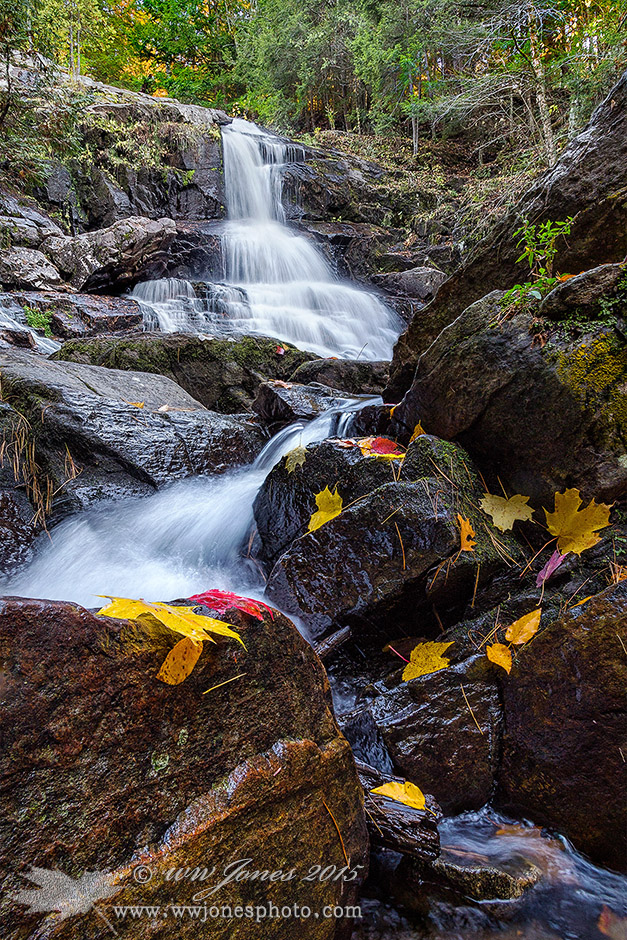
When I made a visit to one of my favorite local waterfalls in October, I had a certain look in mind, so I did some "landscaping." Since the wind didn't blow the leaves to where I expected them, I moved a couple of the sugar maple leaves and imported a couple of red maple leaves from a few feet away. Now I'm wondering if I made it look too "orderly."
Canon 5D Mark III; 24-105 mm.
0.3 sec. @ f/16; ISO 640
7 exposures stitched in PS for depth of field
P.S. Interesting discussion about altering the scene, please join in. (See my comment below, right after Luke's) Note that I added only two leaves from outside the frame to the FG, and moved two or three others that were already in the shot because most of them were on the right side. Way more leaves in the background, but hard to see them.

Comments
19 commentsBeautiful image, nice concept and perfect execution. With respect to the leaves, they don't look too "orderly" but they of course are absent from the upper area which some may pick up on
This reminds me of a scene I shot when a front was moving in, making an opening on the horizon that let the sunrise shine a spotlight on a large cliff that was below thick clouds. I thought it looked spectacular, but because the opening in the clouds was on the horizon hidden behind the mountains, several NPN members remarked that the bright cliff did not look natural under the cloudy sky. Not sure if they thought I imported the cliff from another shot on a sunny day, or what! In the Photoshop age, to some people, things like that sunrise spotlight or these leaves falling only under trees, look as suspicious as Neil Armstrong stepping onto the moon.
I don't think the absence of more leaves looks suspicious. You could be under a tree and there are no other trees along the waterfall. Perhaps the leaf that's balanced on the rock is a bit suspicious because only newly fallen leaves look like that. Most flatten out against the rock. I really admire your effort climbing around those slippery rocks placing them strategically.
The composition works well - 3 wedges - fg rocks, bg waterfall, far bg trees. You could darken the far tree section just a tad which should make the greens richer. The water has good definition.
There seem too many in foreground compared to up stream but great image.
That being said I have no issues with this particular image and it's a great comp. The only nit I have is that one large yellow leaf that is on edge, seemingly teetering on the rock, doesn't fit with the rest of the leaves that seem plastered to the rock surfaces they are on. Out of curiosity Wayne... was that a placed leaf or is that where it was sitting naturally?
- I might not have noticed or focused so much on that if you had not told
and
- It is a beautiful picture regardless.
This amount of "manipulation" is certainly a lot less than a photoshop composite of several images!!! I have no problem with that either, although I do not do it. I do not own/subscribe to photoshop and have never used, nothing against it, just not my thing.....
DAVE: Yes, that "teetering" yellow leaf on the left is one that I moved. It was originally on the right side, partly covering another leaf, and it looked sort of out of place there, too -- partly because it looked "fresh" and partly because it was on the edge of the frame. There were two similar leaves on the right side that I moved, and I sort of tossed them onto the left side to see where they would land. One fell off and was washed away, but this one stuck, so I left it there.
I think my philosophy is similar to yours. I normally avoid rearranging leaves because I am not good at it, but in this case I knew that the ones that were there did not look good, so I figured I could not do much worse than the breeze did. Like you, I don't "import" elements, but I don't have a problem with moving something that is nearby -- usually just out of frame, but in this case, the red leaves were behind and to the right of my tripod, so I rationalized that a tiny change in the breeze could easily have put them in the scene, especially since there were two or three other red maple leaves already visible in the frame, but less noticeable.
I am not sure if in my mind it's an ethical issue any more than one of avoiding the creation of a scene that could not exist without my intervention. For instance, if there were no red maple leaves already on the rocks where I shot this, adding them would not make sense, any more than putting a dead tropical butterfly in the scene. I mention importing the non-native butterfly because that's something that another photographer has had success selling, since his aim is creating a pretty scene that people will purchase, while my aim is closer to documenting what exists in nature. I figure that if the leaves are already there, I can move them a little without creating a scene that could not exist in nature. Another example of creating an "impossible" scene is blending a daytime photograph with a night photograph so you can see the a blue or red sky and details of a twilight-lit landscape at the same time as thousands bright stars. Nobody will ever see that in nature (without hallucinogenic chemicals), but it's a practice that many viewers accept just because it looks beautiful. Time distortions such as star trails and extremely motion-blurred water are other examples. They don't depict reality, but they are camera tricks that are interesting to see. None of those practices would be considered "illegitimate" by most people unless they claim to be something they are not. The very act of "recording" or attempting to reproduce a natural scene distorts the view of nature by the artificiality of the medium, whether it is some kind of pigment applied to a surface (painting) or a chemical or electronic depiction of a scene (film or a sensor) through some kind of lens that introduces artifacts created by its focal length and depth of field that is in focus. As a result, no depiction is totally accurate; each lies somewhere on a continuum between fantasy and memory, but none of them depict reality with absolute accuracy.
P.S. While I was typing, Alberto and Mark added some good points. Alberto mentioned that focus-blending in post-production (using Photoshop in this case) was another form of manipulation. How true! In this case, I used it to attempt to realistically reproduce what I saw (after moving the leave ;^) ) because the camera added the articial element of depth of field, which may be something that our eyes see, but it's something that our brains "correct," which speaks to Mark's point. Photoshop (and indeed all of our photography tools) are just attempt to do what our eyes and brains do.
I suppose everyone has his own value of what is the most important aspect of photography. For me it's seeing. The best and most important aspect takes place before the shutter is released. Big Freeman Patterson fan here. The rest of it is just 'polishing'. Yes, you can improve an image by polishing but I contend that the subject is the main player and should be recognized as such.
Now, I've been known to move a leaf or two at the time of the exposure, but I will not add elements after the fact during post-processing. I may remove bit of distracting stuff at the time of exposure and/or clone out bits of debris. In my post processing, whether it's a digital image or a scan from 4x5, I attempt to adjust color and tone that supports my visualization at the time the exposure was made, with the goal of having my work look 'natural'.
--P