Night Sky
by Richard Teller
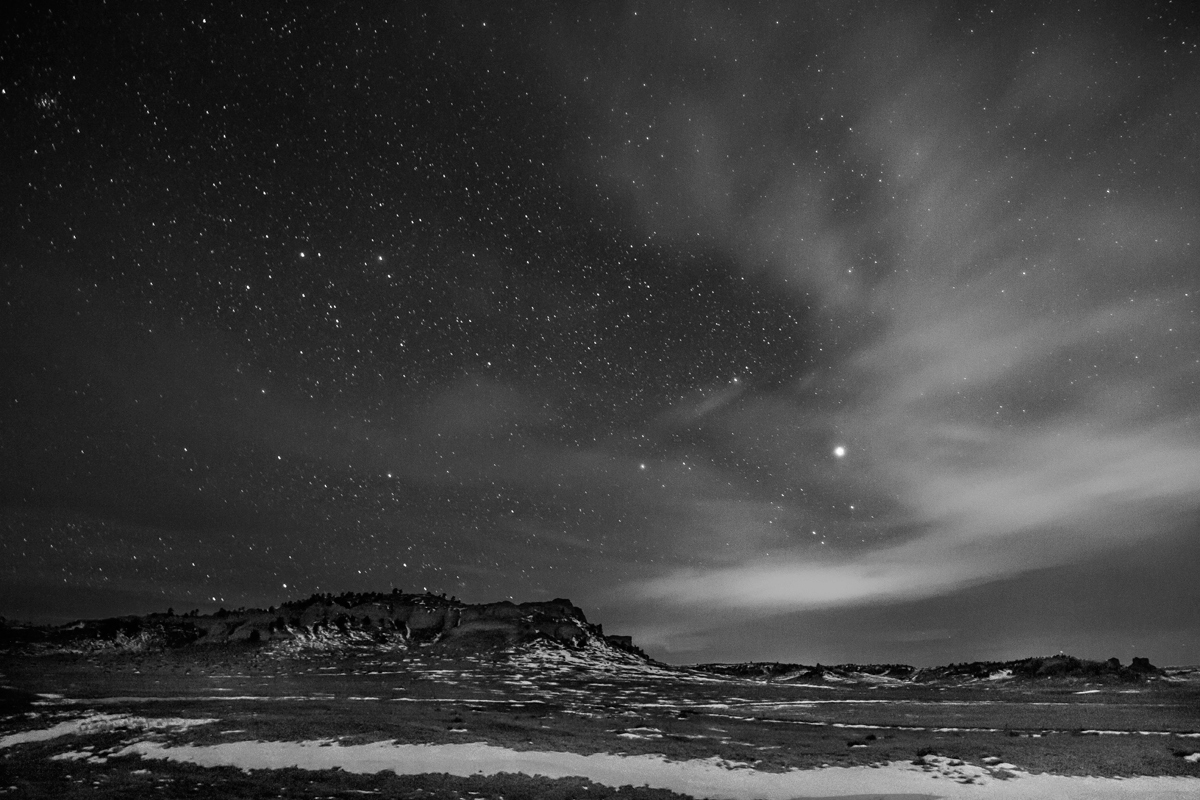
I have been trying to learn to do night photography. The best way for me to learn is to do. The next thing that helps me a lot is to post the images here on NPN for the very helpful feedback I get. I have been going out very early for several mornings to shoot. I tried a b&w conversion on this one and think it works pretty well. I will be sharing one more image from the last few days .I am looking forward to hearing everyone's comments and critiques.
Canon 7D
Sigma 17-70
Shutter 30 sec
Aperture 2.8
ISO 1250
17mm
Tripod, remote shutter release, 2 sec delay
B&W conversion in Lightroom 4

Comments
9 commentsIt takes a bit to get a handle of shooting night photos and this looks pretty good.
I don't do it enough but get better ever time I shoot so that is the key.
You are getting star movement, I would cut down the time to 20-25 sec, with a 17mm lens and up the ISO to compensate.
Exposure time adds as much noise as ISO, you can shoot shorter, have higher ISO and still have less noise.
It has some noise, I use Topaz de noise and I have found it does the best job of NR without a lot of sharpness loss.
You have enough light for the FG, it looks like you had a bit of moonlight?
A bit more would be better for me.
I used to go on moonless nights but have found a quarter moon behind you works much better. You still get stars (not a full blown milky way) and enough light that the photos are not too dark and the FG is lit up.
Hope this is somewhat helpful, you look like you know what you are doing....
One of the reasons I like it is because it actually looks like night! From what I have seen, there are two kinds of night images created by photographers that easily stand apart:
1. Realistic Night Photographs. These are representations of nature as it exists in the real world, where a night scene looks like night time, i.e., dark.
2. Fantasy Night Artwork based on photographs. These are either composites of exposures made during different time periods, or single images where exposure levels of parts of the scene are highly manipulated. (Light painting is somewhere between these two kinds of images.) The results are images that do not -- and usually cannot -- exist in nature, where stars shine intensely in bright skies, and the landscape resembles the twilight period, long before stars would be plainly visible.
I actually enjoy both kinds of images, but I tend to have a greater appreciation of those that represent nature instead of impossible fantasy. To me, your image falls into that nature photography category, rather than the fantasy artwork.
Chris
Albert Darmo
Canada