A Floating Forty Winks
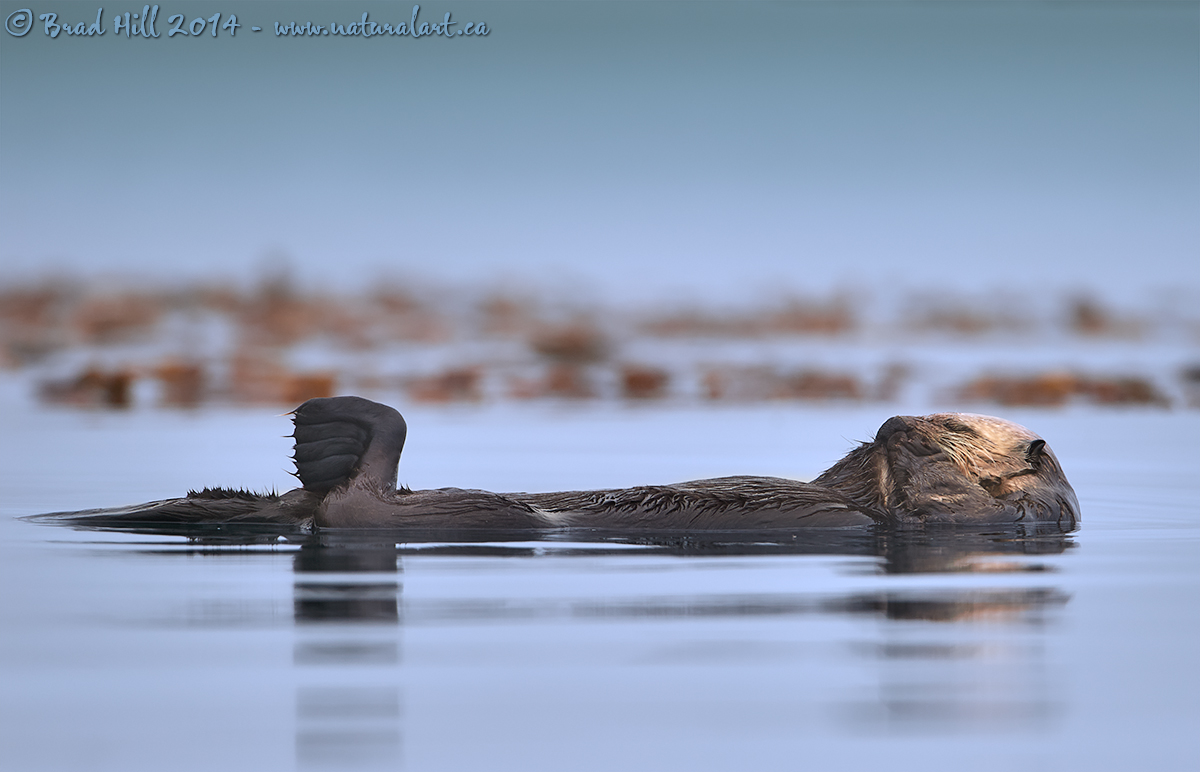
Sea Otters are absolutely fascinating animals. And they're also a completely unique marine mammal. They're the only fully marine mammal on earth that doesn't use body fat and/or "blubber" to help insulate itself from the heat-robbing frigid waters in which they live. Instead, a combination of the insulative properties of their luxuriant and waterproof coat (the densest fur of any mammal on earth) and a high metabolic rate (kept stoked by amazingly high rate of food consumption - up to 33% of their body weight of food is consumed daily!) keeps them warm. Which also means these guys are hyperactive dudes! So...while they do, of course, sleep...they don't do it a lot or for very long. So when we came across this adult male sea otter snoozing along the edge of a kelp forest it was...well...an exciting photo op (and how often do you say that about sleeping subjects?). I'm sure this otter knew we were there (though I didn't see it sneak a peak of us and its ears weren't rotating around searching for sounds), but regardless of our presence, it just laid there and kept snagging its floating forty winks (on what may be considered the original water bed!).
Subject: Male Sea Otter (
Enhydra lutris) bagging some ZZZ's
Location: Northern tip of Vancouver Island, BC, Canada
Camera: Nikon D4s
Lens: Nikkor 600mm f4 VR lens - handheld from Zodiac. VR on and in "Normal" mode.
Exposure: 1/2000s @ f5; ISO 250. -0.67 stop compensation from "recommended" matrix-metered exposure setting.
Crop: Full frame horizontally - sliver off a crop off the bottom of the frame
More about the challenges of capturing this particular image - including the factors that helped me hand-hold the 600mm lens from a floating Zodiac and still get an acceptable image - can be found right here on my website
http://www.naturalart.ca/galleries/latest/
Comments and critiques welcomed - probably best to view the larger version prior to doing so!
Cheers...
Brad

Comments
5 commentsAt the end of the day it ALWAYS comes down to light. And I have spent more than a few hours with these dudes...so about darned time the light came together!
On the "softness" on the part of the head that caught the light - good catch. What's going on there is that there's a boundary layer of water on top of the fur that always makes a body part that doesn't have hair sticking out look soft. You'll see the exact same softness on seals and sea lions when they're wet (and it's apparent in "real life" too - it's not an artifact of the photographic process").
Cheers...
Brad