Nature Photographers Network
This is the preserved archive of the original Nature Photographers Network. The community continues at naturephotographers.network.
One Whale of a Morning
‹ PreviousWildlife GalleryNext ›

One Whale of a Morning

by Brad Hill

Gallery: WildlifePosted August 21, 2014312 views14 comments
One Whale of a Morning!

Just back from leading my annual Aquatic Mammals photo tour...so sorry that there's no bear in this shot! :wink:

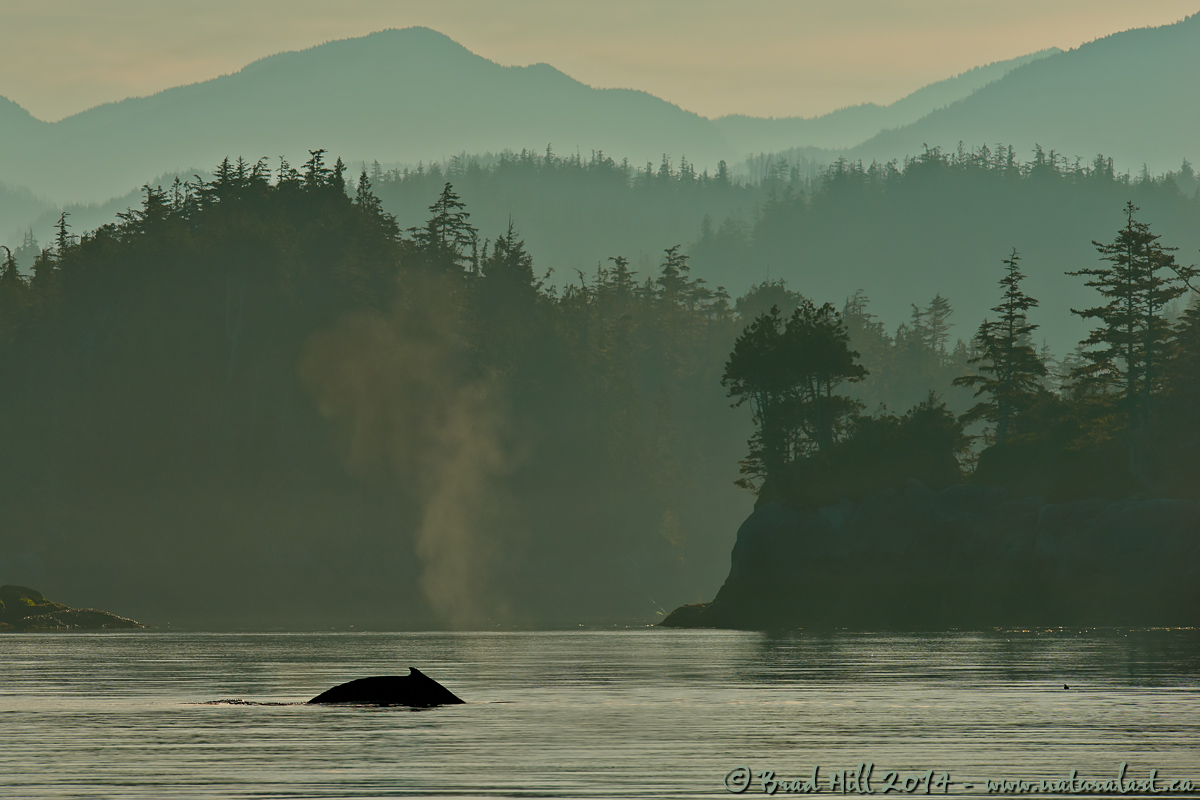
What's that old saying? "Good things come to those who wait"? Well...this image came after a lot of waiting and, in this case, after a few hours of sitting in pea-soup fog while we could hear humpbacks surfacing and blowing but could see absolutely nothing. Fortunately for us the fog did eventually did lift and gave us a few moments of magical, early-morning lighting. Even more fortunately we had a very cooperative humpback whale who chose to surface, blow, and then roll down back under the water in exact position I would have placed it in my "perfect world".

I've said it many times before, but one of the toughest things in wildlife photography is avoiding becoming so completely enthralled by your subject that you can't see the "full scene" (or, I guess, the "big picture"!). In this shot it would have been easy to see "just" the whale and the backlit steam drifting upwards after it blew and not notice the beautiful layered ridges in the background (that so conveniently went from dark tones in the closest treed "ridge" throughout to very light pastels in the more distant background). I find this "not seeing the full forest for the dramatic tree (your subject)" is always something to be on the lookout for, but even more so if you happen to be hand-holding your camera and lens - it seems that when doing so it is so easy to let your eye "rest" on the subject (especially if it's moving) and not study the rest of the frame. One has to actively think "study the entire frame" while looking through the viewfinder in order to avoid the tendency to look only at the subject.

The toughest aspect of capturing this image in the field was positioning the whale this low in the frame and ensuring it was sharply in focus (this is almost full-frame, and the subject WAS this low in the viewfinder - and outside the zone the AF brackets can move to). To ensure maximum sharpness on the subject and still frame the scene the way I wanted I had to use the lowest focus brackets in my viewfinder, focus on the subject, lock the focus, and then quickly recompose the scene to include the distant ridges AND a sliver of sky in the frame. Why use the lowest AF brackets in the frame (rather than having the bracket at the centrepoint)? In using the lowest brackets I minimized the amount of recomposing needed to frame the image as seen above. In this case minimizing the recomposing time was critical to catch the moving whale exactly at the point in its dive that I wanted to. Little thing? Yep. But an important little thing!

Subject: Humpback Whale (Megaptera novaeagnliae) surfacing just after sunrise
Location: Northern tip of Vancouver Island, BC, Canada
Camera: Nikon D800e
Lens: Nikkor 400mm f2.8 VR VR lens - handheld from sailboat. VR on and in "Normal" mode.
Exposure: 1/800s @ f11; ISO 250. -0.33 stop compensation from "recommended" matrix-metered exposure setting.
Crop: Extremely minor - this is at least 95% of full frame

More about this image (including processing details) can be found here...

http://www.naturalart.ca/galleries/latest/

Comments and critiques welcomed - probably best to view the larger version prior to doing so!

Cheers...

Brad

Comments

14 comments
Comment posted by John Tobias on August 21, 2014 at 4:00 PM
Nice one Brad. IMHO it has an oriental flare to it. Good lesson in remembering to see the whole picture. I do detect a bear in a tree on the second ridge line. Thanks for sharing the experience as well as the photo.
Registered on September 12, 2009, 2120 Posts, 6455 Comments
Comment posted by Peter Cross on August 21, 2014 at 4:36 PM
Comp is right on. Love what you did here. What really caught my eye though was the colors. All variations of shades of green rather than the "normal" blue usually seen. Very nice quiet & peaceful mood reinforced by the greens which are usually thought of as calming. And how many horizons lines are there. I'd argue at least 2. Water/land and land/sky but could say each ridge creates an horizon. Hmmm?
Registered on April 3, 2010, 271 Posts, 1342 Comments
Comment posted by Max Waugh on August 21, 2014 at 5:24 PM
The background is great. Wonderful silhouettes, and as Peter mentioned, the greenish tones really give it a different look.

Max
Registered on September 26, 2008, 428 Posts, 2329 Comments
Comment posted by Oscar Benavides on August 22, 2014 at 12:20 AM
Nice image Brad. Thank you very much for your explanation. Even without the animal, it would be a great image, the humpback is like the cherry on the cake.
Registered on January 2, 2011, 12 Posts, 141 Comments
Comment posted by scott lanz on August 22, 2014 at 8:53 AM
Gorgeous image, Brad. I especially like the steam rising from whale. :toast:
Registered on November 14, 2003, 840 Posts, 12902 Comments
Comment posted by Mario Moreno on August 22, 2014 at 4:31 PM
Hi Brad

This image is flawless. Specially because you decided to see "The Big Picture". It places the whale in a very iconic setting telling the viewer the complete story. :toast:
Registered on January 24, 2012, 163 Posts, 369 Comments
Comment posted by Mark Seaver on August 23, 2014 at 10:23 AM
Brad, this is a great "animal scenic" that just sings pacific northwest. The whale, its breath mist and the layered ridges make a wonderfully peaceful and inviting scene.
Registered on January 23, 2011, 1103 Posts, 17270 Comments
Comment posted by Gary Gulash on August 24, 2014 at 12:57 AM
This is a beauty Brad, one of your nicest animalscapes imho, and that is saying a lot! I wouldn't have guessed this was shot with a 400mm, I guess I'm just not used to f11 being used on a super tele.
Registered on January 28, 2005, 879 Posts, 12098 Comments
Comment posted by Jagdeep Rajput on August 24, 2014 at 6:06 AM
Great atmosphere n beautiful image ! I wonder how could you covey the perfect position to whale. :biggrin: The image looks like a water colour painting!
May prefer a touch more canvas on the top.
Jagdeep Rajput :toast:
Registered on April 29, 2008, 686 Posts, 2857 Comments
Comment posted by John Launstein on August 24, 2014 at 6:10 PM
Hi Brad! This is, simply and sincerely, incredible. In fact, I gotta use the word masterpiece here. The combination of the incredible graphic appeal with absolutely flawless composition and storytelling imagery is phenomenal. I mentioned to my wife and Jenaya that this really reminded me of a Roy Henry Vickers painting. It's simply an iconic coastal BC image. I'm with Oscar in that this would be a fantastic image WITHOUT the breaching while, but with that and the resulting spray it is absolutely one of the best pieces of "natural art" I've seen captured (created) with a camera. Just gorgeous.
Registered on April 5, 2011, 223 Posts, 1193 Comments
Comment posted by Morkel Erasmus on August 25, 2014 at 5:53 PM
This is evocative Brad. Love the mood and the layers.
Registered on March 22, 2011, 385 Posts, 2068 Comments
Comment posted by Nate Chappell on August 26, 2014 at 2:48 PM
A beautiful scene with the layers and the blow of the whale adds so much to this. I think a little more space at the top would be ideal if you had it. :toast:
Registered on February 1, 2006, 1158 Posts, 19528 Comments
Comment posted by Lon Sharp on August 27, 2014 at 10:19 AM
The comp is special with all the layers, accented by the wonderful mist rising from the whale. If the very slight greenish hue is natural, then this is as perfect a capture as one could wish for!
Registered on December 9, 2007, 258 Posts, 9892 Comments
Comment posted by Brad Hill on August 27, 2014 at 2:12 PM
hey all,

Thanks for all the feedback on this one. It was a magical morning and I feel very privileged to have laid my eyes upon it. And it's nice to be able to share it.

Lon - the colours are natural. Typically these kind of scenes with layered mountain backgrounds tend toward the blue end of the spectrum, but with fires burning all over BC at the time we had a fair amount of yellowish smoke around - and I think the yellows of the smoke combined with the "natural" blues to produce the greenish haze.

Cheers...

Brad
Registered on May 29, 2007, 431 Posts, 6061 Comments