And now for the rest of the story. About 400,000 years ago, Mount Mazama began its existence in much the same way as the other mountains of the High Cascades, as overlapping shield volcanoes. Over time, alternating layers of lava flows and pyroclastic flows built Mazama's overlapping cones until it reached about 11,000 feet (3,400 m) in height.
As the young stratovolcano grew, many smaller volcanoes and volcanic vents were built in the area of the park and just outside what are now the park's borders. Chief among these were cinder cones. Although the early examples are gone—cinder cones erode easily—there are at least 13 much younger cinder cones in the park, and at least another 11 or so outside its borders, that still retain their distinctive cinder cone appearance.
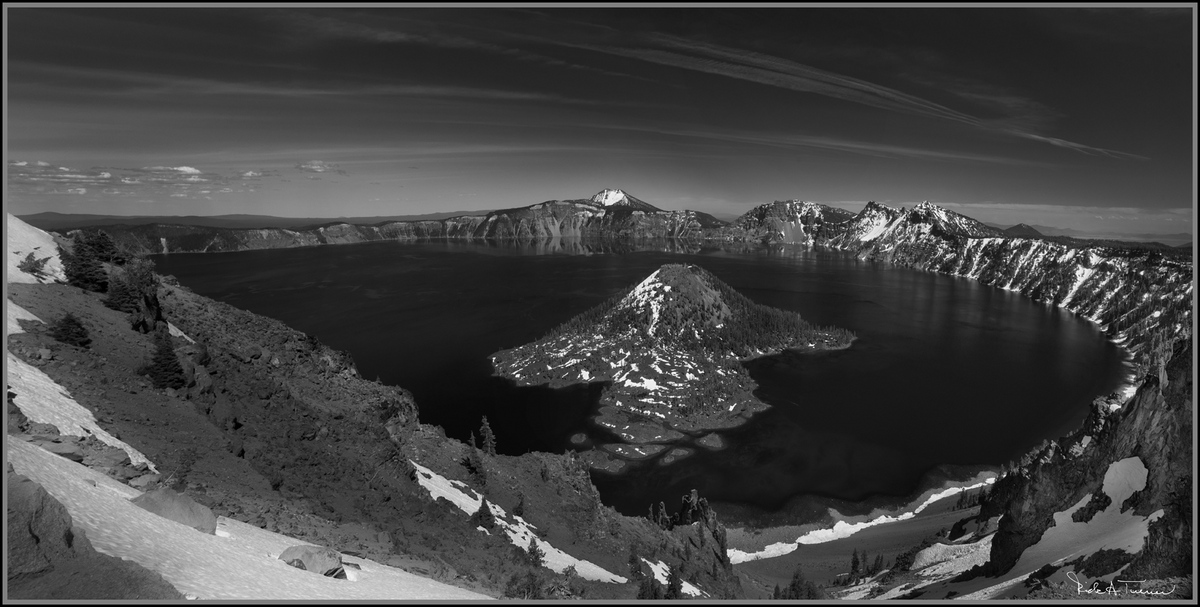
After a period of dormancy, Mazama became active again. Then, around 5700 BC, Mazama collapsed into itself during a tremendous volcanic eruption, losing 2,500 to 3,500 feet (760 to 1,100 m) in height. The eruption formed a large caldera that, depending on the prevailing climate, was filled in about 740 years, forming a beautiful lake with a deep blue hue, known today as Crater Lake.
The eruptive period that decapitated Mazama also laid waste to much of the greater Crater Lake area and deposited ash as far east as the northwest corner of what is now Yellowstone National Park, as far south as central Nevada, and as far north as southern British Columbia. It produced more than 150 times as much ash as the May 18, 1980 eruption of Mount St. Helens.
My previous post shows the lake and mountains and this has the volcano included.
Shot in late May after the roads to Crater Lake were open to the east of the lake.
Silver efex pro 2
CS5
Lightroom 5.2
Pano stitch from 2 horizontals in PS5
Sony a77
Minolta f2.8 20mm prime
iso 100
f 18 @ 1/100


Comments
7 commentsNice info to go with the sweeping view.
Are those contrails? I'm always a fan of cloning contrails out.
The Klamath tribe of Native Americans, who may have witnessed the collapse of Mount Mazama and the formation of Crater Lake, have long regarded the lake as a sacred site. Their legends tell of a battle between the sky god Skell and Llao, the god of the underworld. Mount Mazama was destroyed in the battle, creating Crater Lake. The Klamath people used Crater Lake in vision quests, which often involved climbing the caldera walls and other dangerous tasks. Those who were successful in such quests were often regarded as having more spiritual powers. The tribe still holds Crater Lake in high regard as a spiritual site