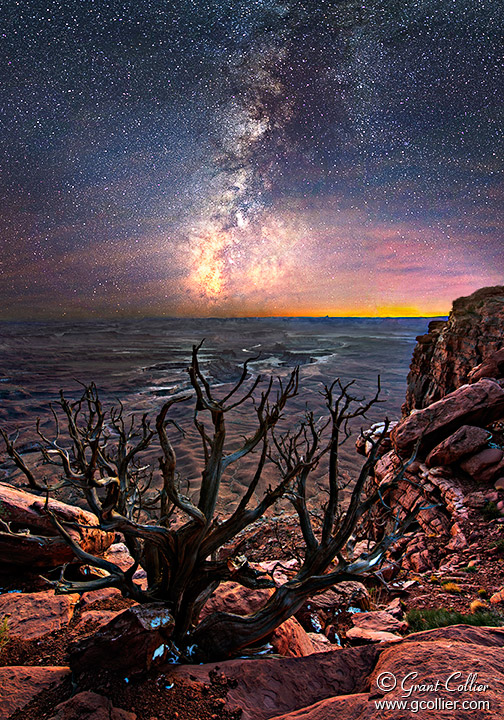
Green River Overlook
by Grant Collier
I failed to get the light I wanted after many attempts at photographing Green River Overlook during the day. So I decided to try and photograph it at night. I took this on a November evening, when the Milky Way is in the western part of the sky after sunset.
I combined two exposures for this shot - one after sunset of the land and one large stitched image from the same spot about an hour later of the sky. I then uprezed the shot of the land so it lined up with the shot of the sky as closely as possible.
To keep things consistent, I used to combine two stitched images ... one for the land and one for the sky. But I found that the stitching software distorts the images and they don't quite line up perfectly anyway. And I've found that without doing the stitched image for the sky, there is too much noise to print it large.
C&C Welcome
Nikon D800e - land shot f8, 14mm, ISO 100, 15 secs, stitched sky shots f1.8 50mm ISO 6400, 10 secs per exposure

Comments
10 commentsI think night photos tend to be subject to more artistic interpretation than daytime photos. This is because we see mainly with rods in our eyes at night vs. cones during the day. Rods are much more light sensitive but you can't see nearly as much detail or color with them. You can't see reds at all, which is perhaps why photos like this with reds in them appear even more unnatural to us.
Cameras, on the other hand, still capture things at night the way we would see them with cones, since that's how they were designed. No camera is able to capture things as we see them with rods. So in post-processing we can try to subdue the colors and details in an attempt to mimic what we see with rods. Or we can keep the colors and try to mimic how we would see if our cones were ultra-light sensitive. I choose the latter, as I think it's fascinating to know all the colors the camera can "see" at night that we can't.
Sorry for the long-winded reply. I've just been thinking about this more lately. People often come into my gallery and ask about my night photos "Are they real?" There's no simple yes or no answer to this question, as people would like. No photo is "real." At best, a photo is a 2 dimensional representation of a 4 dimensional reality. And night photos are even trickier since what the camera sees is significantly different than what we see. All I can say is that I didn't add, remove, or move any objects in the photo and I didn't skew the colors that the camera captured other than deciding on a white balance. I do want the image to be surreal, since the landscape and night sky are quite surreal. But I don't want this to be seen as pure fantasy either.
For me personally, the image in Stan's gallery of "Event Horizon II," with the flashlight and sunstar-moon and ultra-blue sky is more in the realm of photo art than this image. But for me, that's what makes night photography more interesting and challenging. We all have a different way of interpreting what exists at night, as there is no set reality, with the camera seeing things so much differently and clearly than our eyes. To some extent, we can only imagine what the night sky looks like, as we are half-blind to it. The camera can help bring our imagination to life.
I do have a little more subdued version of this shot on my web site, with less sharpening. You can see it at the link below, assuming anyone has actually read this far! If not, at least I've hashed out some more ideas for a book I'm working on.
http://www.gcollier.com/Green-River-Overlook.jpg
Wow, just wow...
Tim!