Night Heron + addition
by Sandy Scott
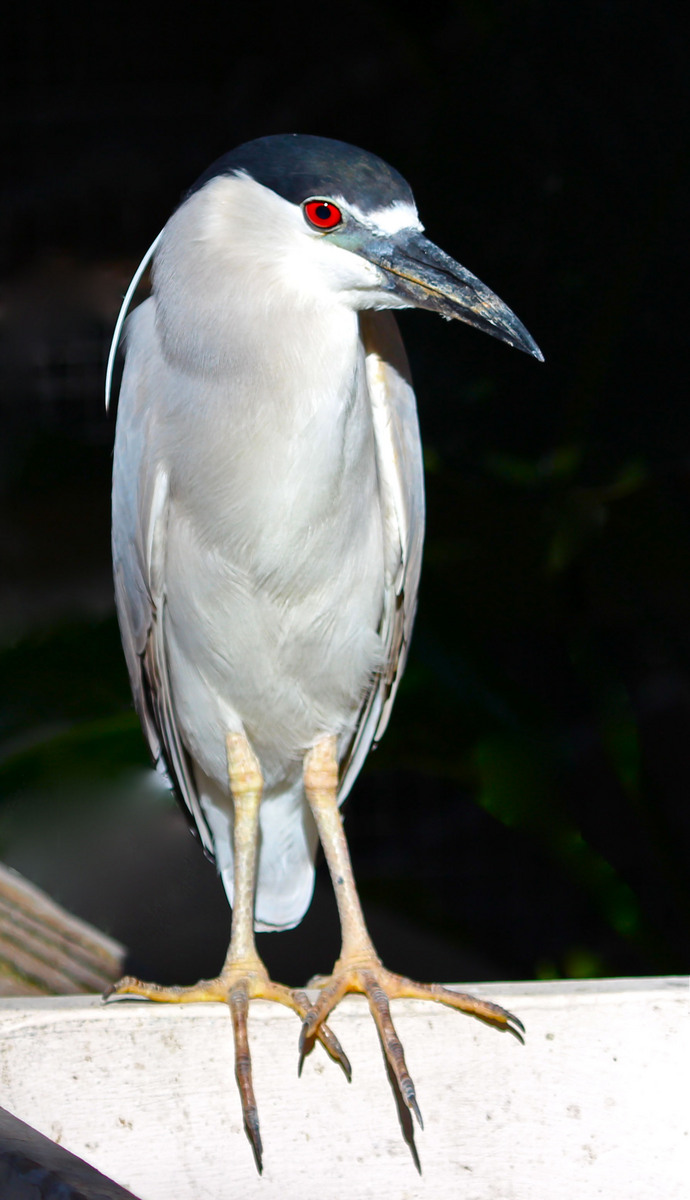
We have quite a few black-crowned night herons in this area and I have photographed them quite a bit. This shot is precisely what I was attempting to accomplish - showing a nice contrast between a black background contrasting with the white plumage and the fascinating red eye of the adult. it is amazing how totally different the juveniles and the adults look both as to plumage, plumage coloration and eye color.
Shot with a Canon T3i, Canon 100-400 L lens at 170mm, f5, 1/500 ISO 100

Comments
10 commentsBoth the original image and the repost have issues, the first being that the whites are blown out which means they show little fine detail in the plumage. I am attaching a screen shot of the histogram for the original image. On the left side of the histogram it shows that the blacks/darks are blocked up which for an image with a very dark background is to be expected, however; the far right side shows that the whites are blown out substantially. the black spike/marks on that side should not quite reach the right side of the histogram. The concrete wall (?) the heron is standing on looks very bright and lacks texture.
Looking at the shadow below the Black-crowned Night Heron's (not black-crested) foot it appears that this image was taken on or around mid day which is not the best time for bird photography unless you have cloudy conditions or diffuse clouds overhead. Many of the bird images I have seen you post have been taken in harsh/contrasty light and the images would be better with the softer light just after dawn or prior to sunset.
I also see color noise in the Black-crowned Night Heron's crown, that can be avoided by exposing the image properly. The images appear to lack fine detail and looks soft, that may be due to cropping the file too much and needing to have sharpening applied in post processing. although sharpening an image that already has color noise will only make the noise worse.
I suggest you shoot earlier or later in the day. Don't use ISO 100 with birds, you want to keep your shutter speed up because they can be active. Expose properly to avoid noise, blocked up blacks and blown out whites. Cropping a lot will cause the loss of fine details. As for composition, leave some space around the bird even when it is a portrait.
The members here have a lot to offer in their critiques but critiquing other people's images will help you to develop a discerning eye and give you the ability to do honest self critiques of your own images.
As an aside, the image was shot at 9:05 in the morning with the early/mid morning sun shining on the heron. I do appreciate the difference in time of day lighting in that I was treated to the most amazing light a bit over a week ago when I was shooting at the amazing Circle B Bar Reserve in Lakeland, FL just prior to sunset - I got some shots with amazing lighting.
BTW, based on my iconoclastic personality, I would not be surprised that even should I someday evolve into a proficient photographer, methinks my work will always be a bit different than the norm - I'm built that way (much to my glee)!
If this had been taken your fifth day photographing or after 5 years of shooting my critique wouldn't change.
One of the reasons that I very specifically stated that, "This shot is precisely what I was attempting to accomplish - showing a nice contrast between a black background contrasting with the white plumage and the fascinating red eye of the adult…," was because I personally achieved exactly what I wanted to. I looked at the shot processed, and liked my original. In this particular instance, I don't care if the histogram is off in China somewhere!
Now Mia, do not misunderstand the above to think that I not only value your opinion, but certainly will take your advice when rendered, but also understand the world need not be so bloody ridged. Rules are to be broken and I have never been one to follow the crowd, and the good news is that I have had an incredibly successful and exciting life because of it. My speech is now completed!
Sandy: I've read through this thread. Mia provided you accurate, seasoned advice. Her input and attention to detail, and taking the time to provide a copy of the histogram is why this forum is so valuable. You've chosen to not take her advice and tell her (and the rest of us) you achieved exactly what you wanted. The problem is, what you achieved is not a technically good photograph, which makes it impossible for it to be an aesthetically pleasing photograph. Good photographs have to be technically sound as well as well as containing an aesthetically pleasing arrangement of the elements. You've said here, and in many other threads that you are very early in your photographic journey. If you want to improve, I'd encourage you to read the input from others and learn from it, rather than pushing back and saying you don't care if the "histogram is off in China". You can do that if you want, but your photography will suffer as a result. You clearly know a lot about cycling based on the awards you've received. Imagine you providing input to a novice cyclist only to be met with the type of resistance you've provided with your comments back to experienced photographers who are trying to help. It won't be long before the kind, accurate (and yes, pointed) advice you've been receiving will begin to dwindle. None of us here have ever created the perfect photograph. I've been at it for 40+ years and my journey continues. I love photography, learning photography, and a big part of that is listening to input, learning from it, and growing. I'd encourage the same.
My speech is now completed.