Gallery: AvianPosted November 25, 2013183 views9 comments
Comments
9 comments
Comment posted by Peter Cross on November 25, 2013 at 11:41 PM
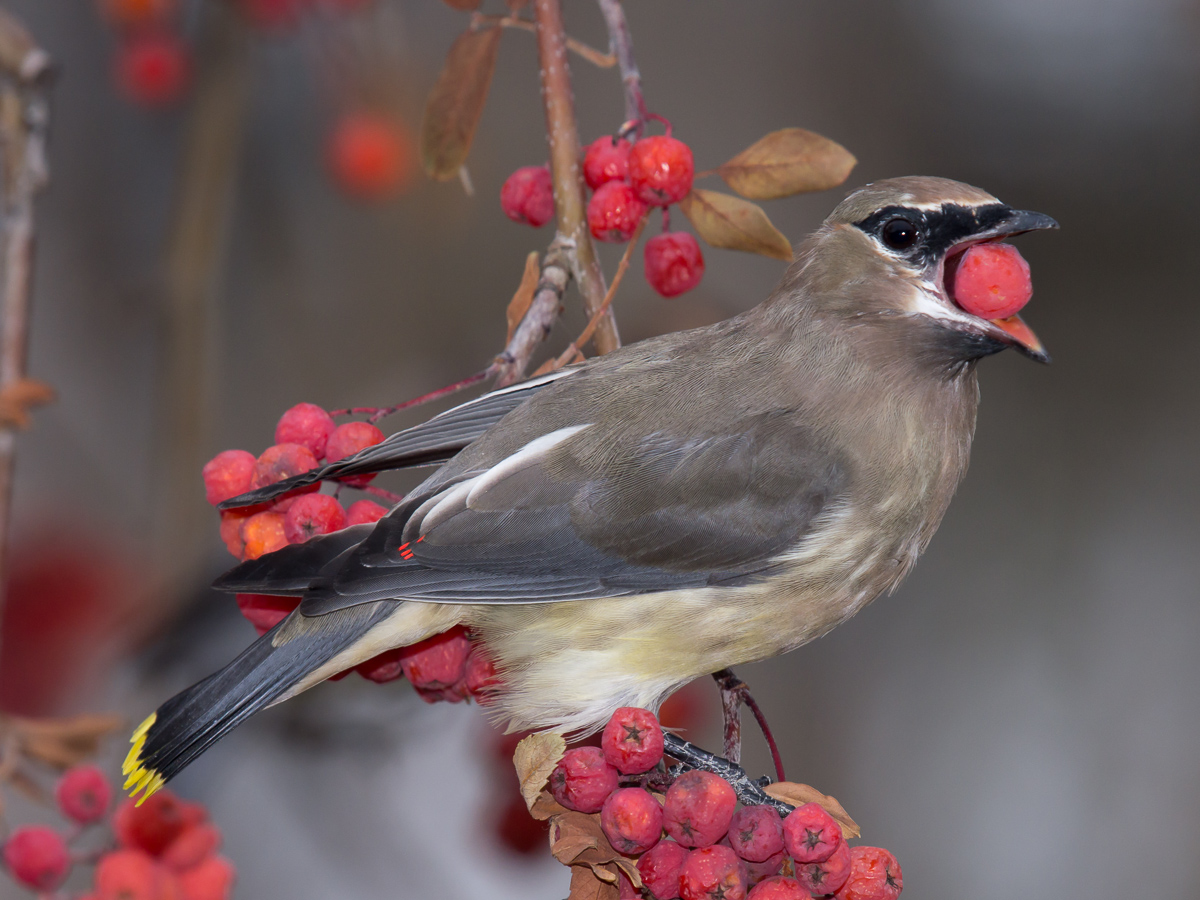
Great photo of a waxwing, Tom. Looks like one of your first posts and it's certainly a beauty. Well composed and exposed. Looks like you used a flash on it which really helped light the bird well. It would help in the critique if you would post you tech info so we all have an idea of what you did. Welcome!
Registered on April 3, 2010, 271 Posts, 1342 Comments
Comment posted by Tom Stermitz on November 25, 2013 at 11:47 PM
I occasionally post over at RMNP; mostly landscapes. Here is more about this photo:
I have an large scruffy Mountain Ash in the backyard outside my office window, which serves as a great place for birds to hide from the Coopers Hawk. This Fall it is (was) covered with bright orange berries. The Robins are frantically stripping the tree, and have been inviting their friends, the Cedar Waxwings. Even the house finches are snacking on the berries despite the nearby feeder.
This picture shows the "wax-wingtips", which are usually pretty hard to see.
Pentax 300mm at f8 and 1/180sec. That lens is somewhat less-than-contrasty wide open, but is nice and sharp by f6.7 or f8. I tend to use ISO 400 or more in order to balance the aperture and shutter speed with flash. The flash helps isolate the bird when the background is bright and gives me some eye highlights, but limits me to 1/180s.
Registered on October 21, 2010, 4 Posts, 4 Comments
Comment posted by Keith Bauer on November 26, 2013 at 8:59 AM
Tom: Nice image of the waxwing. Details look pretty good. My first reaction was that the image looked flashed. After reading your response, that was confirmed. You mentioned that using the flash limits you to 1/180th (sounds like the maximum flash sync speed on your Pentax). I have to believe that you have the ability to use High Speed Sync Flash (that's the term Canon uses, not sure of the exact words that Pentax might use). That is a setting on the flash that allows the camera to sync at speeds faster than the normal sync speed at the cost of much reduced distance for the flash. That applies if you are using a shoe mounted flash, not a pop up. If it was a popup on-camera flash, then never mind all of that info.
Registered on November 20, 2003, 458 Posts, 4836 Comments
Comment posted by Dennis Plank on November 26, 2013 at 10:32 PM
Superb detail in the plumage,Tom. Your settings seemed to work very well.
Registered on January 28, 2008, 1767 Posts, 23192 Comments
Comment posted by Tom Stermitz on November 26, 2013 at 11:50 PM
Well, everything in a photo is about tradeoffs. My lens isn't very contrasty, so I have to stop down a bit. Flash really helps delineate the feathers, but limits my speed to 1/180sec. Fortunately, the bird is stationary, and my camera has IS, so I can hand-hold the 300mm lens.
Flash really helps delineate the feathers, and let's me darken the background. In this case, the day was somewhat cloudy and the bird was only 10 feet away so I didn't need maximum power. Yes, the problem with pseudo high-speed sync is that you lose power or distance especially on a Sunny day.
Registered on October 21, 2010, 4 Posts, 4 Comments
Comment posted by Keith Bauer on November 27, 2013 at 9:13 AM
With the bird only 10 feet away, the power of the flash with high speed sync would have easily been enough.
Registered on November 20, 2003, 458 Posts, 4836 Comments
Comment posted by David Bogener on November 27, 2013 at 4:18 PM
Tom,
Excellent timing in this eyecatching image. Perhaps a little tight, but I like it. Dave
Registered on October 30, 2013, 417 Posts, 1255 Comments
Comment posted by Patrick O'Healy on November 27, 2013 at 7:30 PM
Lovely photo. I like the way it captures the red tips on the wings and the yellow tail as well as the red mouth.
Registered on March 13, 2011, 326 Posts, 1679 Comments
Comment posted by Randy Runtsch on November 28, 2013 at 8:15 AM
Hi Tom,
This is a nice image. The large version emphasizes the fine details of the feathers and the colors all-around. The only suggestion I have is to boost the exposure a tad to brighten the scene. Well done.
Have a Happy Thanksgiving.
Registered on October 30, 2013, 50 Posts, 445 Comments

Comments
9 commentsI have an large scruffy Mountain Ash in the backyard outside my office window, which serves as a great place for birds to hide from the Coopers Hawk. This Fall it is (was) covered with bright orange berries. The Robins are frantically stripping the tree, and have been inviting their friends, the Cedar Waxwings. Even the house finches are snacking on the berries despite the nearby feeder.
This picture shows the "wax-wingtips", which are usually pretty hard to see.
Pentax 300mm at f8 and 1/180sec. That lens is somewhat less-than-contrasty wide open, but is nice and sharp by f6.7 or f8. I tend to use ISO 400 or more in order to balance the aperture and shutter speed with flash. The flash helps isolate the bird when the background is bright and gives me some eye highlights, but limits me to 1/180s.
Flash really helps delineate the feathers, and let's me darken the background. In this case, the day was somewhat cloudy and the bird was only 10 feet away so I didn't need maximum power. Yes, the problem with pseudo high-speed sync is that you lose power or distance especially on a Sunny day.
Excellent timing in this eyecatching image. Perhaps a little tight, but I like it. Dave
This is a nice image. The large version emphasizes the fine details of the feathers and the colors all-around. The only suggestion I have is to boost the exposure a tad to brighten the scene. Well done.
Have a Happy Thanksgiving.