Blackfish!
Hey all,
I'm back from my recent photo tours into the Great Bear Rainforest and chompin' at the bit to get contributing to this gallery again! Tho' the Great Bear Rainforest is best known for its terrestrial inhabitants (and you WILL be seeing lots of those in the coming days and weeks), the nutrient-rich waters that dissect and infuse the region are teeming with life. Abundant krill feeds and supports a diverse network of organisms, including a now-rebounding population of Humpback Whales as well as many species of fish. And with the fish come fish predators, including sea lions and seals. And that brings in both resident (fish-eating) and transient (mammal eating) Killer Whales.
Blackfish. Killer Whale. Orca. What's in a name? In a nearly bygone era Killer Whales were known simply as "Blackfish". This name was used to describe many species of whales, including the Melon-headed Whale, the Pygmy Killer Whale, the False Killer Whale, the Long-finned Pilot Whale, and the Short-finned Pilot Whale. Ironically, none of these animals are fish - all are air-breathing marine mammals. And, just to confuse things further, the Killer Whales (or Blackfish) shown here are also known as Orcas and were even historically referred to as Grampus. Today, the most commonly used name is Killer Whale - which appears to be a mistranslation of the Spanish name "Asesina Ballenas" - which literally means whale killer. And, of course, many, if not most, Killer Whales (or is it Whale Killers?) don't actually kill other whales - they feed on fish. And, Killer Whales (or are they Fish Killers?) aren't actually whales - they're dolphins! Sheesh!
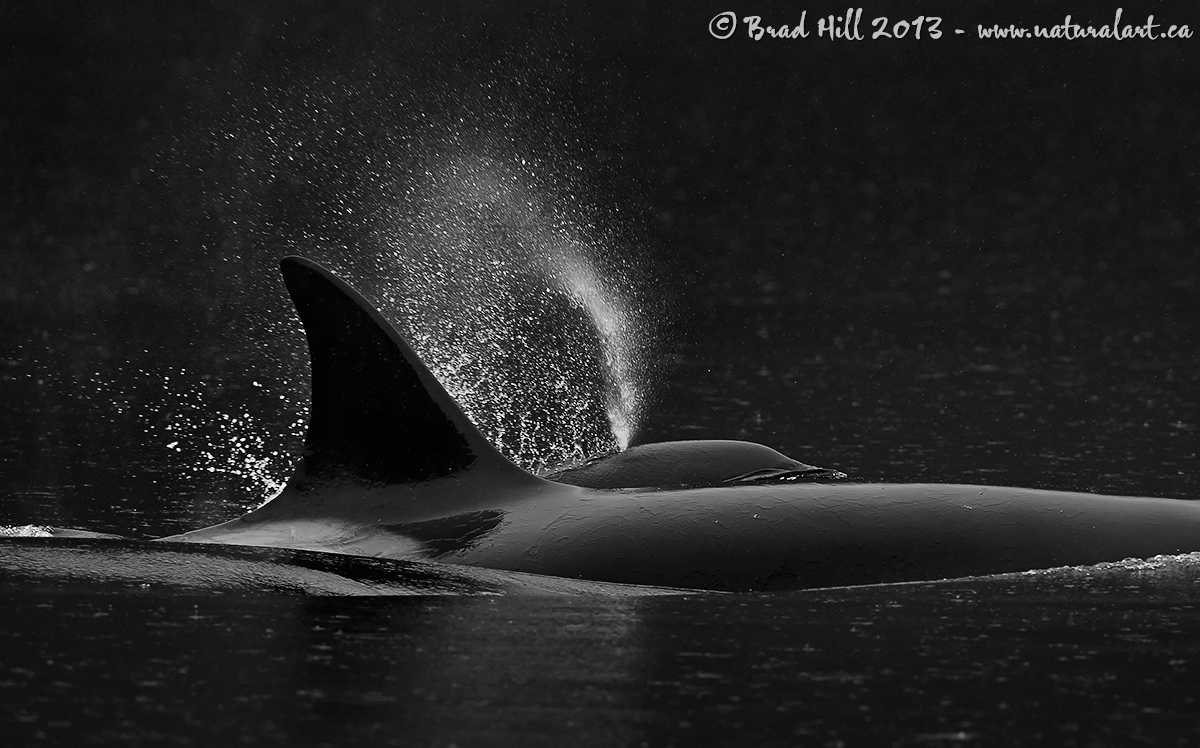
Regarding the conversion of the scene to black and white (or B&W): I've heard many nature photographers say "I didn't like how the image came out in colour so I decided to try it in black and white". I tend to approach B&W conversions differently - I specifically look for scenes that will be strong as B&W images, and my personal preferences for B&W images tends towards scenes that contain some true blacks, some true whites, and a nice tonal range "in-between". I was thinking "black and white" on this image from the outset - even before image capture. In my mind, retaining colour in this scene wasn't at all essential to make the image "work" - and removing colour allows one to focus on those factors that DO contribute to the shot - the smooth lines and curves, the contrast, the detail and texture, and - of course - the tonal range of the scene.
Subject: Ma and calf Killer Whale (
Orcinus orca) surfacing in calm waters
Location: Inlet in Great Bear Rainforest, BC, Canada
Camera: Nikon D4
Lens: Nikkor 400mm f2.8 VR lens - handheld from sailboat. VR on and in "Normal" mode.
Exposure: 1/1000s at f5.6. ISO 2000. -1.0 stop compensation from matrix metered exposure.
Crop: This is about 85% of full frame
As almost always, a bunch more info - including processing details - are available for this shot on my website. In this case you'll also find a higher res (2400 pix long axis) there as well. Just go here if you're interested:
http://www.naturalart.ca/galleries/mammals/other/detail_4.html.
Comments and feedback greatly appreciated...probably better to view larger version prior to doing so...
Cheers...
Brad

Comments
11 commentsI heard somewhere recently that "Killer Whales" have had to adapt to consuming fish, seals etc. because their preferred food source, whales, have seen declines forcing them to find alternatives?
Max
Thanks for the feedback. Both of your comments contain questions, so I'll answer them now:
1. Lon: I'd have no issue cropping the image as you suggest - and just like "the other one" (i.e., tighter). I chose this crop for two main reasons. First, I simply didn't want to produce a near "carbon copy" of that other image...so just for variety. Second, I liked the elongated fusiform shape of the female in the foreground - and cropping closer would have truncated that a little. But I'm sure there will be times and places where I present both the "older" colour version side-by-side with this one (with a near identical crop).
2. Gary: On the diet. I'm not aware of the report you're referring to, but here's what I know: The resident pods of killer whales (and there are several of them) are fish-eaters - exclusively. The transients - which like their name suggests wander over a larger area - are mammal eaters (so sea lions, seals, etc.). There is considerable genetic, morphological, and behavioural differences between residents and transients, and it appears there's been no interbreeding between them in at least 10,000 years. This would lead some to argue they may represent two species. And, there is a 3rd population known as "Offshores" - the closest ones to the area I work in are in the waters to the west of the Charlottes (or Haida Gwaii). They eat sand sharks (and their teeth get ground down accordingly!).
In terms of dietary shifting: I know that the transients that used to feed on Steller Sea Lions up in Alaska have switched off them (largely due to the crashing populations of Stellers in that area) and have focused more on eating seals and have started preying on sea otters. I haven't heard if they are also starting to feed on fish, but it is possible.
In terms of them eating whales: To my understanding, while that occurs, it has always been rare (i..e, whales represent a small portion of their diet). Humpback Whale populations are on the increase and I think Grays (which would be their other primary whale "victims") are stable in numbers. So I'm a bit skeptical if whale abundance is driving a dietary shift...(but maybe?).
Cheers...
Brad
PS to Max: You added your comment while I was typing this one out - so no intent to ignore you! Thanks for your comment!
Lovely tonal range and details in this. I am also looking forward to more from your recent trip!
only one word needed "remarkable"
Congrats on GOTM.
Well Deserved !!!
Billyboy