Gallery: Macro & Close-upPosted February 2, 201392 views10 comments
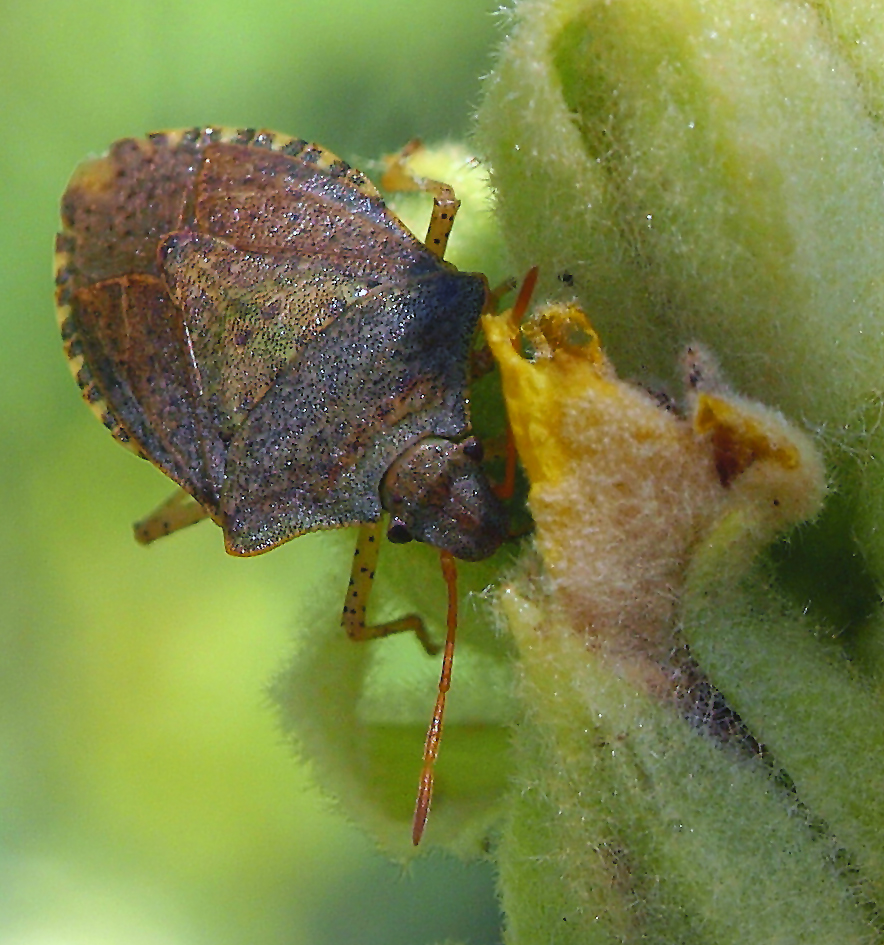
Also not a Spined Soldier Bug, Podisus (Stink bug family)
Olympus E-510
76mm
1/200 sec
f9
ISO200
C&C appreciated
Large view
Comments
10 comments
Comment posted by Carolyn Derstine on February 2, 2013 at 8:22 PM
Great capture of this bug, Charlie. We seem to have had some variety of them everywhere this year, both outside and inside our house. Nice POV with the good view of his head and back. I like his perch; the various shades of green in the perch and background contrasts nicely with the bug.
Registered on February 16, 2011, 610 Posts, 3684 Comments
Comment posted by scott lanz on February 2, 2013 at 11:10 PM
Excellent pov and detail Charlie. The colors overall are quite nice, including the pleasing green bg. What I especially like, however, is the way the comp, light, and detail brought out all the intricate colors and detail in the bug. Well done.
Registered on November 14, 2003, 840 Posts, 12902 Comments
Comment posted by Balan Vinod on February 3, 2013 at 2:03 AM
Charlie ..nice detail here and a new comp too. I like this one like the pov too ..beautifully done
Balan Vinod
Registered on March 20, 2006, 889 Posts, 2312 Comments
Comment posted by John Neukirch on February 3, 2013 at 12:11 PM
Always nice to see great macro shots of insects and flowers this time of year, makes me think about spring!
Registered on July 9, 2012, 207 Posts, 1476 Comments
Comment posted by Charlie Baugh on February 3, 2013 at 1:15 PM
Thank all of you for really encouraging comments and just for viewing my image.
I had a very welcome email from Wayne Jones about the ID of this bug and am sorry to say it is not correct. Though Wayne and I think it is of the "stink bug" family this is not a "Spined Soldier Bug, Podisus". I really should have said that I was not sure of my ID. I will keep trying to ID things I post, but must remember that I'm unschooled and vulnerable to errors.
Thanks again Wayne.
Registered on April 18, 2011, 329 Posts, 1985 Comments
Comment posted by Howard Cheek on February 4, 2013 at 12:55 PM
Good comp & I especially like the view of the head/eyes Charlie.
Harder to ID as it goes through the nymph changes/stages I suppose..
And there's a large number of Shield Bug species to deal with as well.
Nice shot
Registered on July 24, 2008, 1201 Posts, 10758 Comments
Comment posted by Rebecka on February 4, 2013 at 3:12 PM
Unbelievable detail in this wonderful macro shot, Charlie. Nice polka-dot legs he has! Love the texture added by his perch.
Registered on February 5, 2009, 170 Posts, 924 Comments
Comment posted by Wayne Jones on February 4, 2013 at 3:39 PM
Great POV on this bug, Charlie, and good details, too. The colorful background also adds a lot of eye appeal.
As I mentioned when we e-mailed, P. maculiventris -- one of the more recognizable predatory species in the stinkbug/shieldbug family (Pentatomidae) -- has prominent sharp spines on the "shoulders." There are a many non-predatory stink bugs -- such as Euschistus spp. --that look a lot like the one you shot, but there are SO MANY look-alike stink bug species, I would usually not even try to pin it down to species. Most of us are doing well to recognize the order, and you got this one down to the family, so that's doing well.
For those interested... WHAT'S AN ORDER AND WHAT'S A FAMILY?
NOTES ON INSECT ID AND NAMES: Except for some of the more "showy" or well-know insects (butterflies, dragonflies, damselflies, and a few beetles, etc.) most of us are doing well to recognize the order. For those unfamiliar with scientific classification, it goes like this:*
CLASS Inecta (insects);
- ORDER Hemiptera (true bugs, leaf hoppers, aphids, cicadas, etc.); <--- We should try to identify insects to this level.
- - FAMILY Pentatomidae (shield bugs and stinkbugs) <--- We are doing well to ID families, but it's not always easy.
- - - GENUS -- Group of related species, used as the "First name" of an organism, always capitalized
- - - - SPECIES -- never capitalized. When we know the genus, but not the species, species is abbreviated as "sp." or "spp." (spp. is plural for sp.)
Genus and species are printed in italics.
COMMON NAMES are not printed in italics, and are not capitalized. Of course, they vary from one language to another, and most insects don't even have common names.
EXAMPLE: For this photo, I would say that it's an insect in the order Hemiptera (true bugs) and a member of the family Pentatomidae (stinkbugs and shieldbugs). After doing some "looks like" comparisons, I might also mention that it looks like some of the species in the genus Euschistus or simply say something like "possibly Euschistus sp.." But this is such a large family with so many look-alikes, even experts would want to examine the top and bottom of an adult specimen for a more positive ID.
Note that the list of classification levels above is far from complete. There are also other classification levels (to show how various groups are related) that are used less often, such as superfamily, subfamily, subspecies, etc.
Registered on April 18, 2007, 953 Posts, 6435 Comments
Comment posted by Charlie Baugh on February 5, 2013 at 12:43 AM
Thanks for all the information, Wayne. I will absorb some and know that it is ok not to try to be exact in my attempts at identifications. I do enjoy trying to find what I'm photographing.
Registered on April 18, 2011, 329 Posts, 1985 Comments
Comment posted by RL Potts on February 5, 2013 at 5:44 PM
I saw your comment on my photo and figured you might be around here somewhere. This does seem to be the place for insectivores. Tell Doctor Wayne Jones that I enjoyed his lecture. I really like a couple of things about your photo. The point of focus as it concerns the eyes is perfect. I also like the tension of having this guy clinging precariously at the edge of space.
Registered on November 24, 2003, 188 Posts, 985 Comments

Comments
10 commentsBalan Vinod
I had a very welcome email from Wayne Jones about the ID of this bug and am sorry to say it is not correct. Though Wayne and I think it is of the "stink bug" family this is not a "Spined Soldier Bug, Podisus". I really should have said that I was not sure of my ID. I will keep trying to ID things I post, but must remember that I'm unschooled and vulnerable to errors.
Thanks again Wayne.
Harder to ID as it goes through the nymph changes/stages I suppose..
And there's a large number of Shield Bug species to deal with as well.
Nice shot
As I mentioned when we e-mailed, P. maculiventris -- one of the more recognizable predatory species in the stinkbug/shieldbug family (Pentatomidae) -- has prominent sharp spines on the "shoulders." There are a many non-predatory stink bugs -- such as Euschistus spp. --that look a lot like the one you shot, but there are SO MANY look-alike stink bug species, I would usually not even try to pin it down to species. Most of us are doing well to recognize the order, and you got this one down to the family, so that's doing well.
====================================================
For those interested... WHAT'S AN ORDER AND WHAT'S A FAMILY?
NOTES ON INSECT ID AND NAMES: Except for some of the more "showy" or well-know insects (butterflies, dragonflies, damselflies, and a few beetles, etc.) most of us are doing well to recognize the order. For those unfamiliar with scientific classification, it goes like this:*
CLASS Inecta (insects);
- ORDER Hemiptera (true bugs, leaf hoppers, aphids, cicadas, etc.); <--- We should try to identify insects to this level.
- - FAMILY Pentatomidae (shield bugs and stinkbugs) <--- We are doing well to ID families, but it's not always easy.
- - - GENUS -- Group of related species, used as the "First name" of an organism, always capitalized
- - - - SPECIES -- never capitalized. When we know the genus, but not the species, species is abbreviated as "sp." or "spp." (spp. is plural for sp.)
Genus and species are printed in italics.
COMMON NAMES are not printed in italics, and are not capitalized. Of course, they vary from one language to another, and most insects don't even have common names.
EXAMPLE: For this photo, I would say that it's an insect in the order Hemiptera (true bugs) and a member of the family Pentatomidae (stinkbugs and shieldbugs). After doing some "looks like" comparisons, I might also mention that it looks like some of the species in the genus Euschistus or simply say something like "possibly Euschistus sp.." But this is such a large family with so many look-alikes, even experts would want to examine the top and bottom of an adult specimen for a more positive ID.
Note that the list of classification levels above is far from complete. There are also other classification levels (to show how various groups are related) that are used less often, such as superfamily, subfamily, subspecies, etc.