Gallery: Weekly ChallengePosted January 18, 201348 views6 comments
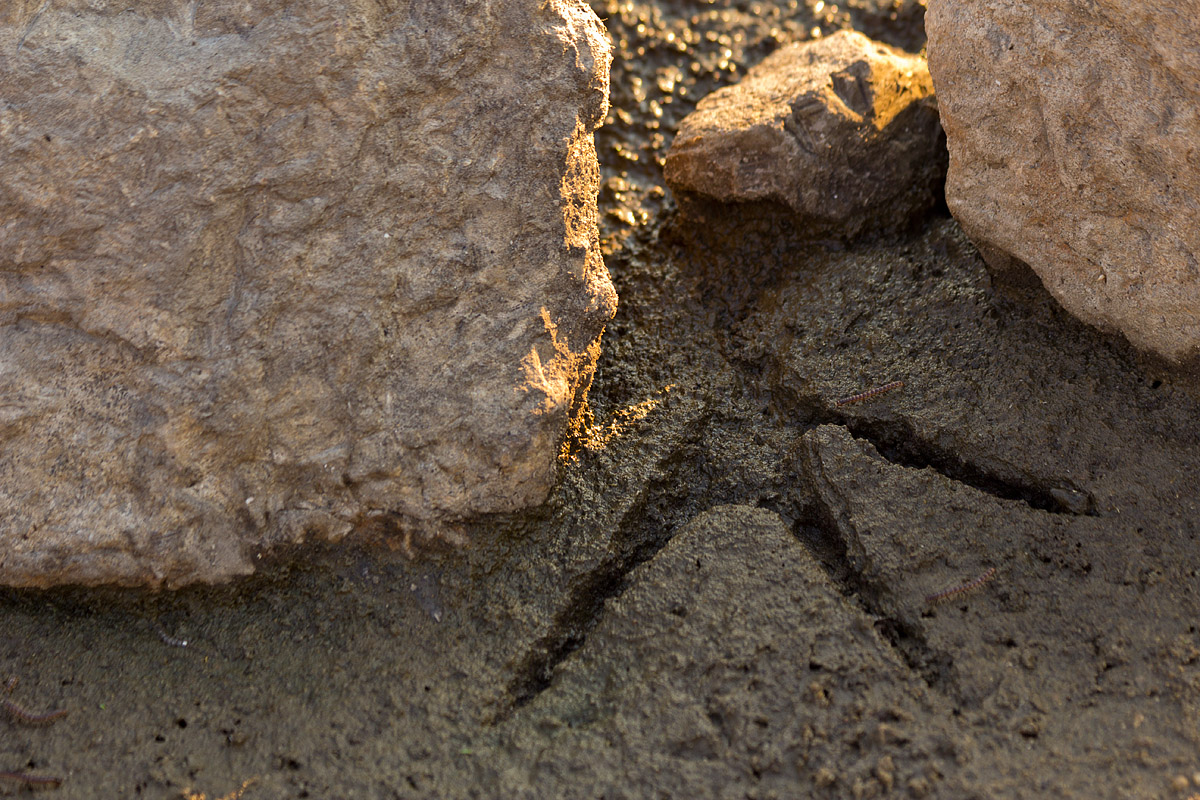
Taken at Cedar River, Iowa.
Canon Rebel T3i, ef70-300 @ 105mm, 1/50sec@f/5.6 ISO 200.
Comments
6 comments
Comment posted by John Clulow on January 18, 2013 at 5:42 AM
I like this composition having recently commented on one that, to me, has similar implications. The elements in this one are the ancient rocks, the light of the sun, and the evidence of something much more recent that was recorded in the sand (which came about from the weathering of yet other rocks over time, however temporarily in the context of the other elements.
The mind wants to find familiar faces of creatures in the texture of the light on the rocks, and I think that the bluriness of the pebbles beyond is actually helpful both in focusing attention on the subject footprint and in expressing the way in which human knowledge ultimatey fades into confusion the further one tries to go back into time.
In writing this, I have no idea what the monthly theme might be. But I'm thinking it may have something to do with footprints. Whatever it is, this one and the other one by Carolyn Derstein I commented on have a lot of depth, at least for me.
Postscript: This must caused me to recall some lyrics I think I recall from a long time ago sung by Arlo Gutherie, something like "teardrops in the sands of time, footprints in the water, lead me back to who I am."
Registered on November 1, 2012, 155 Posts, 1079 Comments
Comment posted by Mark Seaver on January 18, 2013 at 9:43 AM
I like your composition here, Lynne, with the print surrounded by the rocks and the sunlight sneaking through. You also did a good job on the exposure under challenging circumstances. As a minor nit on the photography, I wish you'd have gotten all of the print sharp...the bottom of picture is going soft.
A couple of things make me wonder about your ID. I think I see a backward pointing toe with the tip of that toe just below the point of the small rock. Geese don't have that. In addition, geese have webbed feet and I would expect the webbing to show given the depth of the print. My guess is that this is a crow. If I were there, I'd check on a couple more prints to verify my guess.
Registered on January 23, 2011, 1103 Posts, 17270 Comments
Comment posted by Lynne Doxie on January 18, 2013 at 2:13 PM
Mark, I bet you are right, about it being a crow track not a goose, my bad. There were all kinds of birds in the area the morning I took this including crows, herons, canada geese, ducks - not sure what kinds, some shore birds & an eagle. I think I thought goose over crow cause I thought it was too big for crow, but not seeing the web is a pretty big clue - oops thanks for the input.
Thanks to you too John, I love the Arlo Gutherie reference!
Registered on January 12, 2013, 14 Posts, 19 Comments
Comment posted by Carolyn Derstine on January 19, 2013 at 11:57 AM
Nice capture of a single track imprint. I like the POV you made of this with the low view and the placement of the rocks and track to make this a great comp. The lighting adds a nice touch to this also with the bright lighting behind and the track more in shade. Does lend itself to all kinds of philosophical interpretations. . . Good photos, such as this, engage the viewers' mind beyond just the viewing of a single image.
Registered on February 16, 2011, 610 Posts, 3684 Comments
Comment posted by Marlise Launstein on January 19, 2013 at 3:17 PM
This is a very nice picture! I like the sun on the rocks,and how the bird stepped right in between the rocks to make this an awesom picture! I also like how you can see little centepede's by the print! Do you have any idea what kind of bird print this is?
Registered on August 31, 2011, 28 Posts, 175 Comments
Comment posted by Wayne Jones on January 21, 2013 at 1:01 PM
Nice little scene! I like the subtlety of the light, with brilliant, but well-controlled backlight "sneaking" in.
As soon as I saw this, I thought "That's a heron track." Your assessment that it is bigger than a crow track confirms that. (Crow footprints are generally no bigger than about 3 inches). The depth of the imprint is another clue about the weight of the bird. But the biggest clue is the distinctive shape of the print. Herons have a bit of webbing between the inside toe and the middle toe, which shows up well here in the asymmetrical look to the imprint. Of course, that's not a positive ID, especially from somebody like me who lives in the woods where the great blue heron is the only common large wading bird. I know that some other wading birds have similar-looking feet (ibis, stork, etc.). But if you saw herons in this place, that's probably what made this track -- with its left foot.
Registered on April 18, 2007, 953 Posts, 6435 Comments

Comments
6 commentsThe mind wants to find familiar faces of creatures in the texture of the light on the rocks, and I think that the bluriness of the pebbles beyond is actually helpful both in focusing attention on the subject footprint and in expressing the way in which human knowledge ultimatey fades into confusion the further one tries to go back into time.
In writing this, I have no idea what the monthly theme might be. But I'm thinking it may have something to do with footprints. Whatever it is, this one and the other one by Carolyn Derstein I commented on have a lot of depth, at least for me.
Postscript: This must caused me to recall some lyrics I think I recall from a long time ago sung by Arlo Gutherie, something like "teardrops in the sands of time, footprints in the water, lead me back to who I am."
A couple of things make me wonder about your ID. I think I see a backward pointing toe with the tip of that toe just below the point of the small rock. Geese don't have that. In addition, geese have webbed feet and I would expect the webbing to show given the depth of the print. My guess is that this is a crow. If I were there, I'd check on a couple more prints to verify my guess.
Thanks to you too John, I love the Arlo Gutherie reference!
As soon as I saw this, I thought "That's a heron track." Your assessment that it is bigger than a crow track confirms that. (Crow footprints are generally no bigger than about 3 inches). The depth of the imprint is another clue about the weight of the bird. But the biggest clue is the distinctive shape of the print. Herons have a bit of webbing between the inside toe and the middle toe, which shows up well here in the asymmetrical look to the imprint. Of course, that's not a positive ID, especially from somebody like me who lives in the woods where the great blue heron is the only common large wading bird. I know that some other wading birds have similar-looking feet (ibis, stork, etc.). But if you saw herons in this place, that's probably what made this track -- with its left foot.