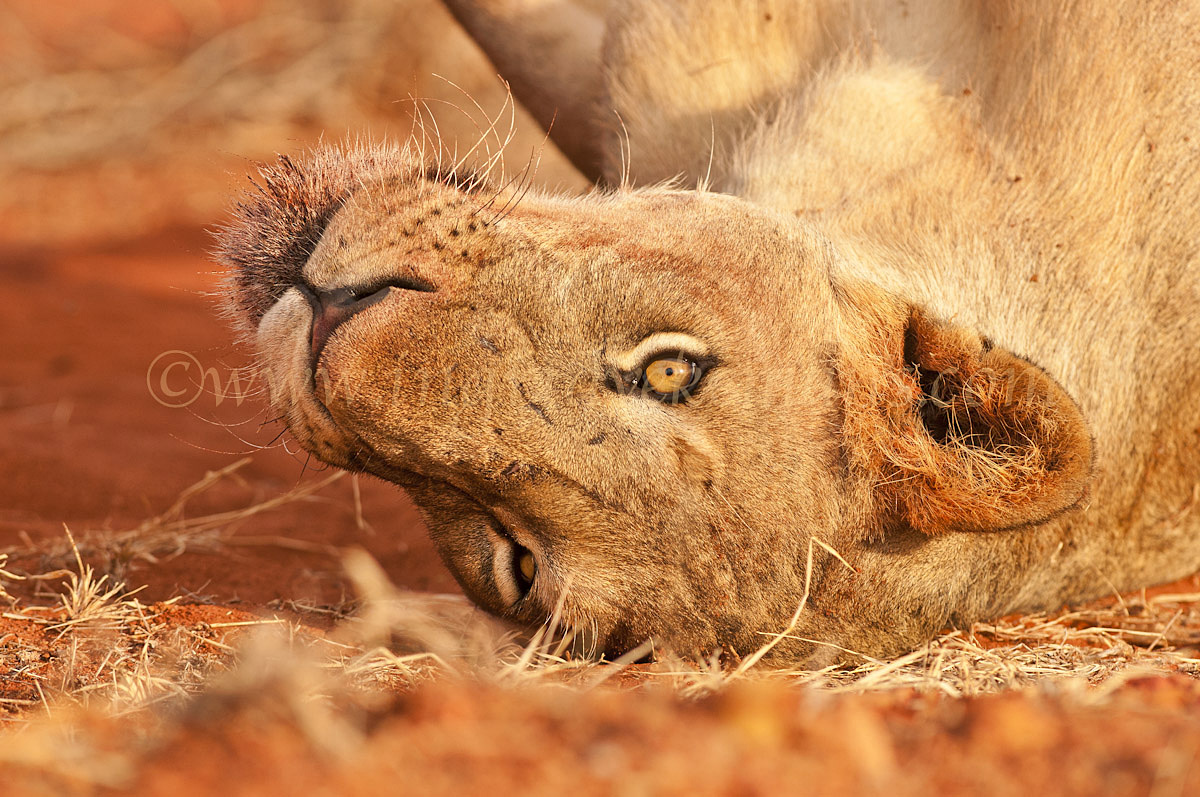
Upside Down
by Ingrid Vekemans
A pride of 4 lions (3 lionesses and 1 male) had managed to take down a giraffe. They had just had a feast and were digesting lazily. The male didn't leave the kill and kept an eye on us all the time...even when he was rolling over. The blood and the red sand made it into a colorful scene.
Tsavo East, Kenya.
Nikon D300
Nikkor AF-S VR 300mm f/2,8
ISO 200
f/4,5
1/640s

Comments
7 comments@Phil: yes, indeed, usually that is the case. However, in the Amboseli/Tsavo region for some reason the males have no or very short manes. There is still no agreement between scientists on the reason for that. Some say it's because of the thick bush, that brushes against the growing mane and hence cuts it (personally, I find that an unlikely story but I'm not a scientist), others stick to the version that it's a genetic thing.
In this case we identified the male by looking at other features
Grtz, Ingrid.
Very nice light, and nicely exposed- the colors really pop! Wish I could have been there, it sounds like quite a scene! Hopefully you have some other shots of them with the giraffe!
As for the mane (or lack thereof) we recently learned about that from our professor in a lion lecture while we were in the Serengeti. He is of the camp of scientists who believe it is a genetic occurrence. This can often be seen in areas that are heavily trophy hunted for lions. The lions with the largest manes are selectively killed by humans, resulting in a population where smaller manes are (artificially) genetically preferred. This can also be seen in horn length of impala and other hunted ungulates. As far as I know it has been quite some time (like 1930s or early 1940s?) since legal hunting has occurred in the Tsavo area though so I don't know if that could actually be a factor.
Anyway, nice photo!
-Cam
Jagdeep Rajput
The eye is compelling, the upside-down pose is unique, and the colour is striking. Together they combine to form a real eye-catchhing shot. The information about the mane (or lack thereof) by you and Cam is quite interesting - thanks to both of you for sharing that.
Cheers...
Brad