Circumspect
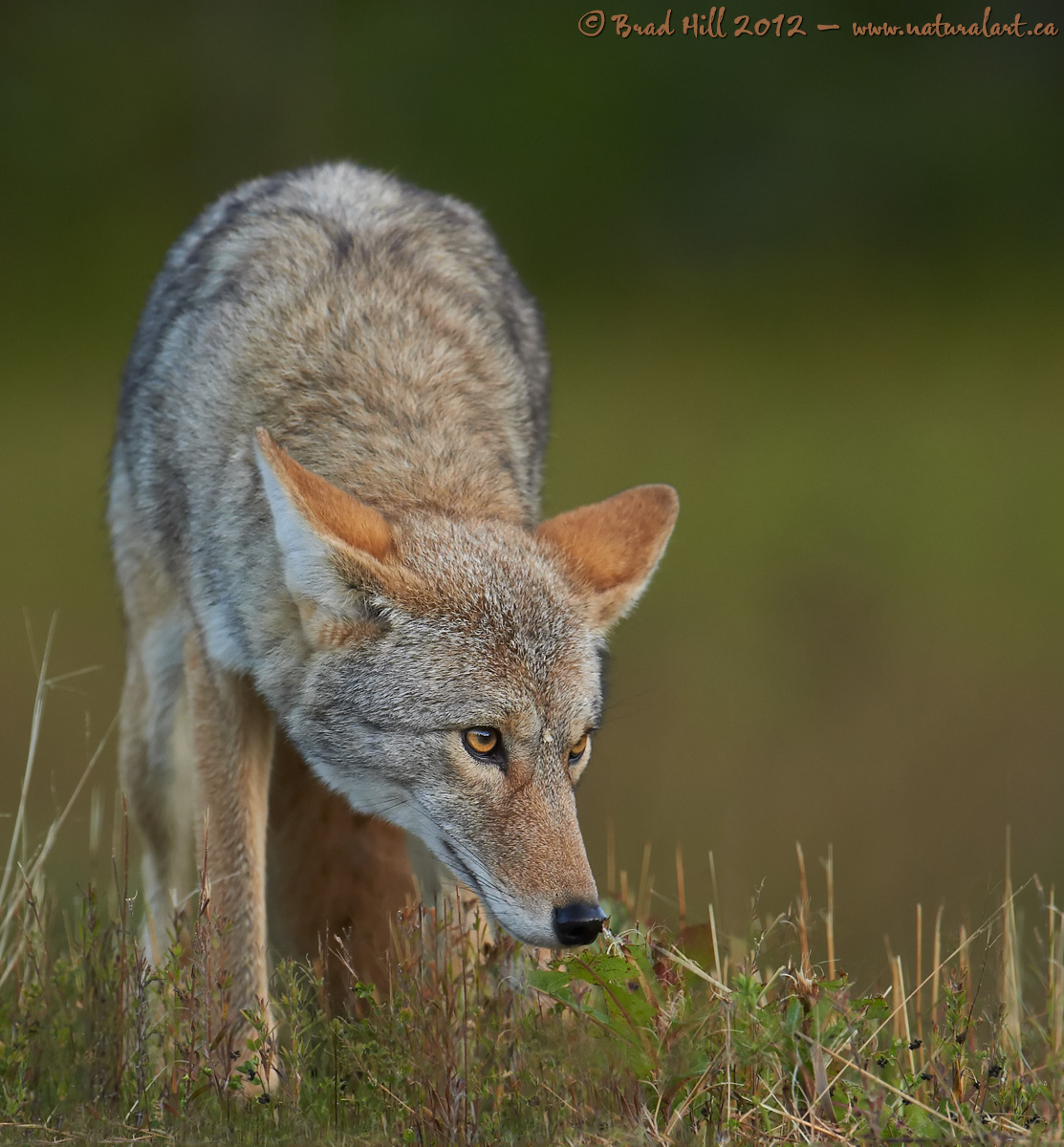
I have an admission to make: I love wild animals (and some selected not-so-wild ones too, like my two Portuguese Water Dogs!). Part of it is their sheer beauty. But even more than the aesthetics, I'm amazed and intriqued by the behaviour of wild animals. I caught this female coyote giving this look as it paused along the side of a busy highway and seemed to be deciding if the potential reward for crossing the road was worth the risk of doing so. It may be anthropomorphic, but I think it's hard to look at this photo and not think the coyote is pondering some decision...
Two further comments about this photo and the situation that lead to it. First, even though I shoot images almost daily and tend to use some pretty nice equipment, I'm still amazed at what advances in camera technology have meant to our images and what we can even consider shooting. This image was captured early in the morning, before the sun had even rose above the mountains that were surrounding me. In short, while it wasn't dark, there wasn't a whole lot of light. We saw this coyote along the edge of the highway while driving along and knew we had to move fast to get the images - there was no time to get out tripods out and set up. I had my 600mm lens on my D4 at the time and it was literally "grab camera, point, adjust a few settings, and shoot". So this image was captured while hand-holding a 600mm lens (while sitting cross-legged on the other side of the highway) at ISO 2000. Stuff you couldn't even imagine doing a few years back. Cool. And what an exciting time to be a wildlife photographer!
Second, this image was captured during a week when I had an enthusiastic wildlife photographer from The Netherlands with me for private tutoring. It's real easy to assume that the way you have always done things is the way everyone does them. But early in the week I realized that what comes "natural" to me is definitely NOT what would come "natural" to others. Early in our week together we were discussing how we actually shoot images. My client (who I call by his real name - Henk) had always focused on a subject (locking on using Single-Servo AF mode) and, once locked on the subject, then recomposed his shot. I have always composed my image first, then toggled my AF bracket to where it was needed to get the right part of the image in focus. And, I almost always use Continuous-Servo AF mode. So, the first thing Henk does is focus, while the last thing I do before capturing the image is focus. No right or wrong here - just different approaches to the same end. And, if one's subject is stationery it should make no difference at all to the final outcome. But, animals move - that's why I like focusing at the absolute last moment before I click the shutter (and that's also why I like using Continuous-Servo AF - those darned animals move, including in the last microsecond between acquiring focus and triggering the shutter). Does my approach (compose first, focus last) produce a higher percentage of sharp images than Henk's (focus first, compose last) approach? Possibly, but the reality is that I actually don't know. But it's something to think about and perhaps experiment with...
Subject: Female coyote (
Canis latrans) debating her options
Location: Kootenay National Park, BC, Canada
Camera: Nikon D4
Lens: Nikkor 600mm f4 VRII lens - hand-held. VR on and in "Normal" mode.
Exposure: 1/640s @ f5; ISO 2000. -0.33 stop compensation from matrix-metered exposure setting.
Crop: This is about 70% of full frame image
Additional details about the image (including processing details) available here:
http://www.naturalart.ca/galleries/latest/.
Comments and critiques welcomed - probably best to view the larger version prior to doing so!
BTW: In a perfect world I'd would have liked a tiny bit more room on the bottom (if, for no other reason to stem those "where's the virtual feet?" comments!!

). But if I included even one more pixel below it would have been road! C'est la vie!
Cheers...thanks for looking...
Brad

Comments
18 commentsFocusing technique is an interesting subject to me, mainly because my own methods have evolved a bit in recent years. Most important is the adoption of the back button focus, getting away from focusing with the shutter button. It makes composing and focusing so much easier (no matter what order you do it in), and is something I wish I had been aware of years ago.
Max
Interesting comments and good feedback re: using the back-focus button - another "different strokes for different folks" thing. I know many folks who swear by it, but I have to say that after trying to force myself to do it a number of times, it simply doesn't work at all for me. I think the reason is simply my preferred camera set-up - if I used the back-focus button then my thumb would have 3 major tasks - making exposure adjustments, toggling the AF bracket all over the viewfinder, AND focusing. I prefer a more equitable sharing of "the critical tasks" between my index finger and thumb without overloading one or the other!
Cheers...
Brad
The feet - neither here nor there as I too have had my fair share of "forced and unforced" amputations in the past year or so.
I am beginning to be more comfortable with it if the other elements are strong enough...e.g. here the face and eyes have all my attention.
I switched to back-focus-button-maneuvre-thingy last year and am loving it...but as you say it places more "strain" on your thumb
Along with the advantage of being able to shoot in lower light situations using higher ISO settings with digital capture, the back focus button is my next favorite option of the new camera bodies. I've been shooting this way a couple years now and would be lost without this option. Essentially you have two focus modes available in one button (one shot and continuous focus). But, for the most part when photographing a still subject I focus first then recompose and shoot.
Ken Archer
Another great one. I especially like her facial expression and the bokeah. Virtual feet are not of much importance to me. I am more of a leg man.
Best
Pat
Truly a stunning image. It's amazing what technology allows us to do these days (just a few years back that ISO 2000 would have made the image unusable). A wonderful find and perfectly captured (well - maybe a TOUCH more room on the bottom)
BTW, I too focus first and compose later and sometimes use back button. I have been shooting from manual camera days, so used to focus first. When shooting action, I prefer to focus first. There are no rights or wrongs and the best technique is the one, you are comfortable with.
Jagdeep Rajput
I find myself wishing the background wasn't so simple. While it does isolate the subject well I wonder if it wouldn't be more interesting to see a bit of the coyote's environment?
Regarding AF mode for me (underwater) it depends dramatically on what I'm shooting. For wide I tend to use a group AF mode and am usually happy to focus on whatever is closest to the camera. Fisheye lenses have lots of DOF so it doesn't have to be perfect anyway. For typical macro or mid-distance portrait shots with a "longer" lens I'm using a single point AF with AF controlled by half-pressing the shutter release. AF-C helps here if the subject or the cameraman is moving or being moved by the water. For super-macro with a dioptre I'll use a single point AF controlled by the AF-ON button or sometimes manual focus to get close and then "zone focus" by moving the whole camera in and out to get the focus perfect.
Clinton
Can't believe you shot this at ISO 2000!! Although there isn't much light, what light there is is gorgeous!