Osiris Rising + Repost
by Nicolaus Wegner
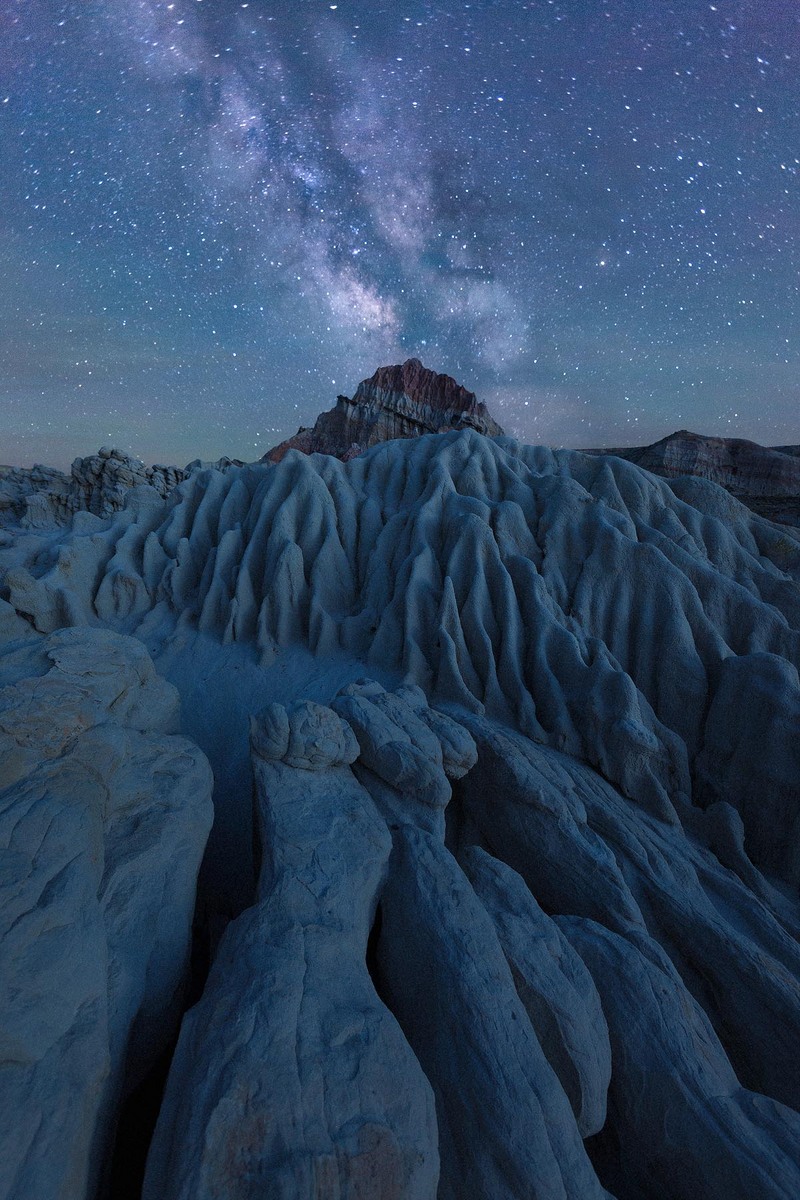
Last photobomb from me. Since things are a bit slow I don't feel terribly guilty about posting another photo here. Mods, if this is too many, please feel free to delete.
Tech: 8 images shot between 10pm and a little after midnight. Foreground is 4 exposures at ISO 400, f8, between 10 - 30 seconds. Sky is 4 exposures, manually aligned(due to rotation) and stacked at ISO 6400, f2.8, 20 seconds. I added a little bit of noise in the foreground and removed a little in the sky to balance the image out for print. Also went a bit lighter with the sky in order to make it work with the foreground. Definitely an artistic interpretation, but I do not feel it's photo art.
Would be curious if others feel this turned out? It's on the darker side, but only the darkest of the shadows have any loss in detail...very little. Best viewed in darker conditions, larger version attached.
Thanks for any feedback, technical or artistic.

Comments
29 commentsPerhaps a crop? I'd hate to lose any stars though...do you feel it hurts the image overall?
I assume the 4 exposures for the land was for extended DOF, but I'm curious as to why 4 sky exposures.
My only advice would be to crop the top and sides a bit to eliminate the flaws created by edge of lens quality limitations @ f2.8.
John, the 4 images for the foreground were for controlling the midtones, highlights, and shadows. Seems I had my camera set up at an angle that allowed me to get the entire scene in focus in a single exposure...for a change, at least the land portion at least. My reasoning behind the 4 exposures for the sky was that I shot at such a high ISO, and a single exposure would have resulted in a lot of noise. Using multiple exposures and stacking them on top of each other reduces the overall amount of noise. Only problem with doing this with a landscape type of shot at night is the stars move fairly quickly. In order to stack them properly I had to manually rotate and align them which in turn made the blend between sky and horizon even more difficult. Wasn't much fun and I almost gave up, but eventually figured it out. Can't wait till they build sensors that allow us to capture entire scenes at night with a single exposure.
How is this crop?
For stacking / averaging exposures keep in mind that with ultra wide lenses there's a lot of nonlinear distortion which means that simply rotating is not sufficient to align the stars. My guess is that's why your stars on the top and edges look a little elongated - either from the blending process, or from the initial capture (due to distortion). I got a lot more behavior like that with my 16-35 than with the Nikon 14-24.. not sure which lens you use.
If you crop the landscape in all the exposures and use good panoramic stitching software that automatically handles nonlinear distortion parameters (eg. PTGui), then you can do it all automatically. I always use that method when shooting high iso starscapes and it works quite nicely.
Used a 5dm2 and 16-35II in this shot. I'm moving to the Nikon 14-24 and new body once I get enough money saved up. From everything I've read on them, they will be the go to combo for landscapes for a few years. Don't see Canon coming out with anything that can beat that for a while.
And you can easily print single exposure from these cameras. Clients want imagery that the like and dont care about a bit of noise. Get the shot and save yourself the pixel peeping for other shots.
Sick work
aF
I understand cameras these days are more than capable of rendering certain scenes in a single exposure. However, I've yet to see that done with a foreground where there is little to no light (the moon was only a sliver and gone by 2130). Guess I'm a bit anal when it comes to noise in my prints (as well as sharpness...dynamic range...blah blah). Can't sell anything to someone if I'm not completely satisfied with it myself. I always ask if it's of a high enough quality that I would display it in my own home. If not, I usually discard it. Not very good at marketing am I?
I would have gone for ISO-3200 in the sky as I have found the noise gain from 3200 to 6400 isn't worth the tad more celestial detail you get?
Morkel, I used 6400 more or less to see if I could, and it worked great. Especially with the stacking.
Chris
Gary.