The Thinker - Ursid Version!
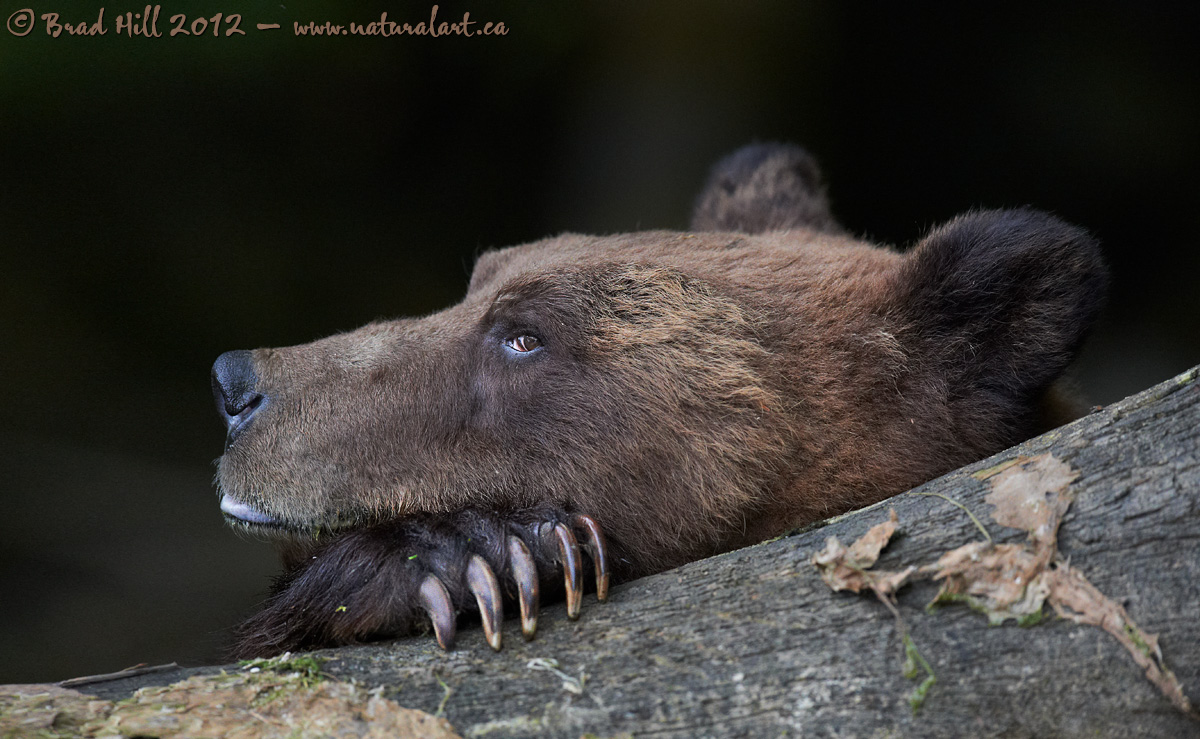
This is a "pose" (supplied by a totally wild female grizzly) that brought a smile to my face - it instantly reminded me of that famous Rodin marble sculpture enttled "The Thinker" (and all those "old style" poses corporate executives used to use for their "official" corporate publications - you know - chin on hand/fist and looking "oh so reflective, pensive, and intelligent"!). This female grizzly had been working (foraging) along the shoreline in the Khutzeymateen estuary when it decided it had had just about enough and decided to take a break. Its cubs are on the "other" side of the log - cuddled into mom's side (and the subject of another photo that I'll post soon).
While a simple shot, this one was a bit tough to pull off in the field. I was shooting with a fixed prime lens (the uber-sharp Nikkor 400mm f2.8 VR) so there were the usual "framing with a prime" issues associated with the inability to zoom in or out to produce the exact composition I wanted. In this case we were a little TOO close for my lens - the original full-framed image was so tightly framed that the bear's nose and lip were almost touching the left side of the frame. If I was using a zoom lens (like the 200-400mm f4 VR zoom) I could have just zoomed out a little. So what to do? Well, some may consider it "cheating", but I simply shot the image as seen and then during post-processing added 400 pixels to the left side of the frame using Photoshop's Content Aware Scaling feature (after increasing the canvas size by 400 pixels and "protecting" the bear from distortion). I'm comfortable with doing this sort of thing, as long as I don't introduce a new element to the image (I'll never paste in an object that wasn't part of the original scene) and as long as I openly disclose the digital adjustment (which I'm doing right now!). If you ask me, the real cheaters are those guys using those dastardly zoom lenses! Kidding! But you get my point - there are shades of grey and personal decisions to make regarding when YOU think image manipulation crosses the line that you just won't cross. It's not my place to tell you what you can and can't do with your own images.
Besides the "framing with a prime lens" issue, there were some other creative decisions I had to make in capturing this image. I wanted a real thin depth of field (DoF) to make the bear "pop" and stand out from the background. Which means "opening up" the aperture. And fortunately, in this case my creative decision was in parallel what the low-light conditions demanded - not only did I have to open up the aperture, I had to let the ISO float up WAY high - this image was shot at ISO 10,000! So not only did I get lucky that what I wanted to do was consistent with what I needed to do, but modern technology let me pull it all off - 5 years ago I simply could NOT have captured this image (or, if I did, it would have been either blurry beyond belief or with so much noise one couldn't have made out the subject!). Oh, and by the way, hand-held from a floating Zodiac!
Alert - Digitally Manipulated Image: This image clearly crosses the line from simple digital correction to digital manipulation. In this case, 400 pixels were added to the left side of the frame using Photoshop's Content Aware Scaling feature.
Subject: Pensive Grizzly (
Urus arctos) taking a break
Location: Khutzeymateen Inlet, Great Bear Rainforest, BC, Canada
Camera: Nikon D4
Lens: Nikkor 400mm f2.8 VRII lens - hand-held from floating zodiac. VR on and in "Normal" mode.
Exposure: 1/400s @ f4; ISO 10,000. -0.67 stop compensation from matrix-metered exposure setting.
Crop: This is full frame (plus more - 400 pixels added to left side of original shot using Content Aware Scaling in Photoshop).
Additional details about the image (including processing details) available here
http://www.naturalart.ca/galleries/latest/.
Comments and critiques welcomed - probably best to view the larger version prior to doing so!
Cheers...thanks for looking...
Brad

Comments
11 commentsDid you use any NR on that dark, buttery BG at all?
RE: Noise reduction on the background: Only the very mild "default" values of my raw converter (Capture One Pro). Didn't bump it up at all and none in any further post-processing. Noise characteristics of this camera at high ISO's are no better than the D3s. But what IS better is that the tonal range (dark-on-dark detail and light-on-light detail) and colour depth holds up better at the crazy ISO's, making the high ISO shots on this machine look much better (and basically not like high ISO shots!). The D800 is getting all the press, but the D4 is the really sweet one!
Cheers...
Brad
Another amazing bear image... Its seems that you are consistently capable of not only creating pristinely beautiful images, but also capturing an animal's personality (whether that personality is real or our brains' attempt at personification I can't say haha).
Aaaaaannnnnnddd ISO 10,000?!?!?!?!?
-Cam
I really like this photo, as it shows the relaxed nature that these bears spend so much of their life doing, yet it displays that ever watchful eye that is almost always present. Excellent detail and as others have stated, 10K ISO with a clean image????
Ohhhh....you tempt me to jump that fence
Congrats on another fine image and excellent info to go with it!
Thanks for your positive feedback and comments on this shot. I like this one myself but one never knows how others will react to an image!
Cam: One of my goals on this photo tour was to grab some tight portraits that conveyed bear "personality" (or the perception of personality). I have a number of presentations and exhibits coming in the next while that could (I like to think) have a positive impact on swaying some folks over to the side of conserving the Great Bear Rainforest (which is the focus of a huge environmental war right now). I think ONE component of creating compassion for wildlife is showing their unique and individual personalities (or the perception of personalities) - the layperson seems to relate better to bears and other "ferocious" wildlife when they start thinking in traits they attribute to humans - like personalities...
Cheers...
Brad