Twilight Kingdom
by Marc Adamus
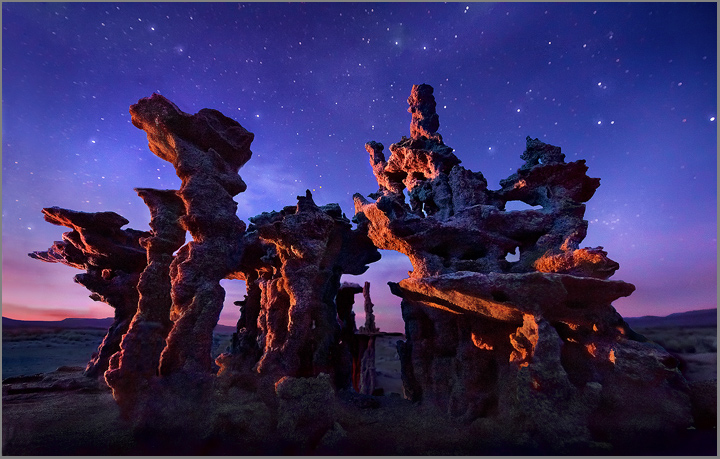
Nature photography, of course, is open to interpretation. I don't view it in the literal sense all the time and we can probably all agree it's rarely about strict documentation. I get bored with the same stuff and some of my new ideas have wandered quite far from what most people are going to find in nature, but at the same time I think these 'interpretations' of nature showcase it in a way that isolates specific characteristics that I find interesting, like the castle-like forms of these tiny Sand Tufa formations at Mono Lake.
What you are looking at here is barely one foot across and a foot high, not the 3, 5 or more feet it may appear to be. It was taken using a combination of DOF blending, light painting (I had lights set up 500ft away lending a consistent soft glow throughout an hour of exposures) and night-time ISO capabilities. My exposures for the tufa were all at 14mm and roughly 5 minutes at f/8, ISO 1600 each. The sky was taken slightly out of focus on purpose to increase the size of the stars and diffuse them for artistic effect.
Why go to all this trouble? Well, the few visitors to Mono who realize these are here are usually captivated by their finite and complex forms, but traditional photography has proved somewhat illusive in my opinion (my own attempts included). Despite the small physical size of some of these formations, I see something that is more grand in this more artistic version and that's what I wanted. Hopefully you do too, but I'd sure like to hear any opinions on it.
NOTE: PLEASE, PLEASE, PLEASE BE CAREFUL AROUND THESE IF YOU GO! They are VERY fragile and the park service does not sign where they are for good reason!

Comments
32 commentsExceptionally creative, artistic, and beautiful.
Congratulations on a great story and sweet capture.
aF
Terrific vision and even greater ingenuity in execution and processing. Putting the horizon and sky as the bg have made this formation looks hugh and grand!
When I started photography, I was quite certain that the image must be exactly the same as in nature in the literal sense. However, the longer I pursue photography, the more I am convinced that it is a serious art form and a truly great photographer is able to transform what he sees in nature and captivate the viewing public with his images which you have done so well here. Congrats.
Question;
With doing the "out of focus" technique to the stars for the bigger luminous effect. I can see this works well if viewing at this size image, but what if you were to print a large version of this? would the stars not be to much out of focus? Also, would breathing on the lens do a better job for this effect?
I took a night shot picture out at the Hobgoblins also with partial clouds, and focused for the foreground at F2.8, and forgot to adjust focus for the sky, and the image looks great printed/viewed small, but loses appeal zoomed in.
your thoughts?
One question: what kind of lights did you use? 500 feet is quite a distance.
For what's it worth, this was one of my 3 faves on your most recent gallery. The light painting looks totally natural and the composition is outstanding. On closer examination, the tufa formations seem to be a little magenta heavy - slightly lessening the natural appearance of the image, but that's just my two cents. Overall, it's a cross between fantasy and reality and I personally enjoy the end result.
Your "New Work" gallery on your website is outstanding
Those pacific oil abstracts are phenomenal
And to the child who sent me anonymous hate mail after my comments on that previous shot by Marc: Grow up! Anyone is qualified to critique photos. If you disagree with a critique man (or woman) up and sign your name to your disagreement.
Sandy
Setting up the lighting so far away worked really well - consistent and soft throughout the formations, as you said. This is probably my favorite shot I've ever seen from Mono Lake - a much more dyanamic and creative composition than most from the location. I love the glow and softness of the stars where they diffuse through those thin clouds, but I'm not sure how much I like the out-of-focus technique when the stars are streaking. It looks like they're streaking a bit toward the edges of the frame, and I'm not sure if it's just the stretching from a 14mm rectilinear lens, or that it was a bit long of an exposure, or if it's just coma from the 14-24. At any rate, that's just a tiny nitpick (and obviously a technological/physical limitation) in an outstanding image.