Metridium farcimen
by Clinton Bauder
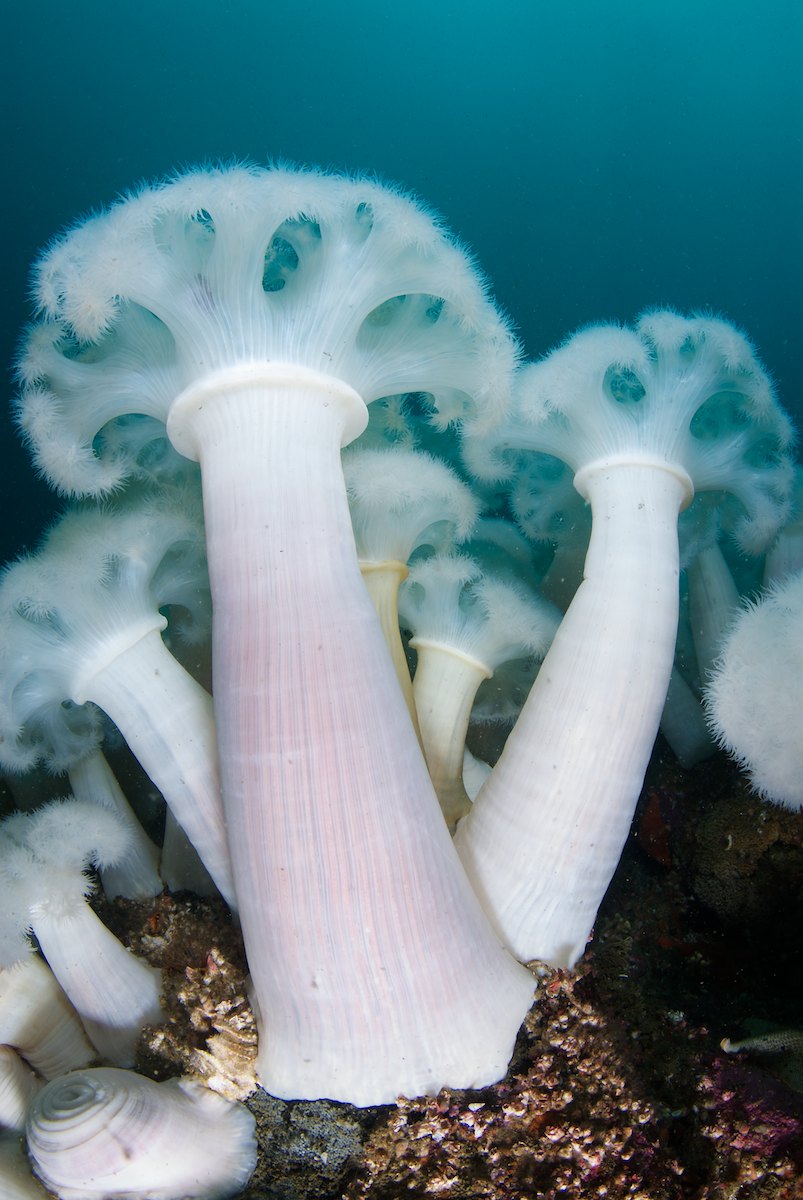
These are Giant Plumose Anemones - Metridium farcimen. They are fairly common along the west coast of North America. This shot was taken at the site of one of my first dives, and the one which really cemented my love of diving; Hopkins Deep Reef in Monterey CA. The reef is just offshore of the Monterey Bay Aquarium and the anemones are in about 65 feet of water. The anemones are about 18" tall.
Shooting these anemones is tougher than it looks. They are quite reflective and it's easy to blow out the highlights. Also, if you get the exposure wrong you can easily lose the interesting texture and details on the stalks. I'd stopped down here mostly because my strobes are fully manual and it's easier to control the exposure with aperture and shutter speed than by playing with the strobes. I don't have to take my hands off the housing to use the camera's controls. Anyway in this case I think the DOF helps. The dome port was only inches from the anemone and at that range even a very wide lens has limited DOF. The slow shutter was to get some background light and since the strobes stop the action and there is nothing in the background the slow speed doesn't matter.
Lighting is tricky since you're so close to the subjects. Evenly lighting the scene and avoiding backscatter takes some trial and error.
Interestingly I took a whole series of these and all of them except for this shot were really meh. This one popped. I was a bit closer and shooting from a lower angle than for the others. Just a few inches helped both the exposure and the composition. Closer meant a better exposure on the anemones, up meant getting more of the detail in the plumes and lightened the background considerably.
It could be argued that the composition is a bit too tight but if I was further away I'd have more partial anemones around the main 2 subjects. Curious as to what people think?
Nikon D200, Tokina 10-17 FE at 17mm, 2 Sea and Sea YS350 strobes at 1/2 power.
ISO 320, f/16, 1/15th
Some light backscatter removal and exposure compensation to make the image a touch darker.

Comments
4 commentsSandy
I've seen these anemones on more northern portions of the west coast and they are quite striking - both in "real life" and in this image. Overall I quite like this and totally appreciate all the technical challenges of capturing this image. My first thought (before reading your commentary) was that the composition was a bit tight on the sides, but I problem of going wider and then chopping off adjacent anemones. Always compromises, eh?
One thing I noticed (more prominent on the larger version) is the blue "halo" on the top edge of both anemones. There could be several possible causes for this (and I doubt it's "natural", but don't know that for a fact), but it almost looks like the anemones were lightened - or the background darkened - during post processing (nothing wrong with that, of course) but the fine edges weren't "picked up" by the lightening? I don't know anything about your workflow or the tools you use, but about the only way I know of dealing with this kind of situation (other than spending tons of time making precise selections) is through the use of luminosity masks in Photoshop.
Anyway...interesting image and a very different form of "wildlife" captured in this one - thanks for sharing it.
Cheers...
Brad
Thanks for the comments. I actually haven't done any selective adjustments other than some spot removal. The halo effect is there in the the original image. It may be that since the small tentacles are nearly translucent that there is background light showing through whereas the parts further from the edge aren't backlit.
Clinton