Dwarfed
by John Launstein
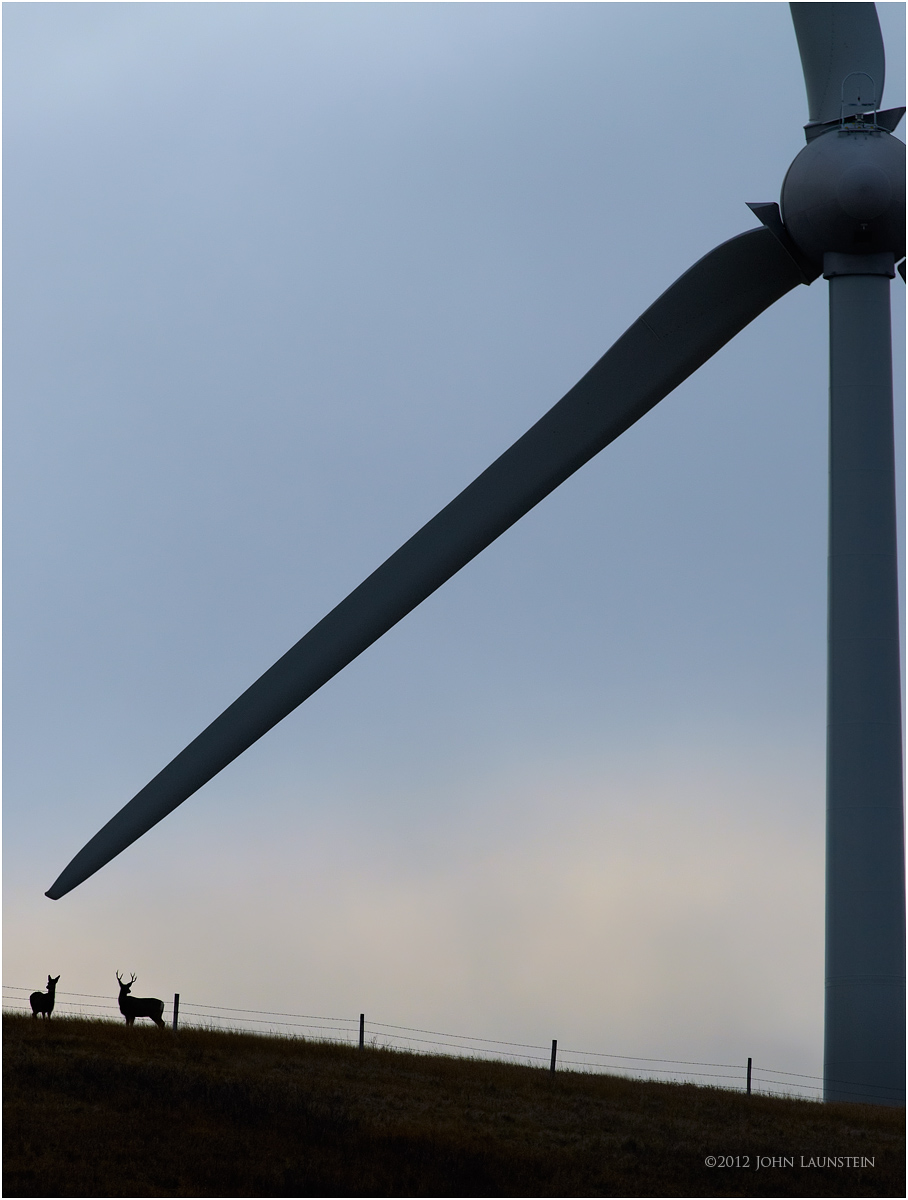
Hi All! My oldest two daughters (fellow NPN-ers Jenaya and Marlise) decided to explore some of backroads just north of our home the other evening (hoping for some cooperative critters, of course). After six years of living here, I realized I always head straight to the mountains and have left much of the area north and east of us unexplored. We got in behind some of the hundreds of wind turbines that rise from the farmland and hills around us, and I looked back at this one in time to see a herd of mule deer grazing their way across the ridge.
The fact that several of the bucks in the herd were fairly decent in size yet remained utterly dwarfed by the turbine was too striking to ignore. In fact, we pulled over and were just talking about how the deer around here have to live in the shadows of these huge metal "trees" when I realized I should grab a few pictures instead of just talking about how dramatic the scene was!
This image as presented is more a representation of what I hoped to capture than what I managed to capture in a single frame...it is a blend of two exposures (the prop angle and deer poses never quite worked out in a single exposure) and does have some cloning work and adjustments to tone and contrast. It is virtually full-frame (I lost a smidgen off the sides after needing to rotate this slightly to improve the perceived angle).
I would love to have a little more room to the left of the deer and I'm sure that it would be fairly easy to add canvas, but something about keeping the comp tight like this seemed to enhance the implications of the image.
Your comments, critiques and suggestions are most welcome!
Here's the scoop:
Nikon D7000
Nikkor AF-S 300mm f/4 IF-ED w/ TC-14EII
ISO 500
1/400sec @ f/10
photographed from truck window
What's been done in post-processing:
- combined two nearly-identical images taken within seconds of each other: one selected for the prop position, the other for the pose of the deer.
- cloned out three deer whose heads broke the skyline and distracted from the impact of the image
- adjusted curves, tonality and slight adjustment to levels

Comments
2 commentsThe subtle colors give this an authentic, "unphotoshopped" look, which can be hazardous in the journalistic world. Your message here about the details of the processing and "construction" of this image is excellenty. It is a message that must be made crystal clear to editors, authors, publishers and everyone else responsible for publication. Staff firings over altered images have been in the news in recent years, but the perception of dishonest journalism due to altered photographs is nothing new. When I was a contributing magazine editor over 30 years ago (the film era) I vividly remember the outrage of the magazine editor when someone blew the whistle on a "faked" cover photo -- undisclosed by the photog -- and the editor had to print an apology. I never saw another photo by that guy in print. Due to such incidents, and similar scandals in recent photo contests, we must be more diligent than ever to make sure that altered images are clearly labeled as such.
Sandy