Hungry Tigers
by Wayne Jones
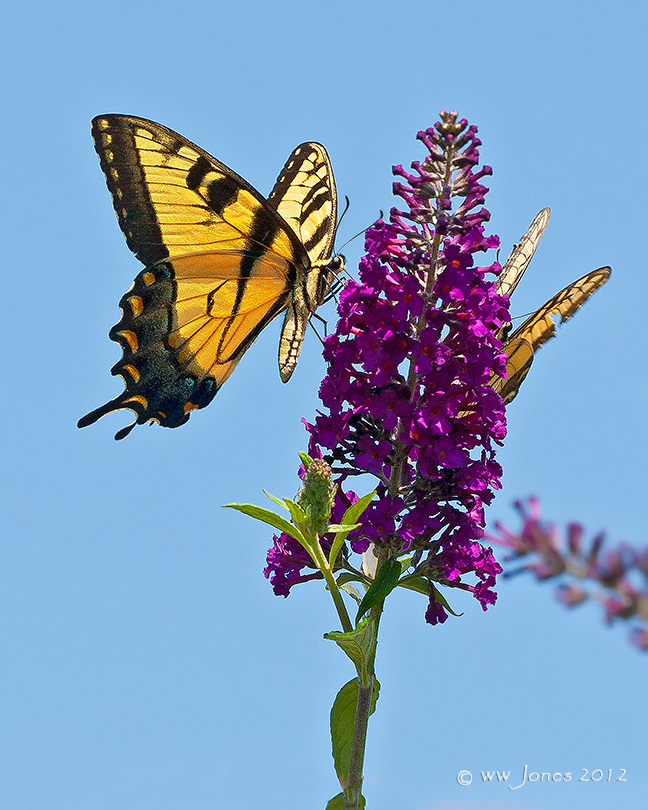
Sometimes butterflies seem to follow each other, crowding around food sources. This is the Eastern Tiger Swallowtail, Papilio glaucus. (Two very similar species in other parts of North America are the Western and Canadian Tiger Swallowtails. UPDATE: I just learned that the Appalachian Tiger Swallowtail is now also recognized as a separate species.)
I recently dug this up from 2008 when the agency I used to work for asked for images for a book, and realized I never posted any shots of this common species on NPN. I may have dedided not to post these before because of some distracting out-of-focus flowers in the scene, but three and a half years later, it was easy to eliminate them in CS5, so I "erased" most of the distractions for the NPN version with content-aware fill. For scientific publications and many contests, edits like cloning are frowned upon, so the agency got the original, complete with fuzzy flowers.
Canon 20D
Sigma 150 mm. Macro
1/640 sec. @ f/10; ISO 800

Comments
10 commentsSCOTT: I actually cleaned up only the OOF vegetation that I didn't like because of the colors or placement in the foreground. I actually like the colorful butterfly bush flowers in the background, and wish there were more. But that does not mean I considered adding more flowers. I guess I still have the "documentary" mindset of a nature illustrator, rather than the "artistic" mindset. My images typically appeared in conservation-related publications that did not want altered images. But I am learning since I retired and joined NPN. This is one of the rare images that I might consider framing (art rather than illustration), so I will try erasing that OOF flower head to see how it looks.
NANCY: Thanks for the hint about BAMONA. Have not visited this excellent site in years, so I took another look tonight, and discovered that I left out another tiger swallow that I should have mentioned as a look-alike species (P. appalachiensis, which was apparently split off decades after I did any entomology work). I'll add that to the narrative, just in case this ends up in some somebody's search for species.
As long as you're cloning out OOF stuff, I'd continue one step more and clone out the remaining OOF flower.
Congrats on a nice WP!
Sandy
Albert Darmo
Canada