Gouldian Finch
by Steve Balke
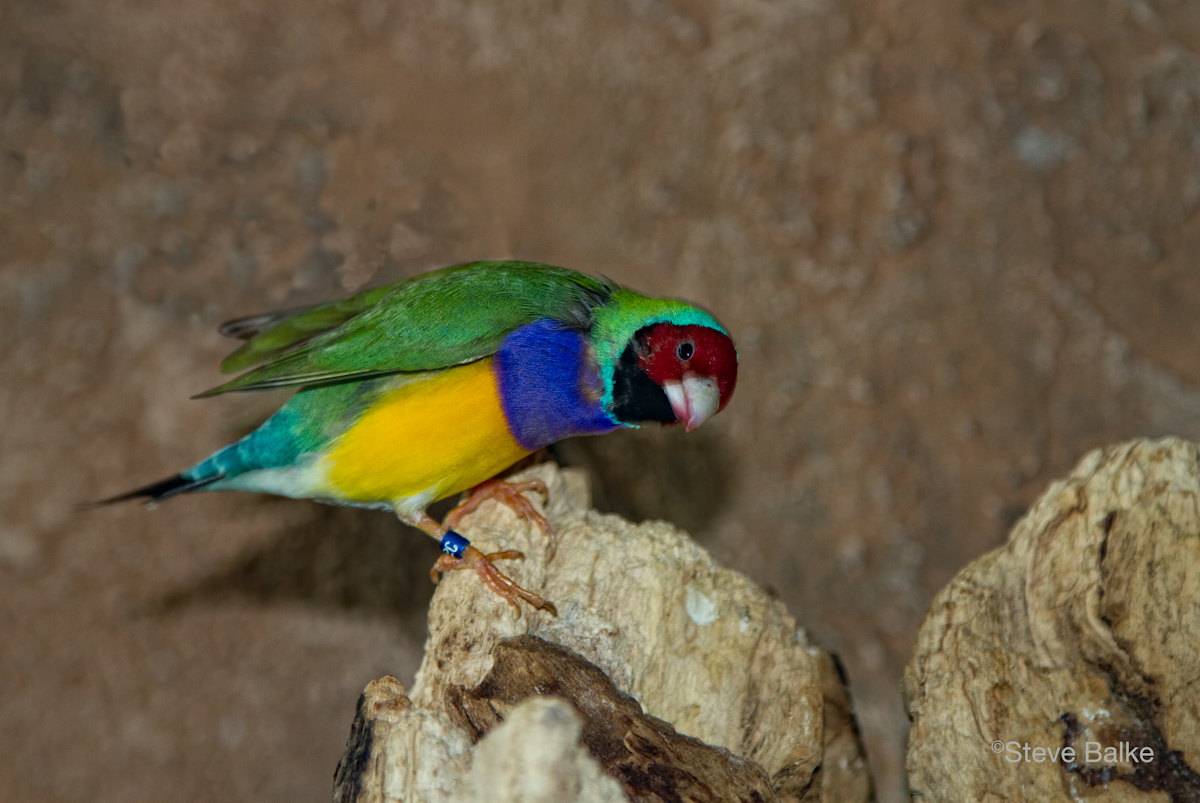
Gouldian Finch (Erythrura gouldiae)
This very colorful little bird is a native of Australia. Although now listed as "endangered in the wild" it is very widely held in captivity. Many interesting details about this bird, including color variants are at:
http://en.wikipedia.org/wiki/Gouldian_Finch
The photo was taken at Bird Kingdom, Niagara Falls, Canada by my daughter, Michelle (she assigned me the copyright so I can post it here). When we visited, it was a very cloudy dark day so we were both obliged to (reluctantly) use flash for almost all shots. There were so many interesting and colorful birds. A few were in cages and some were in the "Small Aviary". However, most were in a very large room (the "Main Aviary") where they could very freely fly. It's advertised as the "world's largest free flying indoor aviary". Our impression was that all the birds were thriving (unlike captive birds I have seen in other places over the years). Although we would love to see these birds in the wild, chances of that are pretty slim. So, this was a wonderful practical alternative. More details are at:
http://www.birdkingdom.ca/
Of all the images we obtained I considered this one particularly appealing. I like the pose of the bird and especially the colors. It may have been even better to obtain more DOF. However, it's sharp where it counts (all of my images of this bird have OOF beaks). As you can see from the low focal length of the lens used, the birds often approached quite close to us (a refreshing change from the wild!). I did clone out a distracting mark on the wall in the bg.
All comments most welcome.
Canon 7D, EF 24-105mm f/4Lq IS, in-camera flash, hand held: ISO 500, 98 mm, 1/60 s, f/4.0, 0 EV, 13.8 MP (77% of 17.9 MP full frame). NR, exposure adjustment, sharpening.

Comments
6 commentsdo you know whether there's a cause and effect relationship reflected in those two facts (as with many parrots and other colorful birds)?
definitely a spectacular bird, I agree that a little more dof would have been nice.
Keith, your statements about the image being evidently a flash shot and the very sound advice about flash compensation made me think about how best to post process an image to erase over flashing effects after the fact. With software such as CS5 and particularly Viveza 2 in CS5, we have plenty of power over exposure. As I look at this image now I could easily remove the shadow for example. However, absence of a shadow would be strange. The shadow could as easily come from sunlight too. I'd enjoy seeing any more comments on this aspect.
Brian, your comment about a possible correlation between the bird's endangered status and its popularity as a pet led me to search out more info on this. I discovered the Gouldian Finch Recovery Project at:
http://mygouldianaviary.tripod.com/sitebuildercontent/sitebuilderfiles/gouldianrecovery.pdf
Discovering the causes of the species decline in the wild and remedying the situation are explicit objectives of the project. From this article it appears that trapping is not the major cause for the decline. Legal trapping ceased twenty years ago but the decline continues. More likely it is due to destruction of seed serving as food for the species by grazing animals and forest fires. Starved, weakened, birds then fall victim to parasites and disease. Please see the article for more details.
VERY cool that your daughter took the shot! I hope for your sake she gets into your hobby! I have a young son, and I admit I beam whenever I hear him get excited over a bird he sees, or when he can identify what kind they are.
Steve: Yes, you could remove the shadow, but I don't think it would solve the overall problem. You noted that the shadow could have come from the sun... Yes, but at the angle of the shadow from the bird, the light quality would have been very different. It isn't just the shadow that provides the look of an on camera flash, it is the quality of light in the entire image. The great thing on this image is you could go back and try another series to see what different results you might get.