Trees...
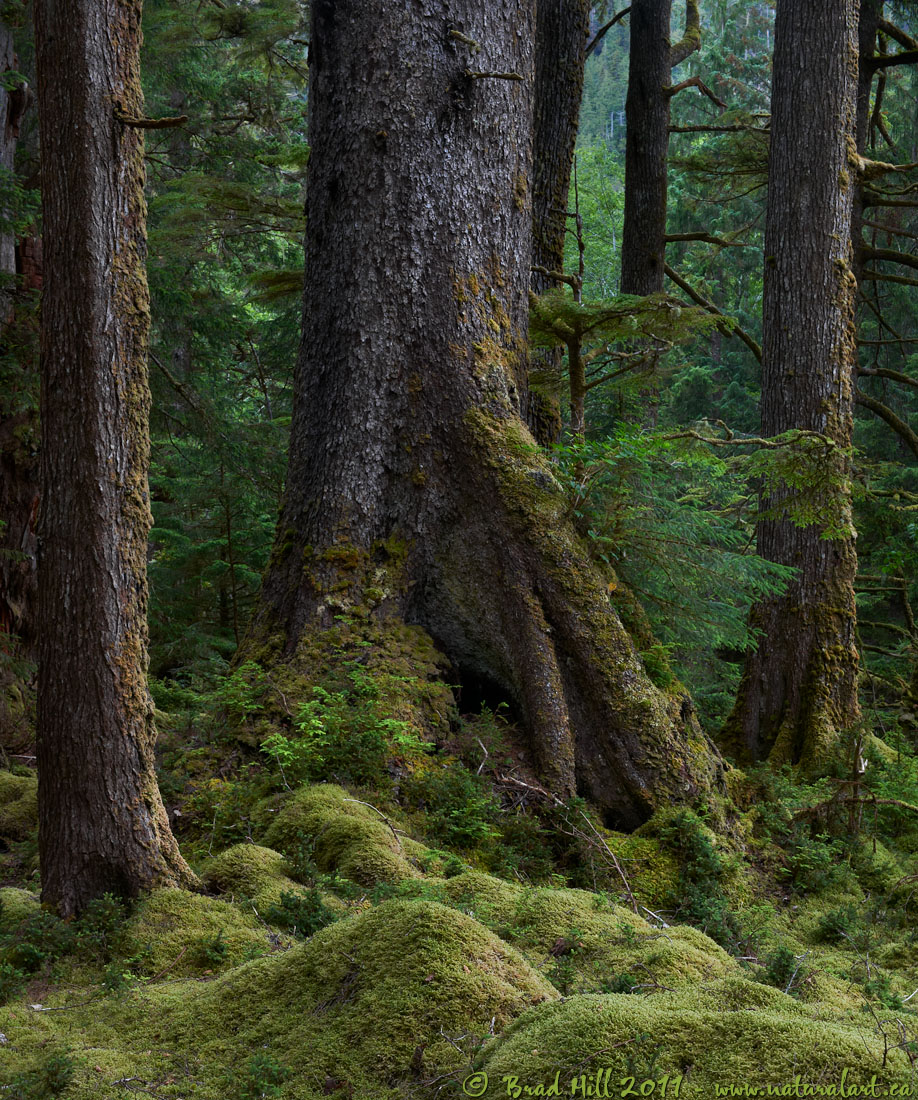
I considered calling this image "Can't see the Forest for the Trees" but thought that might be a little too cliche (and it certainly was over the character limit!), so I went simple with the title. This image may be a tad mundane for some, but I prefer to think of it as subtle and nuanced (kind of an "emperor's clothes" thing - so if you think it's too simple, well...

).
While I AM a biologist (my formal training was in behavioural ecology and my research was on interspecific territoriality in two species of songbirds) as a wildlife photographer I often tend to think of trees in functional terms. You know...primarily as props or backgrounds or even perches in my images of birds or mammals. But on a trip to Gwaii Haanas National Park and Marine Reserve during the summer of 2011 I was struck by the beauty of the trees themselves. It's tremendously hard to NOT be awe-struck by the trees when wandering around in an old-growth rainforest! Yet treating them as subjects themselves - and figuring out a way to make them photographically (and even "graphically") interesting - was quite a stretch for this wildlife photographer!
I liked the nuanced and subtle lighting striking these trees (overcast sky but obviously still with a degree of directionality to it) and the thick, luxuriant moss "carpet" added to the ambience of the scene (why that is there versus an understory is a VERY long story...but involves the introduction of deer to the islands in the 1920's).
Anyway...thought I'd share the forest with you...
Subject: Trees in temperate rainforest
Location: Burnaby Island, Gwaii Haanas National Park and National Marine Reserve, Haida Gwaii (Queen Charlotte Islands), BC, Canada
Camera: Nikon D3s
Lens: Nikkor 24-70mm f2.8 lens at 50mm with B&W circular polarizing filter. Supported on carbon fibre Gitzo GT2541EX tripod and AcraTech Ultimate ballhead. Cable release and mirror-up release mode used.
Exposure: 0.4 sec at f11. ISO 200. No compensation from matrix metered exposure.
Crop: Mminor - this is about 85% of full-frame image
All the gory details about the image (probably a lot more than anyone would care to know!) can be found here:
http://www.naturalart.ca/galleries/latest/.
Comments and critiques welcomed - probably best to view the larger version prior to doing so...
Cheers...thanks for looking...
Brad
PS: I CAN fill you in on the moss carpet/deer thing, but will wait until someone actually asks about it (to avoid boring others to death).

Comments
11 commentsHeading out for a walk in the woods (not these woods!) so I thought I better reply right away. You know, I thought about the warming and applied a graduated warming filter (adjustment layer) which excluded the moss carpet...and the more I looked at it the less I liked it. I ended up yanking it off just before uploading the image. But given I was debating it, and you mentioned it, the idea likely has good merit. May have to re-visit the WB on the raw file...(better control there than with a warming filter).
Thanks for the feedback...
Brad
Thanks...
No deer body prints here, but if it wasn't for the deer this scene would NOT have been possible (I would have been tangled in an understory you'd need a machete to get thru). The Haida Gwaii (Queen Charlotte Islands) have many similarities to the Galapagos - in fact sometimes the archipelago is even referred to as the "Galapagos of the North". Unfortunately, one of the similarities is the impact that introduced species have had. Deer are not native to the islands - they were introduced in about 1923 (coincidentally almost at the same time the Dawson's Caribou went extinct on the islands). Only 23 Sitka Black-tailed deer (a mule deer sub-species) were introduced - primarily so the locals (both Haida and non-natives) would have a food source they could hunt. But...with no natural predators, the population went through uncontrolled growth - today there are over 500,000 on the archipelago. And, they eat everything in sight - including virtually everything that USED to be the understory. So...there are almost no bushes, no re-generation of several species of trees (including Western Red Cedar), and many species of songbirds have declined dramatically in numbers (or are gone altogether). So ecologically it's close to a disaster (if it was up to me I'd probably "accidentally on-purpose" drop a few wolves onto one of the islands!!).
Paradoxically, the total lack of understory in many places makes for a BEAUTIFUL park-like setting to walk thru and it definitely adds to it's photographic appeal. So when I'm wearing my ecologist's hat the impact of the deer makes me see red (at the ignorance of mankind). But, admittedly, when I have my photographer's hat on (baseball cap turned backwards!) and I'm carrying my camera gear I end up smiling a lot. Talk about being being pulled in two directions philosophically!
Cheers...
Brad
Chris
Ed
Michael