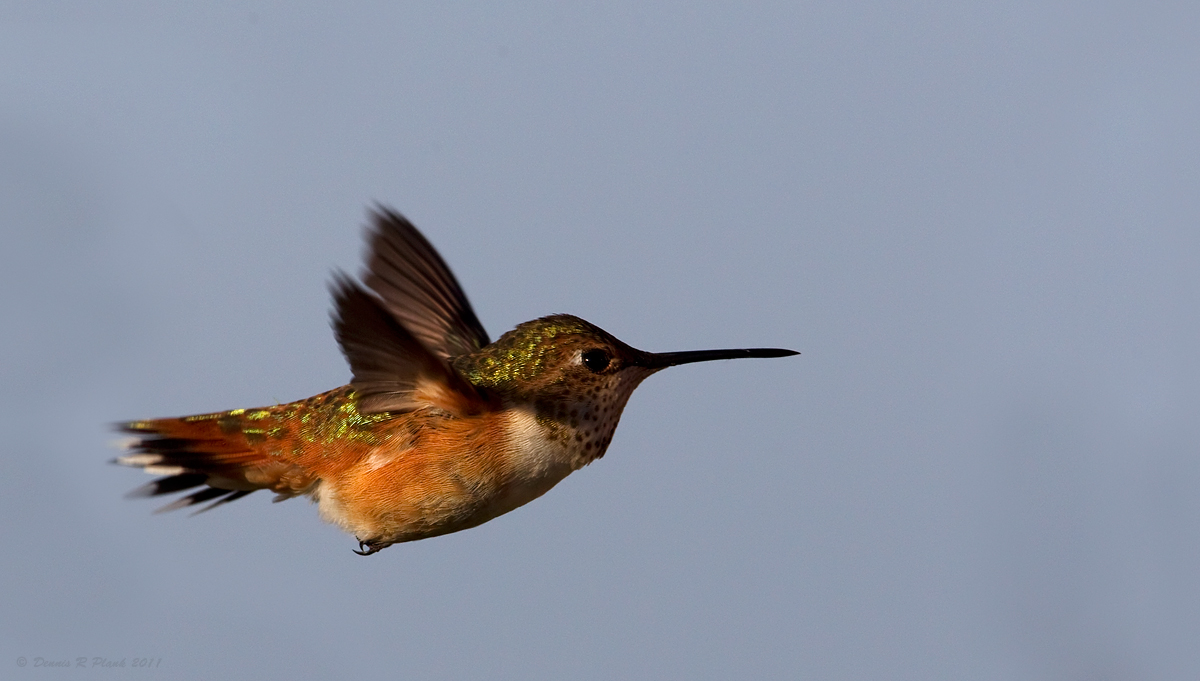
Fem. Rufous Hummingbird
by Dennis Plank
After posting the shots of the male a while back, we've had a spate of truly miserable weather. However, we got a bit of sun over the weekend and I was able to get a few shots of this female. I think this is the first image I've ever gotten of one in a more or less horizontal flight pose. I do wish she'd angled herself to the light a bit better. What isn't shown is the feeder. She had backed off like they often do and was just re-approaching it.
1DMkIV, 500mm f4 + 1.4TC, Black Widow on Gitzo legs, f9.0, 1/2500, Av mode with -2/3 compensation, iso 500. Cropped from 17 to 6.2MP, normal processing in CS4 with minimal sharpening. I didn't really need the negative compensation on the exposure, but I had just taken some shots of a breast on tree swallow perched above the feeder and hadn't wanted to blow the whites.
I always appreciate your comments and criticisms.
Thanks for looking,

Comments
13 commentsHope to see more.
I do fall in with the school of thought that a touch of lighting in PP on the face would almost certainly enhance this already wonderful image all the more.
Regarding the tail. My experience is that hummingbirds move their tails almost as much and as fast as their wings in many situations. I'm not exactly sure what it was doing in this case, but she was in the middle of a change of posture and they use their tails a lot in that effort.Also, I think it was spread at the time, so the far half may have some dof blur even at f9 (she was just about minimum focus distance).
Ken Archer
P.S.: The question of motion blur on the near wing even at 1/2500 s (0.0004 s) got me looking around on the Internet for an estimate of the beats/s of a humming bird wing: could be about 200 times a second (0.005 s for one beat) but I saw lower estimates too. At first I was surprised that it was so slow compared to your shutter speed. However, then I realized: the reason for the visible motion blur is that motion blur doesn't require one whole beat.