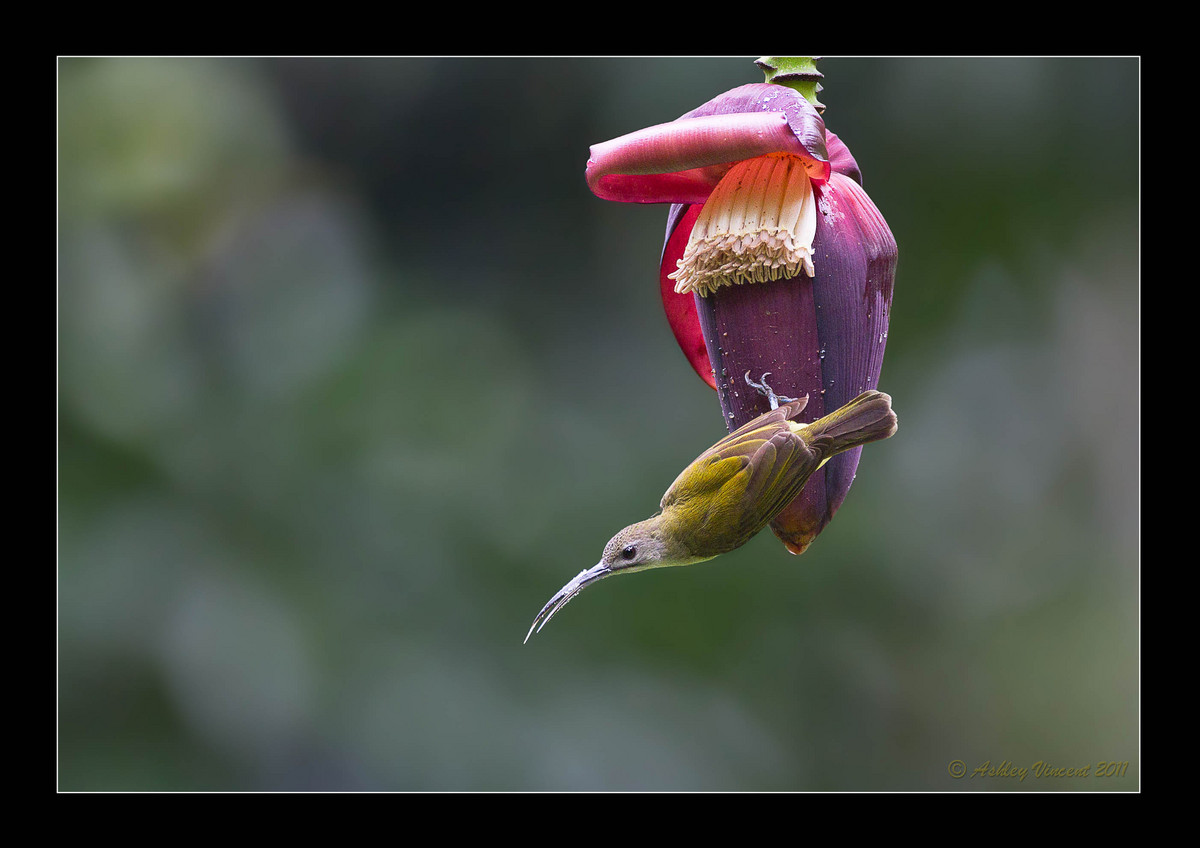
Little Spiderhunter
by Ashley Vincent
Canon EOS 7D, EF 500mm f/4L IS USM, Shutter Priority, f/4 (1/500 sec), ISO 640, Tripod, JPG from RAW, Cropped About 40% from Full Frame
Been concentrating my time recently on working with our new Canon printer, hence the reason I haven't posted up any photos these past few days.
Although I still have a fair number of other bird species I like to show you taken on my last trip to Malaysia, I thought it better to show you some more little beauties I've encountered here in Thailand, lest you start thinking we're not so well blessed with Nature's jewels here as they are down there ;^)
Previously I've shown you pictures of Grey-Breasted Spiderhunters I came across on the Malay Peninsular, this one, however, is aptly named the Little Spiderhunter, which I came across one morning while out on a walk in Khao Khitchakut National Park, located in Chantaburi, Eastern Thailand, a few hours from where we live.
Although I'm no expert when it comes to flora (or in truth even fauna!), I recognise this maroon-petaled flower as belonging to a plantain plant, which grows fairly low to the ground and also bares fruit - closer to the main stem - similar in shape to the banana, but much smaller and far less sweet.
What first attracted my attention though was a shrill high-pitched continuous tweet in the undergrowth. Moving forward cautiously in the direction of this sound my eyes soon locked onto this tiny bird zipping back and forth until it decided to latch onto this particular flower.
This was a first for me; not only in seeing a new species of Spiderhunter, but fully appreciating Nature's clever design for their extremely slender beaks.
I was absolutely delighted with this encounter for a number of reasons, one of which was that I was able to get relatively close (for a change!) to an exquisite little bird so close to the ground that I was almost guaranteed excellent eye level contact; I was ecstatic with joy looking through my viewfinder and firing off numerous frames …... until I pry my face off the back of the camera to take a quick peek at the LCD and realised with my setting on aperture priority every image resulted in a distressingly blurred effect ;^.
The light conditions in the undergrowth was far too dark to allow a fast enough shutter speed, and raising the ISO much beyond 500 on the 7D causes serious noise issues. So I quickly switched to shutter priority, knowing from experience that this would result in a much darker exposure but would at least allow me the best opportunity to acquire some sharp detail. Adding exposure and light to such an image in PP doesn't always work out well, but in a situation like this without a flash, IMO flicking from aperture to shutter priority is about the only way you stand a chance of capturing a decent image.
And in this case (thanks to what I learned from my previous mistake-turned-valuable-lesson with the Stork-Billed Kingfisher on the river!) I think the result came out rather well ;^)
In case you're wondering BTW, I do indeed own a good Canon flash (Speedlite 580EX II), but with so many other things I've been endeavouring to learn over the past six months, I just haven't gotten around to figuring out how to best use this piece of equipment, though I know I really ought to make the time for it.
Another of my long-winded commentaries I know, but hopefully it gives the image and setting a little more context. Happy as I am with this shot, I'll be just as happy to receive critique, comments and suggestions that may open my mind still further. Thanks for your time, attention and of course for viewing :^)

Comments
19 commentsIf you are metering the same scene in the same light, whether you are in aperture priority or shutter priority, the brightness of the exposure should be identical.
According to my Birds of SE Asia guide book, this species is the smallest at 16cm in total length.
Now that you mention it, the bill does appear a tad bright, something I'll attempt to adjust before going to print, thanks for the observation my friend ;^)
While admittedly I'm working more with my logic rather than a full understanding of how cameras operate, let me try and clarify what I meant re opting for shutter priority in a situation like this.
Although I didn't keep any of the first blurred shots I took, so I can't tell you exactly how slow the shutter speed was while I was still shooting in aperture priority, I seem to recall it being set somewhere around 1/20 - 1/40, which was nowhere near fast enough to freeze this constantly moving subject.
I tried various speeds in shutter priority working my way down from 1/1000 to 1/500 and my guess is that at these higher speeds far less light is hitting the sensor resulting in a much darker image.
Reading what you wrote a second time, I think I'm better understanding what you mean though. You're suggesting that if I'd pushed the exposure in the camera higher, say by 2 or even 3 full stops, this might have allowed me a faster shutter speed while still in aperture priority, is that what you meant?
Although I forgot to add this in the shooting data above, I had in fact pushed the exposure up to +2/3 in the camera, but it didn't seem to help much at all by way of offering more shutter speed, and having had poor results in the past vamping up the exposure compensation to 2 or 3 full stops tends to deter me from trying this more, especially seeing as I've had much greater success with switching to shutter priority.
That said, I'm aware that shooting in shutter priority is quite unusual for wildlife photographers, which suggests that it's more likely that I'm doing something wrong rather than I've stumbled on a mode and method that will revolutionize wildlife photography from here on out - LOL ;^)
Seriously, any further advice or suggestions related to this issue would be much appreciated, as so many of my photographic opportunities seem to be found in low light settings.
Brian is certainly right with his statement about metering in aperture or shutter priority. In fact what you did by selecting shutter priority is forcing the camera to underexpose as the lens was already wide open and thus the camera could not choose a wider aperture to gather more light to make a correctly metered exposure.
While I agree this would also make for a pleasing vertical composition, reason why I liked this one horizontally was that most of the many photos I captured of these subjects (there were a couple, probably female and a male) I shot in portrait, i.e. I was more than happy to find one among them where a landscape format worked just as pleasing to my eye ;^)
Most likely the next one I post up here will be one of those portraits, so there'll be something for everyone ;^)
Vincent: Thanks for clarifying this again for me :^) I think I'm still a fair way off feeling comfortable going fully manual, but this all serves well as a reminder that I need to experiment with further practice :^)
cheers
Rob
What is a spiderhunter doing on a plantain flower
Govind: To date I've been lucky enough to see and photograph four different species of Spiderhunter (although only two species well enough for me to want to show them to anyone!), and pretty much all of them seemed much more interested in the nectar of flowers than spiders, which leads me to think their name is a bit of a misnomer :^. That said, I still live in hope that one day I'll capture a wonderful shot of one tossing a spider in the air just before it falls down the hatch ;^)
The next shot I'll post up will better show how perfectly designed those bills of their are :^)
regarding this,
it would be just the opposite. if you're in aperture priority and have selected a given aperture and ISO, the only variable that the camera can choose to create the right exposure is shutter speed. if you're using positive exposure compensation (letting more light into the camera) you're selecting for a slower shutter speed, not faster.
Although I never thought of it this way before, what you say about using positive exposure compensation (letting more light into the camera) you're selecting for a slower shutter speed, not faster, does makes sense to me. Next time I'm out I will adjust accordingly :^)