Words Not Required
This one is a monitor tester!!
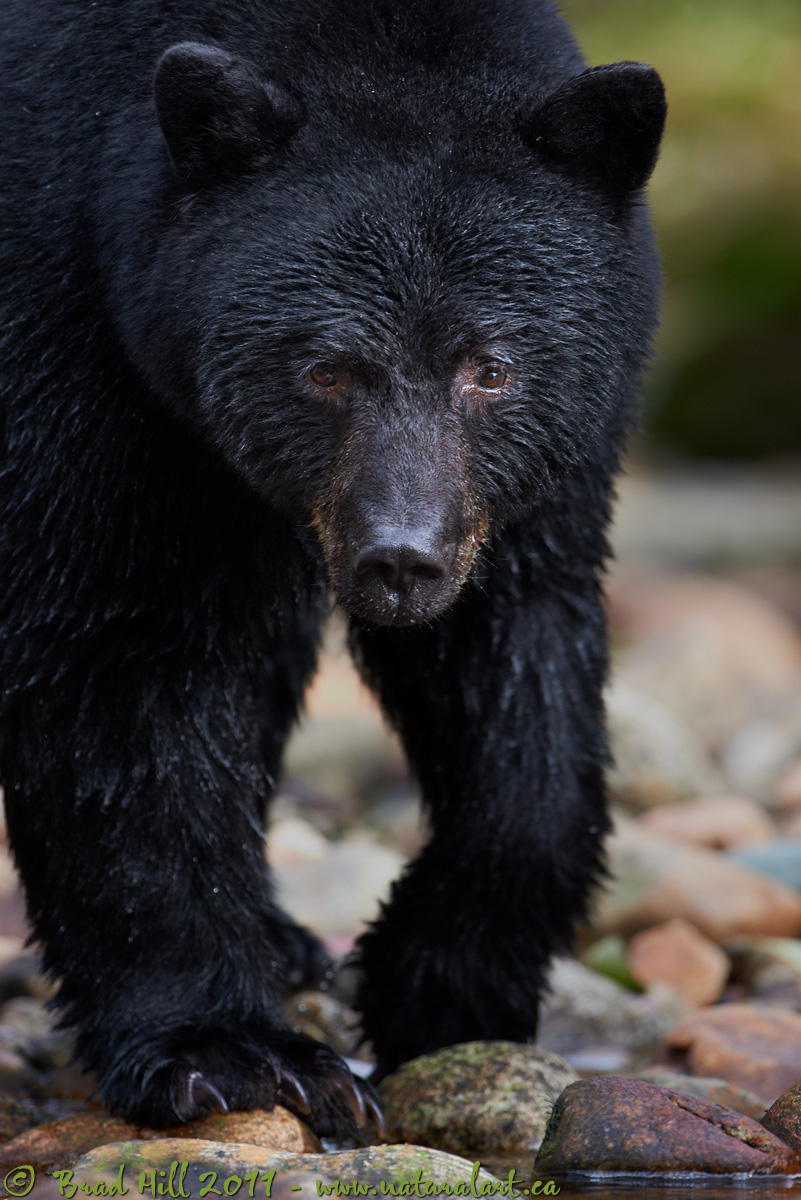
During my short academic career I did research on vocal and non-vocal communication in animals. Since then I've always been fascinated by how universal non-verbal communication is (i.e., how much of it crosses the lines between species) and by just how much can be communicated without a single word being spoken. If anyone doesn't think that non-human animals actively communicate their emotions (and ponder some pretty complex things) then they're either not really watching the wildlife they're looking at or they're just choosing to ignore what they're seeing (and what the animal is clearly "saying" to them). If this bear's posture and facial features aren't directly telling me both that he's intrigued by my presence but all the while feeling a little ambivalent about what to do next (and pondering his options), well...
I really like shooting what I call "active portraits" - fairly "tight" shots where the subject is doing more than just sitting there and the resulting image conveys a little about the animal's "personality". The powerful eye contact of this black bear is the dominant "theme" in this shot, but I think the implied motion of the bear's left paw - while being fairly subtle - still adds a little dynamism to this image and, at least to me, makes the shot much more interesting (and certainly helps put it in the category of "active portrait").
Whenever I'm working closely with an animal - like when shooting these active portraits - I try to include enough visual information about the the animal's surroundings to put it in the right environmental context but not so much detail that it becomes visually distracting. This is one major reason why I'm so darned anal about trying to control and use depth-of-field (or DoF) effectively in the field. I always try to ensure that key areas of the image - those spots where I want the viewer's eye going FIRST - are rendered sharply. In the case of this image I wanted the entire head of the bear (and, of course, especially the eyes) very sharp. But, as much as this, I also wanted most of the rest of the image rendered softly and out-of-focus. I knew a few of the foreground rocks would be sharp and was pleased after the fact when it turned out the rocks with water lapping at them were the sharp ones!
But what about the raised leg and the claws? Would it have been better if they were "tack" sharp? Should I have stopped down and widened my DoF? It's debatable (and feel free to debate it!

), and I had the light to do so. But to my way of thinking - no. In my opinion, both of these elements are sharp enough to "do their job" while not competing as much visually with the head as they might if they were really sharp. And, of course, pulling those elements into reasonably sharp focus would have meant stopping down to at least f8 (or possibly f11) and then the distant background would have been much less smooth, more detailed, and more distracting.
Subject: Black Bear (
Urus americana) on stream edge
Location: Great Bear Rainforest, northern BC coast, BC, Canada
Camera: Nikon D700
Lens: Nikkor 600 mm f/4 VRII lens supported on tripod with Wimberley head
Exposure: 1/250s at f5. ISO 720. -0.3 stop compensation from matrix metered exposure.
Crop: This is about 90% of full frame
As always, more details about the capture and processing this image are on my website - right here...
http://www.naturalart.ca/galleries/mammals/bears/detail_87.html.
Comments & critiques welcomed. Probably better to view larger version first...
Cheers...thanks for looking...
Brad

Comments
13 commentsPeter
You ask:
Good question. I'm ALWAYS thinking about DoF (first) while in the field...I knew that at f5 I'd have the whole head in focus (given where I focused) and that's what I wanted. And I knew the background would be rendered softly. I did scan the background and foreground for distractions and had a real good feel for what else would be in-focus (and what wouldn't). The majority of my attention was fcused on the bear's head and its eyes and I snapped the shutter when we made contact. So...what was second nature and what was reasoning? I guess it's somewhere in the middle? I think what's second nature in the field evolves with experience...but I'm still premeditated when I'm shooting...
Hope that helps?
Cheers...
Brad
For this image, I think think the composition and slight crop, whatever you did, are near-perfect. I read your decisions pertaining to dept of field with interest, and agree with your in-field decisions. In my opinion, the image is stronger by keeping our attention so riveted on the portion of your subject that is riveted on "us." Bringing the leg and claws into sharper focus would compete with the stare (glare?), and weaken the overall power of the image at least a little. I will admit to noticing my eyes drop to the bear's right (closest) paw more than once as I simply took in and enjoyed the image, even while concentrating on the bear's face. Perhaps that argues toward greater sharpness there, but IMO it argues as effectively against it: because it is softer I am reminded to return to that which the photographer intended me to be absorbed by. And in the end, I am.
A wonderful image of one of my favourite species on the planet.
Thanks for the inspiration and (aside) for all your wonderfully informative, introspective, and interesting commentary that accompanies your posts.
That said, I must confess I'm still at the very early stage of doing all I can to keep my excitement and adrenaline in check well enough when a thrilling encounter appears before me to catch at least one decent shot before the moment is lost forever, i.e. I've still a ways to go before I'm coolheaded enough to be able to think of things like, "Should I go for f/4 or f5/.6 for this one?" prior to squeezing off another shot in the hope of at least one eye coming up relatively sharp regardless of how the rest of the image turns out - LOL ;^)
But seriously, the more I read and absorb thoughts and concepts like the ones you generously offer, the greater the chances of these seeds sprouting roots and, once I've better mastered my emotions, I'm sure these things I'm learning will seemingly click into gear. Many thanks as always for sharing your time and ideas Brad :^)
I too, like Vincent, would have liked just a tad more room at the bottom.
Ken Archer