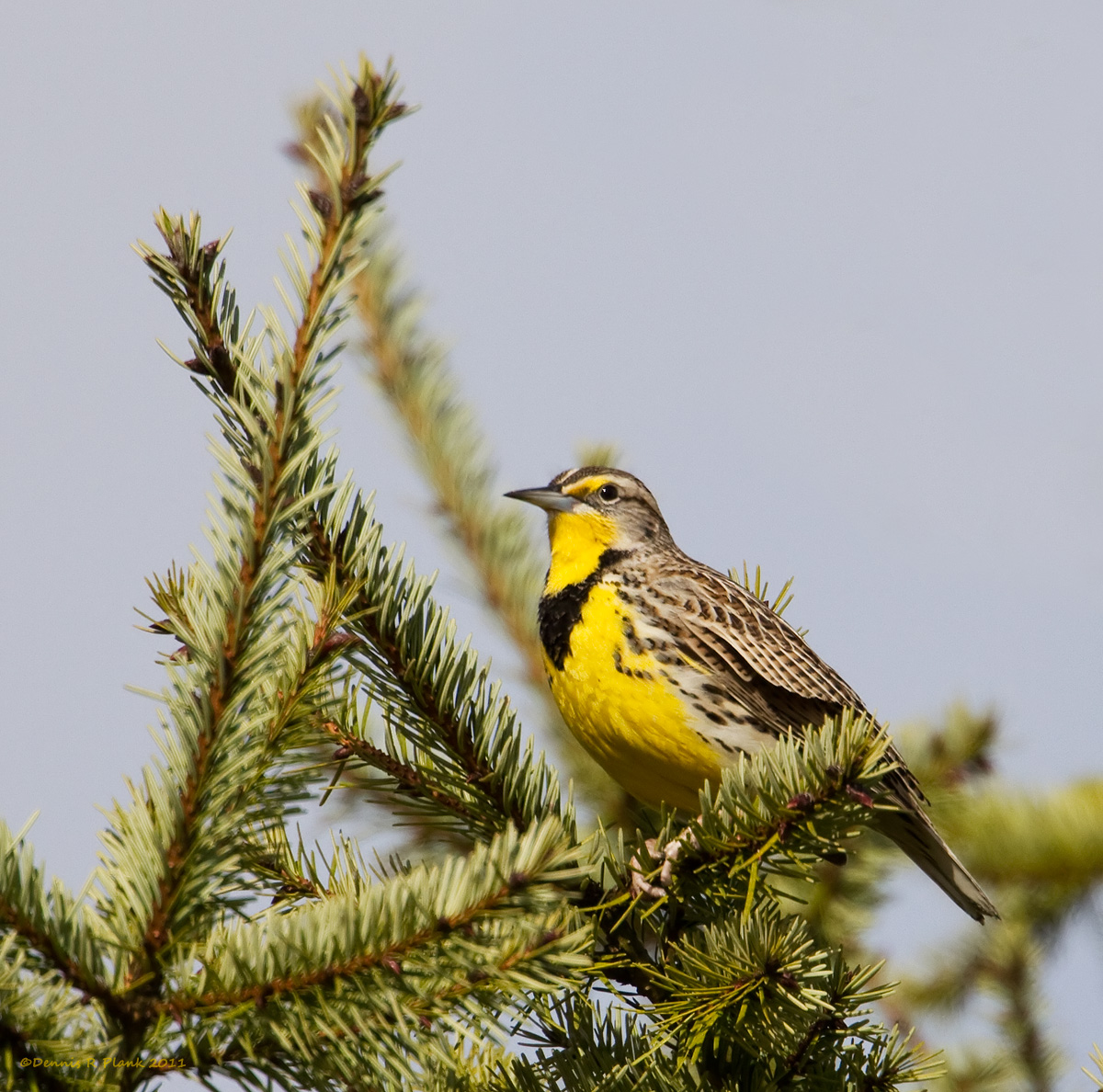
Female WesternMeadowlark
by Dennis Plank
Taken this morning at a local county nature preserve. They're just starting to set up territories. This female was one of a loose flock moving through the area-probably starting to check out the guys. She was fairly far up a tree, so to avoid too steep an angle, this was a pretty distant shot and a large crop.
7D, 500mm f4 + 1.4TC, Black Widow on Gitzo legs, f5.6, 1/2500, iso 400, Av mode with no compensation, filtered sun, taken about 10:20 am. Cropped from 18 MP to 3.7 MP. Normal processing in CS4. Some twigs cloned out of the upper right quadrant.
I always appreciate your comments and criticisms.
Thanks for looking,

Comments
13 commentsVery cool shot.
Where's the obligatory fence post?
I'd be tempted to remove the mowhawk errupting from the birds head??
cheers
Rob
Actually, Rich, my wife, who is a Meadowlark enthusiast, to say the least, is the one who determined the sex.
It's subtle, but in the males, the upper part of the yellow bib that extends into the cheek area goes all the way to the root of the beak. In the females, there is the patch of buff color between the yellow and the beak root. Note that this only works for the Western Meadowlark. In the eastern, the male is closer to the Western female and the female theoretically has no projection of the yellow into the cheek area. Probably not very useful information in the field!
She uses Peter Pyle's "Identification Guide to North American Birds" as the reference. It's pretty useless as a field guide, since it's black and white. I suspect it's intended for museum specimens, but it works pretty well with photos as well.
As to the Evergreen perch, the preserve where I shot this bird is in a remnant prairie ecosystem left from the last glaciation and maintained by Native American burning practices. Since burning ceased, Douglas Firs have invaded and covered most of the old prairies, except those that have been turned into developments and parking lots. I'm fortunate enough to live next door to 1000 acres that are under preservation, though even that has 200-300 acres covered by Douglas fir and occasional clumps elsewhere. We're reducing the evergreen presence slowly and reestablishing a burn regime, as well as reintroducing native forbs and grasses.
Cheers,
Dennis
beautiful pose, perch and colors. I really like this comp.
Albert Darmo. Canada
Good details even with the large crop, nice one