Stack vs F32 challenge
by Gary Yeoh
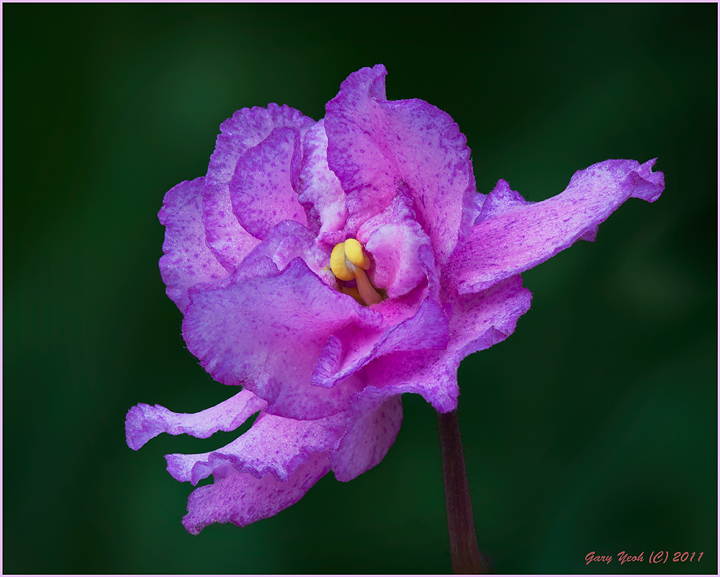
Sometimes I just spent too much time doing PP in PS and fiddling with the images and ended up not liking it or not very different from the original. Here is an example with this African violet. I took 10 images and focussed stacked them on CS5, darken background on Viveza 2, adjust the contrast with curves and levels using TK luminosity mask, and USM - overall takes me about 30 minutes. On the other hand, I also took a single F32 shot, curves and USM - took 3 minutes.
I find very little difference in the overall sharpness and DOF of both images. I am not going to disclosed which image is stacked and which is F32 just yet. Just for fun, I want you to pick which is which before I disclose them next week. This is image A

Comments
19 commentsI'm a capture guy and don't relish the time I have to spend on a computer. I'm not at all claiming that it's superior to get solid captures than to enhance an image with post-processing. I see both as different and complementary aspects of the art. My take on stacking - which I don't do merely because I've been too lazy to get the software - is that it allows you to shoot shallow in order to minimize the effects of the BG. This BG is obviously not busy enough to require significant capture blurring. But that also brings up another point which you don't mention and that is the effect of diffraction with small apertures. I know some folks get pretty doctrinaire about never using an aperture smaller than f16 because of the degrading effect of diffraction. I kind of scratch my head and wonder what they are seeing. Whichever of these is the f32 I can't see any defects. Interesting exercise. Thanks for doing it and I'm looking forward to the other comments. >=))>
Also, I like your diagonal presentation.
Thumbnail caught my eye.
Well done,
Carol
An interesting exercise. To me image B is the weaker image whether stacked or not. I've never done a stack using PS, but only Helicon Focus and if B is the stacked image, I think it's fairly weak stacking work - not necessarily your technique but possibly just the limitations of PS versus Helicon. If A is the stacked image, it's still not as sharp to my eye as it would be if you had used Helicon and deliberately tried to get all the bloom and stem in sharp focus. I guess what I'm saying is that neither of these strikes me as an example of stacking where you want all of the image in sharp focus. Stacking, even with Helicon still lets me control dof, in fact the idea at least for me, is that it gives me more control over dof than not stacking - I just generally end up going for full dof sharpness throughout the subject because that's usually the style I like.
Short answer I can't tell which of these is stacked. However, I do like image A the best. I'll be interested in what you tell us and this was thought provoking (at least for me) and fun to do.
pat
Well done and great exercise.
D&L
Another excellent image!
Like the first one best, whaich I think is the stacked one. There is a small blip at the base of the stem that might be cloned out - I see what it really is on the other images, but on the first one it looks like a "blip".
Sandy
Lori
Albert Darmo. Canada
Conclusions:
1. There is very little difference in the DOF on the flower between the stack and F32 images in this setting. However stacking is still useful to manage:
a) the background and
b) in extreme close up where f32 does not give sufficient DOF.
2. I agree with Bill's comment that diffraction blur at F32 is overstated and can be easily corrected by post process sharpening. It is not an issue for practical purpose.
well i've done stacking quite a few times & tried to equate it with F/32 but at 100 % of my 5d i can really make some differences in the overall sharpness of the image but once u downsize it, it can be very diffcult to choose between the 2
Mike Moats use F/32 & creates breathtaking sharpness in prints
pat
I much prefer the 1st version which is obviously stacked.