Although I’m a long-time photographer and have been an NPN member for several years, this is my first post in the ES&S gallery.
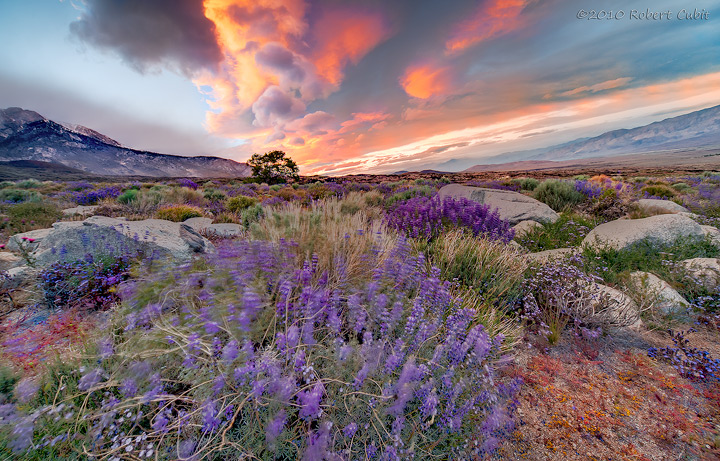
This image was captured six weeks ago along Division Creek Road in Owens Valley California, near Lone Pine and the Alabama Hills (in the foothills of the Eastern Sierra Nevada Mountains). I timed my 3-day visit for a period when one of the last storm fronts of the season was passing through, hoping for some dramatic skies. Of course, Owens Valley isn’t exactly known for still wind conditions. And I realized that the passing weather front would likely make photographing these long-stemmed bush lupine a bit challenging!

Fortunately, I had two days when there were brief lulls in the winds at sunset during which, with some patience, I could shoot. However, this shot was taken on the third day when the winds were a constant 15 mi/hr, with 30 mi/hr gusts all day. So I deliberately decreased the shutter speed hoping for a pleasing motion-blur effect on the foreground lupine.
I was several miles (and several thousand feet) up Division Creek Rd when I saw this sky developing. So I quickly drove back down to an area that I had scouted earlier with the lone oak in the BG and began frantically searching, like the manic photographer that I am, for a foreground to stick in front of it. I was able to capture 20 bracketed exposures, before the color was gone.
So my questions are, does the motion blur of the lupine enhance or detract from this image? I would also appreciate honest opinions on the overall effectiveness of the composition and processing?
Nikon D700, 12mm, 6-sec, f/16, ISO 200
2-exposures blended in Photoshop CS5
Bob

Comments
23 commentsI'd say welcome to NPN, but apparently you've been lurking for a couple of years, so I guess I'll just have to welcome you to the ES&S Gallery! Welcome aboard finally!
Putting aside the blowing lupine for a second, I'm really liking the colors throughout and especially how several of the colors are echoed in the sky and clouds. The hues of purple throughout I think help tie the landscape and sky together. I wouldn't say this has a strong HDR look, IMHO, but perhaps slightly over saturated? It's really hard to tell though at this small size.
About the blowing lupine. Again, I think it's hard to judge here. At this size, it's certainly not a distraction for me considering the big and somewhat dominant sky. Perhaps in a bigger web or print version it will be more of an issue. I think it's one of these cases where you either A. make the blowing/blurred flowers THE major focal point, or B. you don't and you wait for that lull in the wind and just have the lupine compliment the scene. Does that make sense? And of course, that's just one person's biased opinion. Definitely would love to have seen this big though because it's a very pretty a fairly dynamic landscape from the Eastern Sierra.
Lon
of the foreground Lupine bothers me somewhat. The deeper lavendar
Lupine bush back a little and somewhat further to the right in front of
a large boulder doesn't seem to be blurred as much. Maybe it was pro-
tected from the wind, or perhaps it is just as much blurred but not
recognizable as such from that distance.
A possible consideration might be to crop out the lower blurred section
of the foreground Lupine and see if that works. Nevertheless, I like the
image.
"Great scene Bob. I would work the exposures a bit more so you could get some real blacks into the shadow. The heavy HDR effect here is taking away from the drama IMO."
Thanks for the comments and suggestions, Richard. I wasn’t deliberately going for an HDR look here. But I do see what you mean. The sky and fg are from two separate exposures blended with a gradient layer mask in PS (if I had more time, I would have also made some exposures using my GND filters). My original conversion for the fg was a more traditional higher contrast version. However, I felt it lost some of the more subtle tonal qualities I remembered on location. I think what you refer to as an HDR look is due to the fact that, in this version, I applied a slight reverse ‘s’ curve after setting the blacks point to just clip the darkest pixels. But I did not clip the whites in the fg all of which tends to soften the contrast.
Bob
Paul
Paul, that is a very good point that I also noticed during post. Here is a crop of the two lupine from the original fg RAW exposure. Only overall saturation boosted 15 points to better show the strange color effect. You'll notice that not only do the two lupine not match in color, But the left half of the fg lupine doesn't even match the right half!? I had a similar effect on other lupine shots the evening before where half of the sky was warm toned and the other half was clear blue/cyan sky. But in this image the warm light was coming from behind, not the side. So I have no idea what caused this. I also thought it might be caused by the blur having some wierd effect on the camera sensor. But some of the moving stalks have the cooler tint. In the final image, I simply applied a cooling filter selectively to the left side of the fg lupine so at least the entire bush would look the same! Maybe I should have warmed the color temp. of the right side so both lupine matched better?
The pano crop is a good idea. I think it helps to remove some of the subject competition between the oak and the fg lupine. A higher crop also works if I also crop the edges in for a smaller aspect ratio.
Bob
dramatic sky.
It struck me that what some are saying is a lack of true blacks in this image may actually be a perceived effect from the lack of white/bright tones in the fg, which reduces the contast. In this version, I increased the highlights in the fg. May have over done it a bit to illustrate the point.
Thanks all!
It struck me that what some are describing as a lack of true blacks in this image may actually be a perceived effect from the lack of light tones in the fg. In this version, I increased the light tones, while keeping the black clipping levels the same.
Thanks all!
JG
This thread is getting a little long in the tooth. But if the admins don't mind and others might learn form your suggestions for improving the sky---please do!
Bob
“And of course, that's just one person's biased opinion.”
Funny you should say that as I’ve found your opinions among this least biased and most appropriate (not to mention most prolific) of any NPN member. Those are rare skills I personally respect, value and aspire to as much or more than the ability to capture compelling images.
Three cheers to your time-honed wisdom, sir!
Bob
What's also Interesting is that I've found two images at the same exposure setting---one with the right side of the fg lupine still and the other with the left side still. With a bit of tedious high-magnification work, I think it will be possible to blend the fg lupine from both frames to nearly eliminate the motion blur!
The only problem is I'm getting a little tired of looking at this image now, Time to go out and shoot!