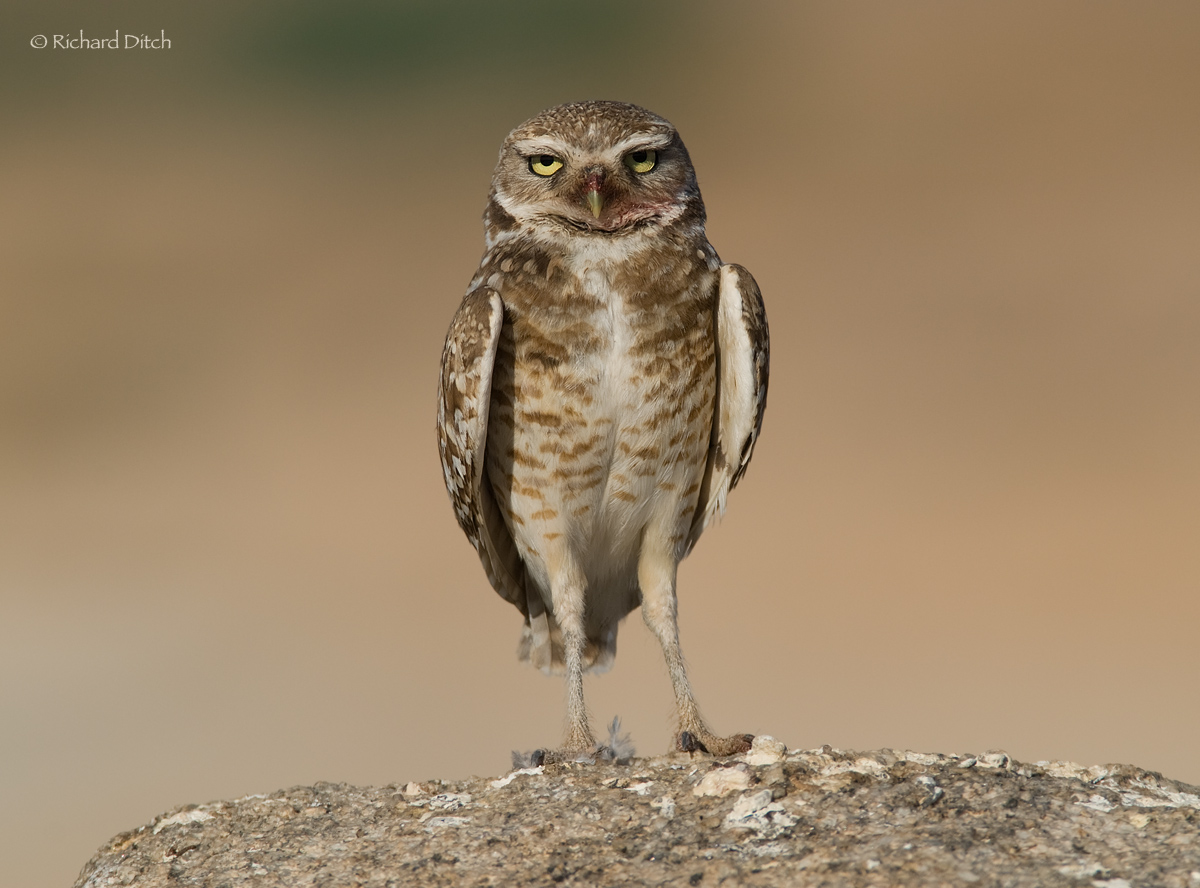
Burrowing Owl
by Richard Ditch
Burrowing Owl (Athene cunicularia)
Place: Gilbert, AZ, USA
When: June 6, 2010
Equipment: Nikon D200, Nikkor AF-S 300/2.8 & TC20E (2x), monopod from car window
ISO 100, aperture priority center-weighted meter @ -1/3 ec, 1/640th @ F/8
Raw, PS CS3 on Mac G4, minor crop from for proportion
A friend alerted me to another local pair of Burrowing Owls that I was able to visit one morning two weeks ago. But the AZ sun was brutal already by 7:14 am when I was finally able to approach this bird. The owl had obviously been feeding recently as evidenced by the blood on the face and the feathers stuck to one foot.
A surprise as I was checking the EXIF for this post – I had the meter switched to center weighted instead of my usual matrix setting. I don’t think I've used center weighted since Nikon first went to matrix (except for my ancient manual focus lenses that don’t work in matirx). This was unintended. I just checked my D200 and confirmed the setting, which I’ve switched back to matrix. At least that helps explain the bad exposures I got yesterday!
Honest critiques requested; all comments appreciated. Larger image fro critical viewing provided.

Comments
20 commentsI am interested to hear more about which metering system is preferable and why. This is an area that I have never seen much discussion on, and I'm sure I could learn a lot. I think I was told early on the center weighted was the way to go and I've been using it ever since.
If you get a chance to talk about it I know I would appreciate it and I bet many others would too.
Peter
While I like this image as presented, I feel this would benefit from a vertical comp.
Thanks for sharing this.
Matrix can be better than center weighted in situations with more complex subject/light conditions. When matrix first became available Nikon ads (and magazine reviews) talked a lot about how Nikon created a database of scenarios based on light distribution over the entire frame (like a matrix) and filled it with the exposure decisions of hundreds/thousands of professional photographers for subjects that matched those light distributions. In effect, matrix metering gives Nikon shooters professional experience for tricky lighting. I've used it long enough (at least for the 12 years I've had my 300/2.8) to know when it works and to trust it in those situations. Where I suspect it won't work (birds small in the frame with strong backlighting) I switch to spot metering.
I think Canon's evaluative mode is modeled on Nikon's matrix mode, but I don't know how they populated their database. But judging by the published pages of fudge factors for Canon meters for subject size and tone against various backgrounds I suspect it doesn't work as well as Nikon's. You'll be much better advised about Canon metering by experienced Canon users.
- Richard Olsen
To be clear, this bird is not at he Gilbert Water Ranch. I didn't mean to give that impression. This bird and it's mate are in an bankrupt housing subdivision 8-10 miles from the GWR.
- Govind
I thought that at the time and shot as a vertical as well, but the files just don't look as good to me as the horizontal ones. I couldn't get any closer than this, so the verticals show more dead space above and below. The background above turns dark gray just above what shows here - there's a plastic/rubber liner for an unfilled pond on the bank there. I'd need a lot more depth of field for the rock at the bottom if I included more of it.
Mauro
Laura Stafford
I don't see that center-weighted caused any problems here..
I often use it, but matrix metering seems to work best in most situations of course..
Great bokeh, and those eyes really grab ya
Well done
Couldn't ask for any better image of this owl. Just enough view of the perch, lovely warm tones, sharp details and a nice smooth background. Perfect!
Thanks for posting,
Ronnie G.