Dinosaur Rock
by Laura Stafford
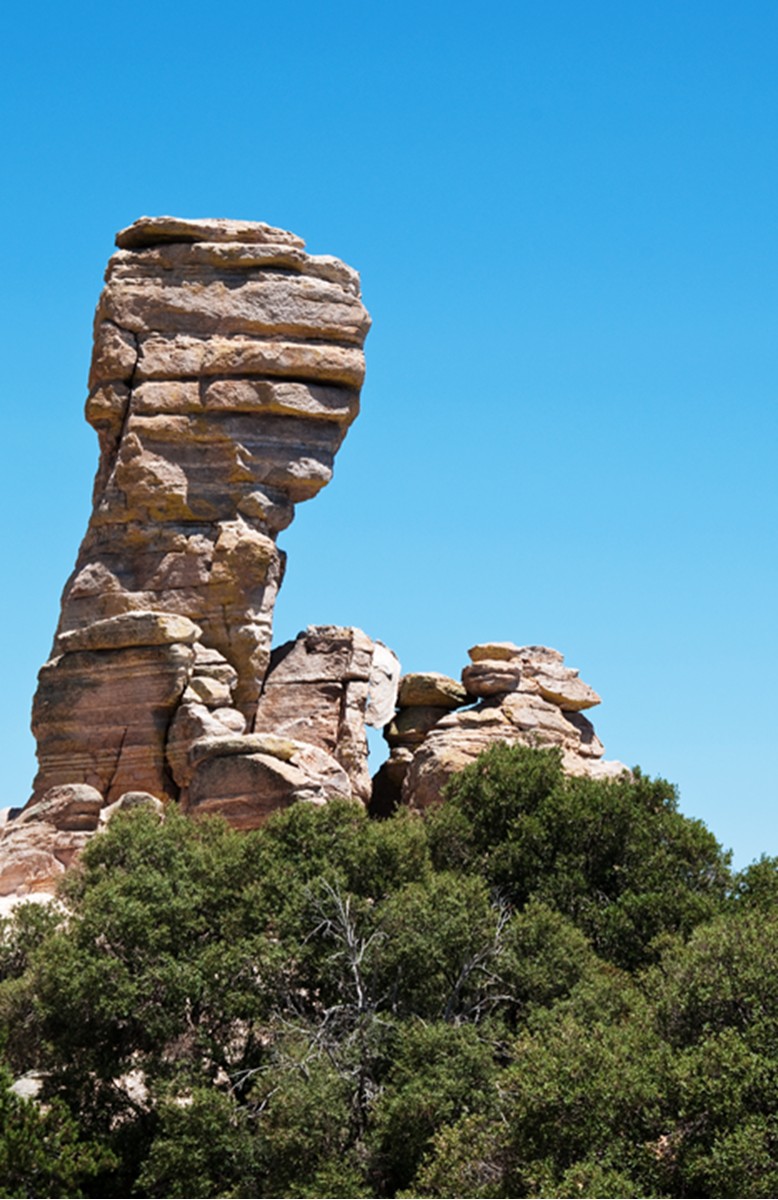
My husband & I drove up to Mt. Lemmon today to escape the heat (70 degrees vs. 105 degrees), and I saw this rock formation that reminded me of a dinosaur. It was taken mid-afternoon so the lighting was terrible.
Nikon D90
Aperture Priority F/11
ISO-200
Auto focus on single point
hand-held
I've read so many landscape photography books, but I am still not sure what the best focus mode to shoot with: single point, dynamic or 3D-tracking? Any tips would be appreciated.
Laura Stafford

Comments
3 commentsMust be from "Windy Point" on the way up to Mt. Lemmon. I recognize this because I captured a sunrise over Tucson here from 1983!!! A long time ago.... and I hiked up the rocks above the parking lot a bit to get the city lights in the background.
Anyway, this is a nice day-time capture of this fascinating rock formation. No real nits, but I might suggest a slight crop from the bottom to eliminate the bright patches poking through the trees and also a bit of the sky since it's really not adding to the composition. Other than that, if you're local, this is definitely a spot to return to for sunrise or sunset - or of course during the monsoons... :-)
Lon
Came back here and discovered I didn't even attempt to answer your question. In addition to what Doug is suggesting by going manual, I would recommend a couple other things. One of those things is to begin understanding and evaluating the scene you're trying to photograph. What is the most important element in the scene that you want sharp? How close or far are the other elements that you also want to be sharp. Do you want to isolate something with selective focus and a shallow depth of field? These are the questions you need to ask yourself during the process of creating an image.
You also must remember that regardless of ANY camera, brand or technology, a lens and film plane can only have ONE "plane of focus." It doesn't matter what "mode" you put the camera in in terms of that plane of focus - just imagine a giant sheet of glass out there in your scene that is parallel to your sensor or film plane. The "modes" will help determine what aperture perhaps to give you more or less depth of field, but there can only be one plane of focus. And it should be up to you to make the decision of what you want in focus and how much depth of field you want.
You could still use the "single point" auto focus, but you should also have an AF lock. Say for example, you pointed the center of your camera down a little to single point focus onthe trees in your image here. If that's the plane of focus you want, you would "lock" in that focus point (or turn off AF for that matter) and then recompose and shoot.
Lastly, you can practice, practice and practice some more right at home just learning selective focusing and depth of field.
Hope this helps,
Lon