Nature Photographers Network
This is the preserved archive of the original Nature Photographers Network. The community continues at naturephotographers.network.
Warbler:  Before - After
‹ PreviousAvian GalleryNext ›

Warbler: Before - After

by Steve Balke

Gallery: AvianPosted June 20, 2010162 views7 comments
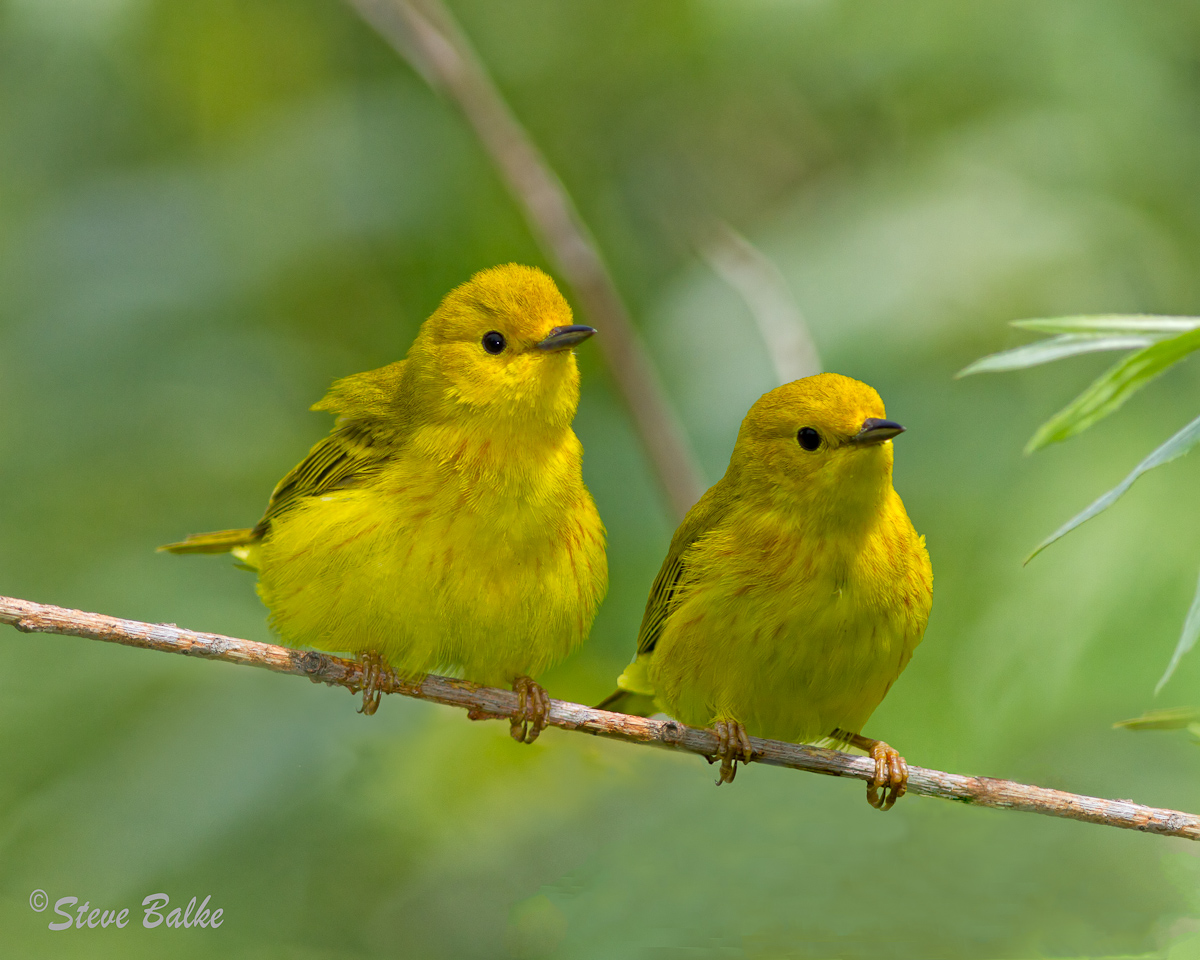
Yellow Warbler (Dendroica petechia)


This image is a composite of two images of the same yellow warbler taken within one second of each other. I was surprised by how fast this bird could “deflate”! I think that this is a female bird judging by the near absence of reddish streaks on the breast. The pair of birds were quite excited by my presence. Likely their nest was nearby. I don’t know if the inflation performance was an effort to scare me away. My impression was that this was all very routine and the bird was just “taking a breather”.


I welcome any comments on this image. I know that some of the weird background looks like Photoshop artifacts. However, the vast majority of it was there in the raw files (notably the OOF white branch growing out of the RHS bird's head!). That said, if you do spot something that you think is due to Photoshop, I’d like to know. It did take a fair amount of work for me to merge the images...and I still keep finding bad bits that I missed!

EOS 7D, EF 400 mm f/5.6, 580 EXII: each image was identical in settings: ISO 400, 1/1000 s, f/6.3. The flash fired for the “Fat Bird” image but not for the “Thin Bird” image. (If you look carefully you make out a small catchlight due the flash). Both images subjected to NR and sharpening as well as some exposure adjustment. The composite image is 3395 pixels x 2716 pixels (=9.2 MP or 51% of the 18 MP of the 7D).

Comments

7 comments
Comment posted by Richard Ditch on June 20, 2010 at 12:36 PM
An interesting composite. Good PS work. Most interesting to me is how well this shows the effects of the fill flash.

I see a little discontinuity in the branch on the top near the tail.

This would probably fit better in the Bird Forum or Photo Art gallery.
Registered on November 1, 2003, 1031 Posts, 12705 Comments
Comment posted by Dennis Plank on June 20, 2010 at 12:54 PM
Neat, Steve. You did an excellent job on the Photoshop work and the original images look like they were both excellent. :toast:
Registered on January 28, 2008, 1767 Posts, 23192 Comments
Comment posted by David Sparks on June 20, 2010 at 10:23 PM
Steve:
Nice sharpness on both images. I don't think I've ever seen an "inflated" yellow warbler. Cindy's startle explanation seems plausible to me. I will be curious to see what others have to say.
Registered on May 26, 2007, 290 Posts, 4270 Comments
Comment posted by Monica Siri on June 21, 2010 at 3:40 PM
Steve,
"two" beautiful yellow birds. Excellent detail and PS work. :wavey:
Registered on September 20, 2009, 132 Posts, 3764 Comments
Comment posted by Brian Gatlin on June 21, 2010 at 11:44 PM
interesting comparison, Steve, both for the flash/non-flash and the inflated/deflated looks. good work on your merging of the shots. I might reduce the exposure on the branch that is coming out of the head of the deflated bird.
Registered on March 21, 2009, 202 Posts, 4187 Comments
Comment posted by Derrick Lipinski on June 22, 2010 at 12:55 AM
Pretty cool, Steve. Nice work with Photoshop; if I didn't read it, I would've thought they were different birds. :smile:
Registered on October 5, 2007, 58 Posts, 2039 Comments
Comment posted by Steve Balke on June 22, 2010 at 9:57 AM
Thank you everyone: interesting, thoughtful comments as usual! Regarding the cause of the "warbler inflation", it may have been the flash...but I don't think so. This bird was subjected to several previous flashes and did not react in that way. In fact, curiosity seems to have been the main reaction that I observed this time. I have often see birds visibly jerk when the flash fires but not inflate. I note that Cindy mentioned that this bird is a male. Again, that's possible. However, the second bird that was flying around me showed much more distinctive and a greater number of stripes on the breast. Glad to see my Photoshop work looked good. Now I'm going to try again to find the discontinuity in the branch that keen eyed Richard Ditch found!
:wink:
Registered on June 18, 2009, 229 Posts, 2915 Comments