Nuthatch+Repost
by Steve Balke
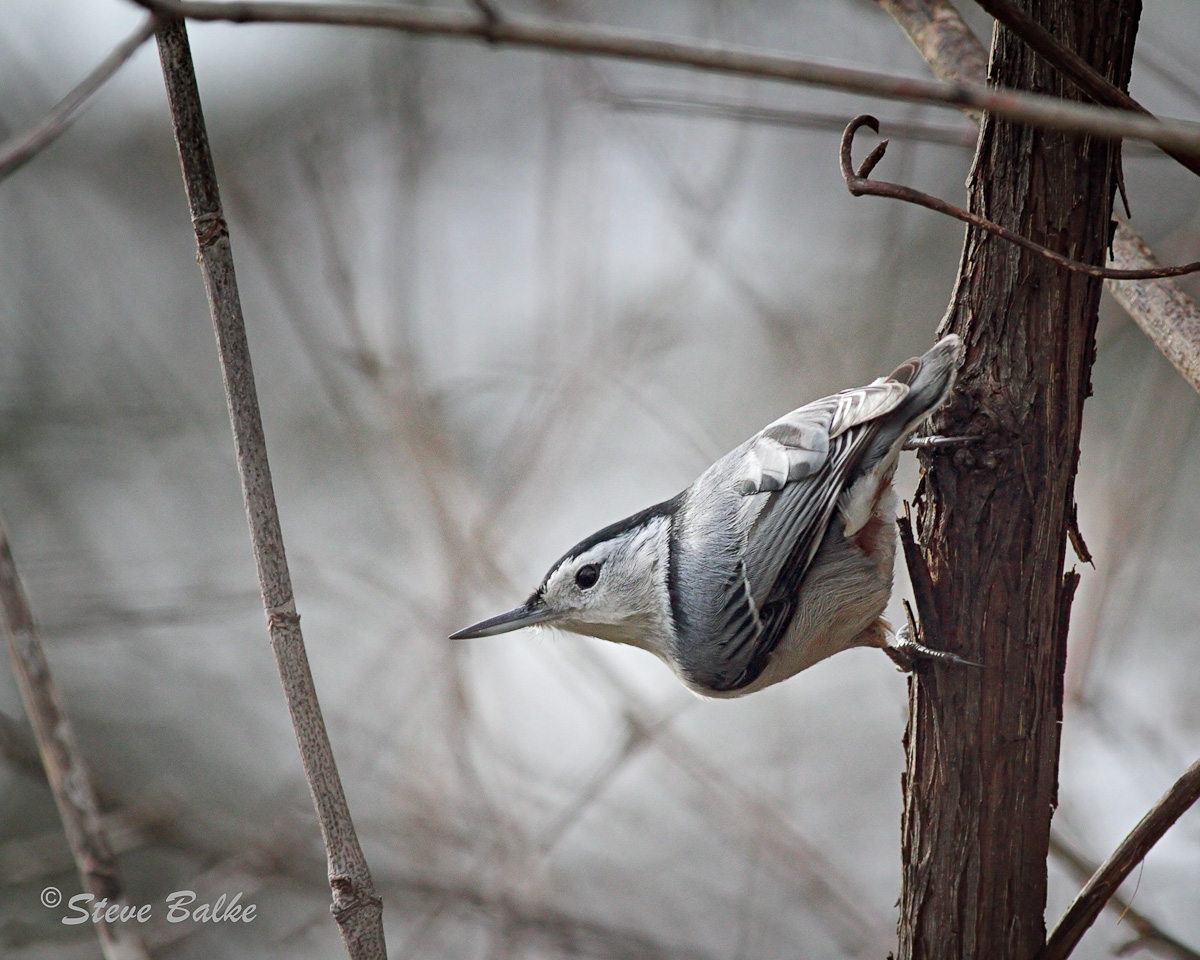
White-breasted Nuthatch (Sitta carolinensis) : I like this “behind view” because the head turn shows the nuthatch interested in us and the surroundings look so desolate on this pre-Winter day.
This image was captured on Dec. 2 just as my previous post (Downy Woodpecker). It was subjected to the same workflow. In particular, noise reduction and sharpening was carried out in the same way.
I always welcome your comments.
EOS 7D, EF400mm f/5.6 L: ISO 1600, 1/800 s, f/8.0, image is 4039 x 3231 pixels (=13.1 MP or 73% of full frame for the 7D)

Comments
7 commentsI'm interested in why you are still shooting in ISO 1600 ?
I guess with the low noise capabilities of the 7D this isn't really a problem, but it would save you a lot of hassle with using NR every time if you lowered the ISO and perhaps used some fill flash for shots like this.
It's an interesting shot. This particular "behind view" seems to truncate the bird and makes the head and beak seem large (for a nuthatch). I'm not complaining, just trying to explain to myself why it seems unusual. I like this view of the bird, especially since you have such nice detail in the head and wings. The bright BG and backlighting has grown on me too.
I like the laciness of the twigs in the background of this image and how the light seems to emanate from within the background and above the bird. I would crop some from the top to eliminate the one OOF branch that extends from the right almost nearly across the frame, while it really isn't a distraction for me, I do believe the image would be stronger without it.
I can detect some color noise in the chin, rump and just to the left of the lower leg and while some noise isn't all that bothersome to me, color noise does tend to change the tones & colors of those areas. I'm not sure if that would have been present at ISO 800 or not.
When using high ISOs begins to give the same IQ as those shot at 200 - 400 ISO, with limited noise and beautiful details I'll be willing to use it.
I like the pose you captured of this nuthatch, the head angle, light in the eye and how your composition left room for the bird to look into on the left side of the frame.