
by Brad Hill
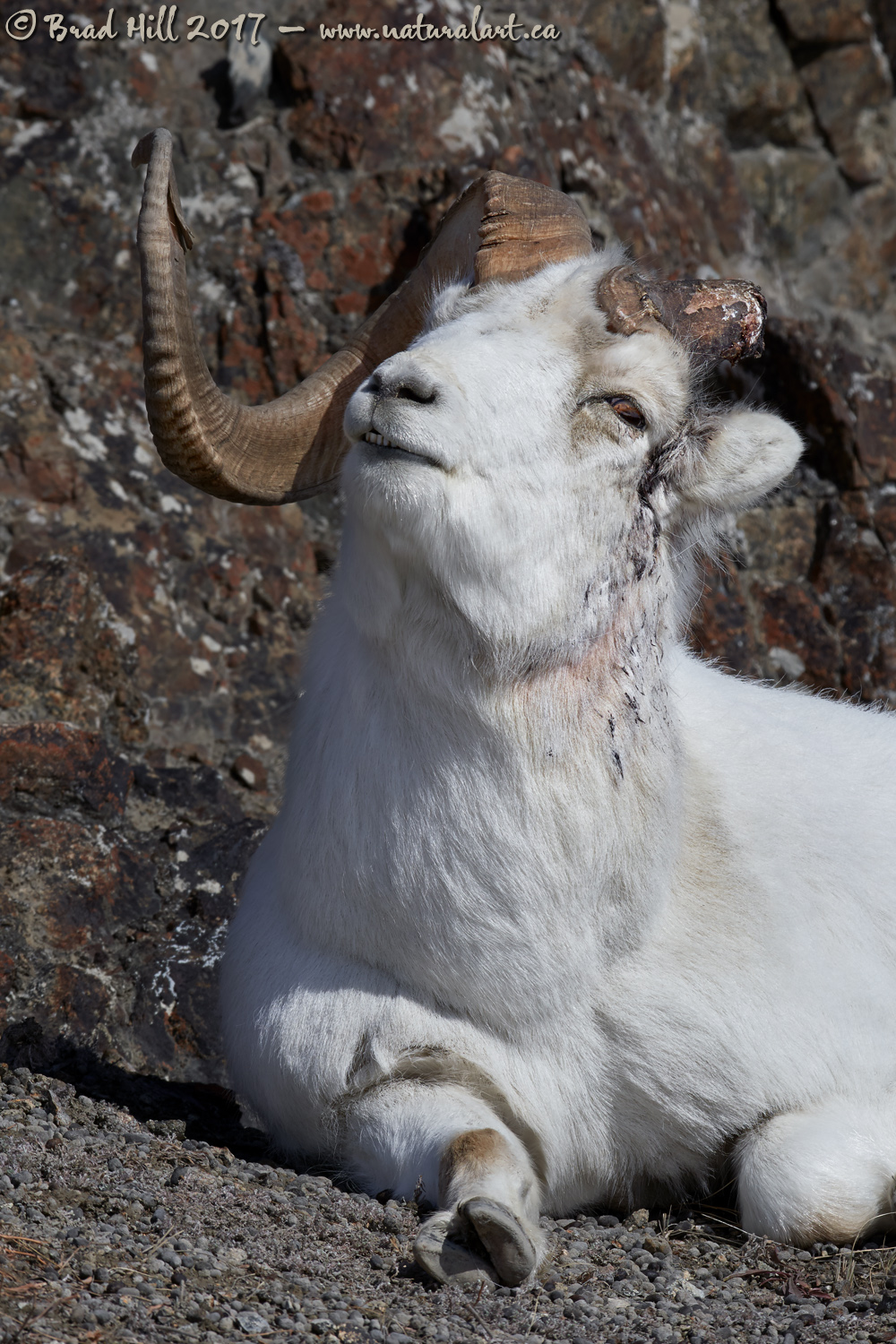
If you've ever watched male Bighorn or Dall Sheep engaged in serious social dominance "wars" you probably came away thinking "Wow...how do they even survive THAT kind of violence (and have any energy left to mate)?" Remarkably, in the vast majority of cases the clashing rams walk away unharmed. But...that's not ALWAYS the case...the dramatic head butting sessions DO come with very real risks attached, and occasionally - like in this case - "career-ending" injuries are experienced by one of the participants.
I photographed this injured Dall ram at the beginning of April 2017 and it is very likely (though we can't know for sure) he lost his left horn as the direct result of clashing with another male back in the late autumn. When rams DO lose a horn like this (if you look closely you'll see that only the "core" remains) they bleed for AGES...the nearly-black crud between this guy's ear and eye is dried blood and you can see traces of fresh blood on the core of the horn, even though it's likely this injury occurred months ago. OUCH!
Besides the obvious "here and now" physical harm done to this ram, he also is "done" now in an evolutionary sense. It's possible that BEFORE this injury this ram sired some offspring, but if he didn't...well...you can be sure he won't be leaving any of his genes to the next generation now. Which makes it likely this guy is an evolutionary "dead-end". Talk about rubbing salt into an open wound! And we think WE have problems! 
The biggest challenge I faced in capturing this shot was managing the depth-of-field (or DoF). As you can see, this ram decided to thrust his right hoof out directly in front of him. Because I didn't want his hoof out-of-focus I was forced to go with a wider DoF than I would have liked (and I stopped down to f9 to get that "expanded" DoF that would keep the hoof in sharp enough focus). But, unfortunately, this extended the DoF further BEHIND the ram as well, which meant that the background rocks are MORE in focus (resulting in less visual separation of the subject from the background) than I would have liked. I debated going with a thinner DoF (like that which would have been produced by going to around f5 or so) as I waited for the ram to lift his head, but in the end I decided the hoof added enough visual interest to the shot that I wanted it in-focus and that I would have had to live with the "less-soft" background. Of course, if the ram had held this pose for more than a shot or two I would have shot the scene with a variety of apertures but, alas, it was a quick head-lift, head-turn that lasted only a second or two (and it was the only time he really gave me a good look at the missing horn and associated mess on the side of his head).
Subject: Male Dall Sheep (Ovis dalli) nursing his war wound
Location: Southwest Yukon Territory, Canada
Camera: Nikon D500
Lens: Sigma 500mm f4 Sport lens (for a total EFL of 750mm). Supported on Really Right Stuff TVC-24 tripod with an Acratech Long Lens Head. OS on and in "OS1" mode, with OS1 stabilization customized to Moderate View mode; AF customized to Fast Priority AF.
Exposure: 1/800s @ f9; ISO 110. No compensation from matrix-metered exposure setting.
Crop: Extremely minor - this is about 95% of full frame
A whole lot more info about this shot - including a 2400 pixel version it - can be found on my website using the link immediately below.
http://www.naturalart.ca/galleries/latest/
Comments and critiques welcomed - probably best to view the larger version prior to doing so!
Cheers...
Brad
PS: Like all wildlife images on my website and that I post on NPN, the subject is fully wild and completely unconstrained. Besides the potential impact of my presence, nothing has been done to intentionally alter or affect the ongoing behavior of the subject and, of course, there has been no use of any form of bait or other form of wildlife attractants (including vocalizations).
Comments
7 commentsI have seen lots of animals with damaged horns, I find it extremely sad.
The qualities of this image are remarkable
You did a great job of capturing the result. The pain wild animals endure is nearly unimaginable. This had to hurt for a long, long time.
Well done!