
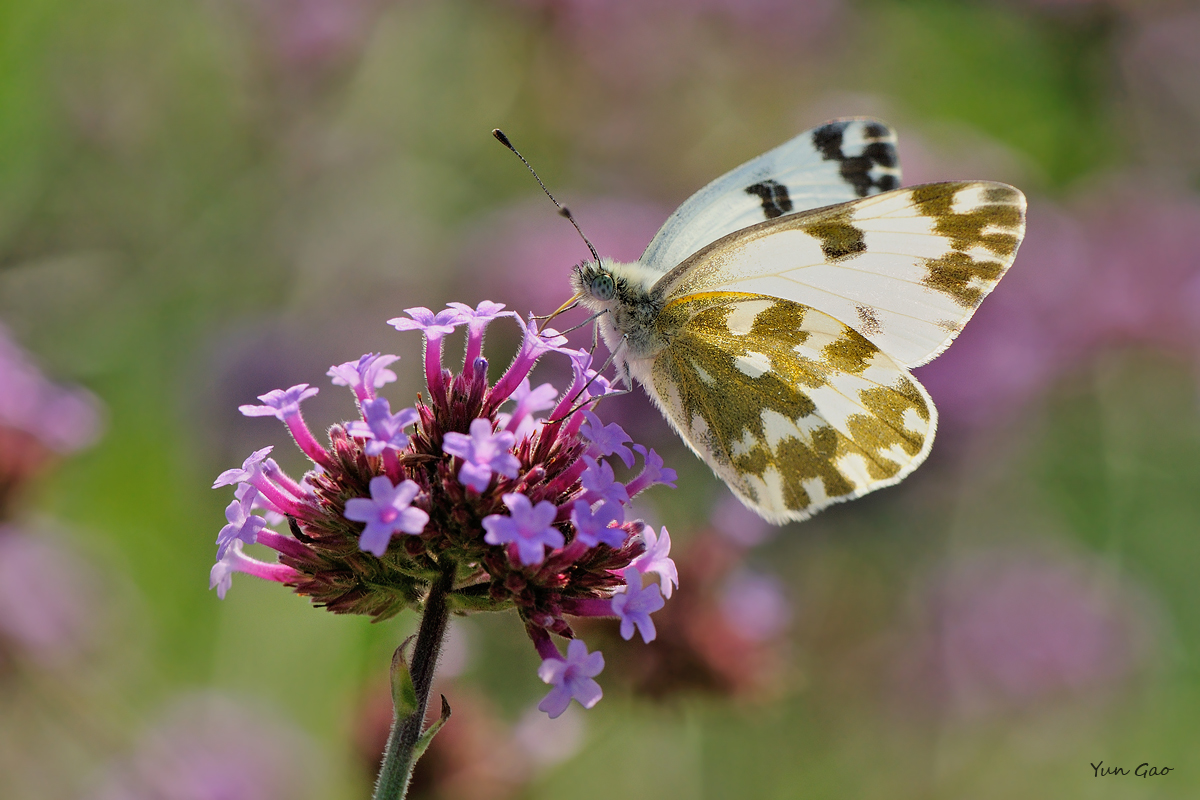
by Yun Gao
A sunny image for winter. I did some researches on the ID. My guess is this may be a female orange tip butterfly. Only the males have the orange tips.
D90, 105 mm, f/9, 1/400, ISO 250, 80% of original frame. Beijing, September 2016.
All comments are welcome and appreciated.
Comments
8 commentsI see there is disagreement about "blown" highlights. That is to be expected with differences in monitors. On the technical side, the histogram shows there is no clipping of highlights, but the brightest parts of the wings can look that way on a bright monitor, due to the fact that that there is little contrast between then backlit white parts of the wings and the veins there. The problem is that the veins do not show up dark enough. (The lightest part of those wings are actually not as bright as the sunlit flowers, opposite wings, or hair on the thorax.) I would guess that this is an accurate presentation of what you saw, when viewed on some monitors -- mine is calibrated with X-rite equipment and software, which tends to look less contrasty than monitors calibrated with Spyder systems. To make matters worse, viewing sRGB images on wide-gamut monitors can introduce even more differences, depending on how they are calibrated. This would make a fine print, but due to the prevalence of brighter monitors for viewing on the Web, you may want to darken the backlit veins, (but not the white parts of the backlit wings, which should remain bright) to enhance contrast there. That can be done with a small dip in the tone curve at the appropriate spot on the curve, while "pinning down" the surrounding parts of the curve. Plug-ins like Topaz Clarity and the Free Nik Viveza can make that job easier and produce excellent results, too.
Making some photos look good on all monitors is hopeless, but many viewers don't care. Many, many monitors are not calibrated, and come from the factory way too bright for critical photo viewing, although they are good for video games.
Thanks for the comments.
Scott, yes, I did selectively darken the bright part of the top wing. Good eye to spot this.
Wayne, thank you for your detailed review and explanations about the veins and monitors. I understand better now why the wings of this species (and Cabbage White) are never very sharp.
Not easy to get good shots of active subjects.
Very well done.
D&L