Gallery: LandscapePosted December 10, 2016146 views6 comments
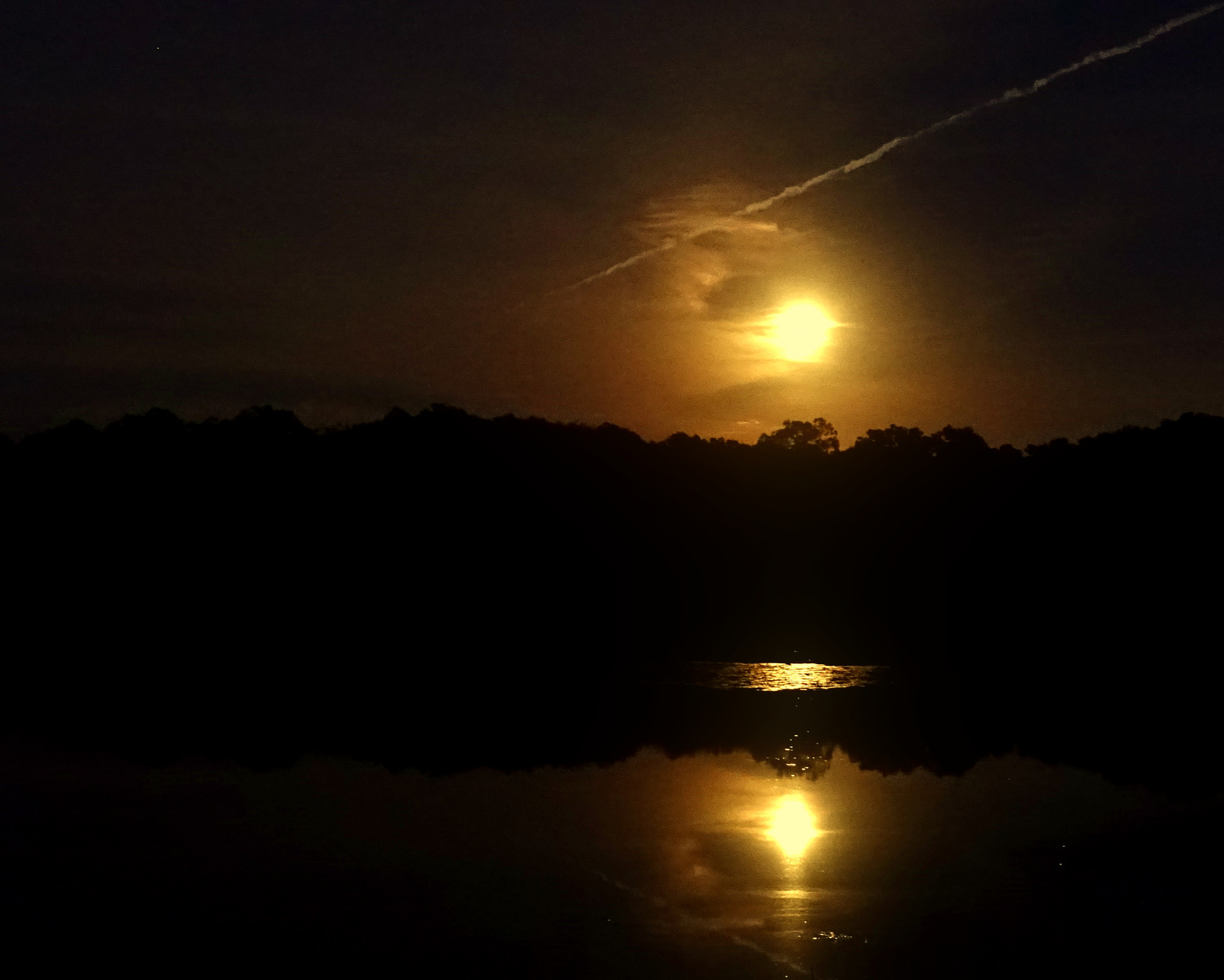
Harvest Moon glows and reflects on an otherwise dark and gloomy night.
Please tell me what I'm doing wrong...lots of noise in larger view. ISO maybe?
Sony DSC rx10 M lll, f/5, ISO 2000, AP, exp 1/3 sec
Comments
6 comments
Comment posted by Lon Overacker on December 10, 2016 at 1:30 PM
Hi Lori,
We all are attracted to the setting/rising sun, reflections and all that happens during this time of day and I like what you were trying to capture. I think though you've already identified part of the issue, which is why you're posting.
I'm not an expert on sensors, noise, etc., but there are a couple of factors that exacerbate the problem. First, by default is just about impossible to shoot directly in to the sun and maintain a proper exposure throughout. It wasn't until exposure blending, HDR and other methods of combing exposures were photographers then able to do this. In a single frame, set on auto-exposure you will get this result. The issue is that the super brightness of the sun is causing the camera to automatically adjust the exposure in order to "average" the exposure to a middle gray tone - this causes all the other areas that aren't the sun, to go dark. Again, the only way to avoid is by using multiple exposure and blending techniques. Actually, many cameras these days, including cell phones, probably have features to automatically do hdr blending - in camera.
Hopefully someone else chimes in, but that fact above combined with the high iso probably significantly increases the noise level. I'm not familiar with the sensor in your camera (but I googled and see it's a large CMOS sensor in a mirrorless camera) and I would think the noise in modern sensors should be pretty minimal, even at iso 2000. So I would go with the extreme light/dark of the image shooting in to the sun as the primary culprit. And shooting directly in to the sun, you probably could have chosen a smaller iso, because having enough light wasn't a problem... ;-)
Too bad about the contrail too, but not much could have been done at the time. I would have been ticked if the plane flew by after I was all set up... ;-(
Lon
ps. Here's what you might do. Do some testing. Set up a street scene in front of your house around dusk, where it just starting to get dark. Take a bunch of pics at different settings (in manual mode, or say aperture priority) using your full range of apertures and ISO settings. Tripod of course so your shutter speed doesn't matter. Make some notes and then review on the computer to see what your most optimum combinations are. This is also helpful to do these type tests in regular light and check for image sharpness over the full range of your zoom. just a thought.
Registered on November 24, 2006, 521 Posts, 19147 Comments
Comment posted by Lori Lafargue on December 10, 2016 at 1:54 PM
Thank you so much, Lon, for your insightful and wonderful critique. I do want to clarify a couple of things that may or may not change your opinion. First, I thought this was the moon rising at 6:54 pm, but on 10/15 before DST, it was the sun setting...so you are quite right-thank you! I did use my tripod and it was on aperture priority, not auto, according to the camera info.
I will def try your techniques of many pix at the same spot. This is very helpful. I appreciate your taking the time for this.
Happy Holidays, Lori
Registered on September 30, 2016, 54 Posts, 59 Comments
Comment posted by Lon Overacker on December 10, 2016 at 1:55 PM
Registered on November 24, 2006, 521 Posts, 19147 Comments
Comment posted by Lon Overacker on December 10, 2016 at 1:59 PM
Lori,
Duh... you did say Harvest moon didn't you. Of course the moon can do the same thing, it's just as bright as the sun, but still offers the same problems depending on the time of day and when it rises/sets.
Also, aperture priority is still an auto-exposure mode; meaning it's automatically setting the exposure, you just get to pick the aperture. Only in manual or with EV compensation can you fool the meter in to doing something other than averaging for middle gray tones.
You're welcome, and thanks for the clarifications.
Lon
Registered on November 24, 2006, 521 Posts, 19147 Comments
Comment posted by Igor Doncov on December 10, 2016 at 2:03 PM
I pretty much agree with everything Lon wrote. Even though this is a moon it's still too bright to handle the dynamic range of the sensor. The higher it rises the brighter it gets. That's why in most images its on the horizon. If the composition didn't have the reflection you could have used a grad filter and have the moon appear as just a round disk in the dark sky. The land could have some detail then.
It's interesting in that what you see through the viewfinder is not what you get. This is one of those cases.
Registered on November 22, 2014, 189 Posts, 2733 Comments
Comment posted by Mark Seaver on December 11, 2016 at 9:27 AM
Lori,
Night shooting has many special challenges, with exposure being a big one. A full moon is as bright as a standard mid-day scene (it's reflected sunlight in both cases) while the land and sky away from the moon are much darker. As Lon says, with digital processing, when you seen a night shot with details in the full moon, it's either a composite of two images (I'll typically do a second exposure for the moon at 2, 3, and 4 stops under exposed) or someone used a graduated neutral density filter. There's a night shot in my gallery (here) that had only a sliver of moon, yet the moon looks round and shows as a starburst. Noise is due to the combination of high iso, small sensor and exposure time. You may be able to reduce the noise a bit in your processing, with best results on RAW files. It's a fundamental property of digital sensor chips that smaller pixels show more noise for a given exposure and the noise level depends on the chip. While your camera/chip is much better than a cell phone or even a low end point & shoot, it's not as good as a DSLR.
A full moon rising (or setting) image is best made the day before the actual full moon. Then you still have enough light on the ground to balance with the full moon low in the sky in a single exposure.
Registered on January 23, 2011, 1103 Posts, 17270 Comments

Comments
6 commentsWe all are attracted to the setting/rising sun, reflections and all that happens during this time of day and I like what you were trying to capture. I think though you've already identified part of the issue, which is why you're posting.
I'm not an expert on sensors, noise, etc., but there are a couple of factors that exacerbate the problem. First, by default is just about impossible to shoot directly in to the sun and maintain a proper exposure throughout. It wasn't until exposure blending, HDR and other methods of combing exposures were photographers then able to do this. In a single frame, set on auto-exposure you will get this result. The issue is that the super brightness of the sun is causing the camera to automatically adjust the exposure in order to "average" the exposure to a middle gray tone - this causes all the other areas that aren't the sun, to go dark. Again, the only way to avoid is by using multiple exposure and blending techniques. Actually, many cameras these days, including cell phones, probably have features to automatically do hdr blending - in camera.
Hopefully someone else chimes in, but that fact above combined with the high iso probably significantly increases the noise level. I'm not familiar with the sensor in your camera (but I googled and see it's a large CMOS sensor in a mirrorless camera) and I would think the noise in modern sensors should be pretty minimal, even at iso 2000. So I would go with the extreme light/dark of the image shooting in to the sun as the primary culprit. And shooting directly in to the sun, you probably could have chosen a smaller iso, because having enough light wasn't a problem... ;-)
Too bad about the contrail too, but not much could have been done at the time. I would have been ticked if the plane flew by after I was all set up... ;-(
Lon
ps. Here's what you might do. Do some testing. Set up a street scene in front of your house around dusk, where it just starting to get dark. Take a bunch of pics at different settings (in manual mode, or say aperture priority) using your full range of apertures and ISO settings. Tripod of course so your shutter speed doesn't matter. Make some notes and then review on the computer to see what your most optimum combinations are. This is also helpful to do these type tests in regular light and check for image sharpness over the full range of your zoom. just a thought.
I will def try your techniques of many pix at the same spot. This is very helpful. I appreciate your taking the time for this.
Happy Holidays, Lori
Duh... you did say Harvest moon didn't you. Of course the moon can do the same thing, it's just as bright as the sun, but still offers the same problems depending on the time of day and when it rises/sets.
Also, aperture priority is still an auto-exposure mode; meaning it's automatically setting the exposure, you just get to pick the aperture. Only in manual or with EV compensation can you fool the meter in to doing something other than averaging for middle gray tones.
You're welcome, and thanks for the clarifications.
Lon
It's interesting in that what you see through the viewfinder is not what you get. This is one of those cases.
Night shooting has many special challenges, with exposure being a big one. A full moon is as bright as a standard mid-day scene (it's reflected sunlight in both cases) while the land and sky away from the moon are much darker. As Lon says, with digital processing, when you seen a night shot with details in the full moon, it's either a composite of two images (I'll typically do a second exposure for the moon at 2, 3, and 4 stops under exposed) or someone used a graduated neutral density filter. There's a night shot in my gallery (here) that had only a sliver of moon, yet the moon looks round and shows as a starburst. Noise is due to the combination of high iso, small sensor and exposure time. You may be able to reduce the noise a bit in your processing, with best results on RAW files. It's a fundamental property of digital sensor chips that smaller pixels show more noise for a given exposure and the noise level depends on the chip. While your camera/chip is much better than a cell phone or even a low end point & shoot, it's not as good as a DSLR.
A full moon rising (or setting) image is best made the day before the actual full moon. Then you still have enough light on the ground to balance with the full moon low in the sky in a single exposure.