One month later
by Barbara Graham
Sweetwater Wetlands, Gainesville, Florida
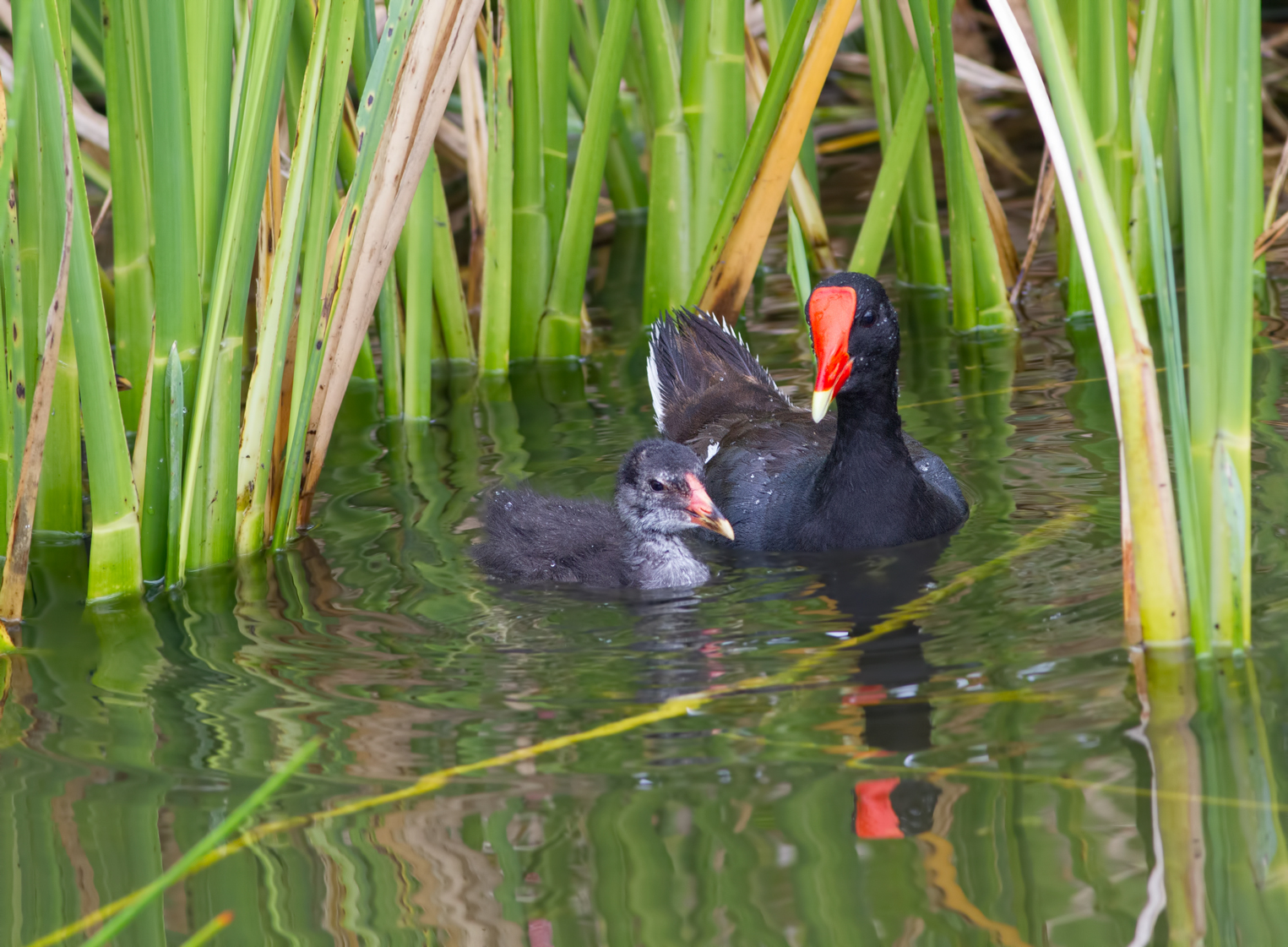
The first pictures of this Common Gallinule chick and its mother were taken on July 6. This was on 8/6/2016 – 8:50:31 AM. I can't guarantee that this is the same chick, but I'm pretty sure it's the same mother. There seemed to be only one family there, with three chicks.
Canon EOS 7D EF400mm f/5.6L USM
1/200 sec; f/7.1; ISO 800
Manual; Spot metering
LR5, PS6, Topaz DeNoise, Topaz Detail, cropped to 50% of original
I realize it's a large crop. Some of mine are going to be. I think that quite a few people post images without including the cropping information, especially when it's a large crop. I'm going to go ahead and post images that I like for one reason or another and put the cropping information, and I'll be grateful for the feedback on other aspects of the image if the cropping bothers you. Or if you think it looks okay even with the cropping I'd be glad to know that, too.
I can't get another lens, and I can't always get any closer, usually because of water/wetlands and I won't take even a step in the water and take a chance on water moccasins or alligators, and I want to do bird photography anyway.
So, having said all that, any feedback would be greatly appreciated. :)
Thank you!

Comments
5 commentsI like this as a documentary image, and I like the composition from an artistic standpoint. The adult plumage is tack sharp and the eye of the youngster is as well. For some reason (and at this angle it's not making sense to me) the youngster seems just a touch soft. It may just be it's plumage-some birds are that way. You could try selecting the youngster and adding a touch more sharpening to it. I like the little cove of cattails that are so much a part of their habitat. Nice work.
You would not get me into the water either
Great image, the slight softness of the chick is probably the still downy feathers?
As for getting closer, the main reason to stay out of Sweetwater is it's sewage. Wading isn't a very effective way to get closer to wary birds anyway. Bigger glass or a blind and a lot of patience. When I was last in Central Florida, I used a bag blind with some success.
Re the amount of crop, it is the amount of pixels left that count. As Dennis pointed out newer cameras have a lot more pixels, so even large crops are possible. I have two minor nits - it looks like the reds are oversaturated as I do not see details in parts of the beak. Also, looks like the image could do with a small clockwise rotation based on the reflection. Boh should be easy fixes.