Nature Photographers Network
This is the preserved archive of the original Nature Photographers Network. The community continues at naturephotographers.network.
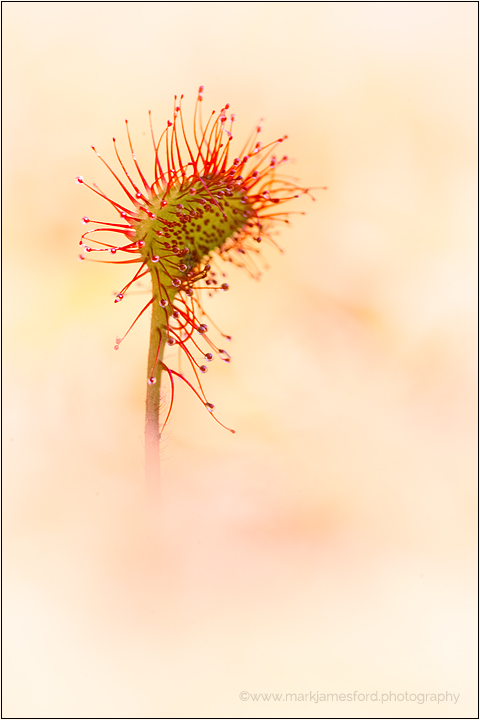
Drosera Romance II
‹ PreviousFlora GalleryNext ›

Drosera Romance II

by Mark James Ford

Gallery: FloraPosted July 17, 201678 views5 comments
I am very keen at the moment to explore motifs which emerge from the surrounding light with only hints of background / foreground forms and structures ... Here a shot from last weekend where we had the chance to work with the Common Sundew (Drosera rotundifolia) in a small, very wet, muddy and midge infested 'High Moor' habitat in the Odenwald, Germany. Lying in/on the peaty marsh ground, this was soon forgotten as the careful light management and ETTR allowed me to begin to isolate the subject as I desired ...

A larger view can be found HERE

Sigma SD1 Merrill, Sigma 180mm Macro, F8, 1/60 sec., ISO 100

  

Comments

5 comments
Comment posted by Kathy Barnhart on July 17, 2016 at 5:18 PM
Whatever trials you had to endure to get these last two postings were worth the effort. Love the look of the suggested background. I'm not sure what ETTR is....could you please explain? Wonderful images.
Registered on November 11, 2011, 404 Posts, 1639 Comments
Comment posted by Mark James Ford on July 18, 2016 at 8:13 AM
Hi Kathy, many thanks for the compliment.  Sorry for using the abbreviation.  ETTR is “Expose To The Right”.  This means that, irrespective of what the correct exposure for the image would /should be, the image is as over exposed as possible whilst still ensuring that all highlights are FULLY recoverable in the RAW.  For my Sigma SD1 Merrill I know, for example, that when the lightest areas in the image are just blown as per in camera preview or the out of camera jpg, then this is fully recoverable in the RAW converter. Of course once a channel has blown through completely then data is lost and the image has been exposed too much! The reason for doing this is that much more ‘data’ is collected in the right hand half of the histogram in the left hand half. (This is why shadows become so noisy so quickly if an image is pushed (shadows are lightened) in the post processing to any great extent – In terms of our perception the normal histogram for a digital camera is not a linear scale).  It is much better in terms of quality of the digital data to pull the image back somewhat – this is somewhat counterintuitive and needs a certain amount of ‘mental control’, since, at the time of taking the images and previewing them ‘in camera’, they do not ‘look’ particularly good ;-) ...and … one runs the risk of losing the image completely if, as I said, one or more channels are blown. This is generally the best strategy for taking a digital image if the contrast range of the image is much less wide than the dynamic range of the camera, which is often the case in the macro environment. Since I know/knew I wanted to go for a High-Key final result I needed the image to be exposed as long as possible.   The use of a diffuser and/or reflector then helps to control the lighting of the subject … (I hope I’m not 'preaching to the converted' here … ;-) … )
Cheers, Mark
 
Registered on January 16, 2015, 60 Posts, 430 Comments
Comment posted by Bill Fach on July 18, 2016 at 9:11 AM
Mark: Superior work and a very compelling result. Superbly crafted image.>=))>
Registered on November 1, 2003, 1805 Posts, 26981 Comments
Comment posted by Philip Hodgkins on July 18, 2016 at 9:42 PM
Looks like the thing that was after me just before I woke from a bad dream!sad Unique subject. I like that it arises out of the fog of the OOF background. I like both the subject and background colors They go well together. A well made image.cool 
Registered on July 24, 2006, 2741 Posts, 12349 Comments
Comment posted by Giuseppe Guadagno on July 19, 2016 at 5:07 PM
I love the style that you have chosen. An excellent photo, very impressive.
Registered on February 3, 2007, 827 Posts, 5052 Comments