Glacial Fingerprint
by Harry Lichtman
Large Version Recommended
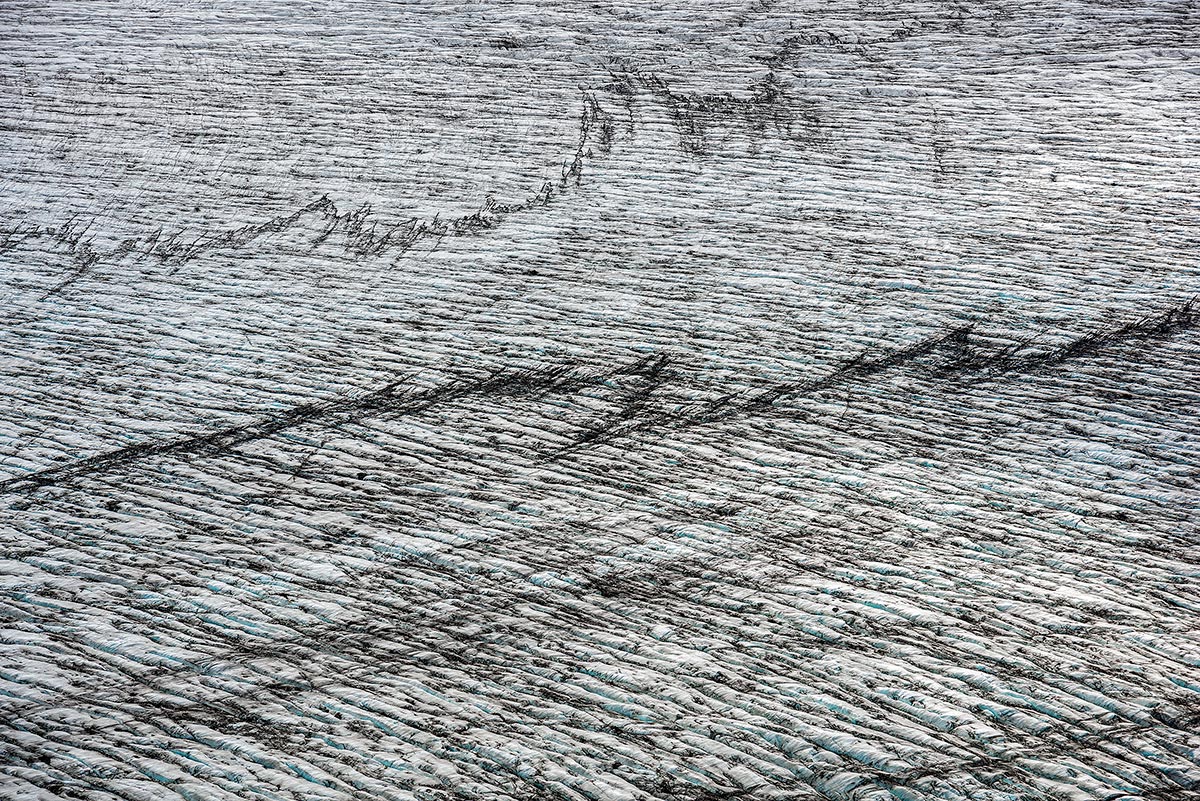
I made several semi-abstract images of the many glaciers I came across in Iceland. This tight view of Skaftafell Glacier intrigued me due to the jagged dark lines on the surface of the glacier. I haven't seen these in any of the other glaciers I have come across in my travels around the world. I shot above from a hike I did nearby. The lines reminded me of seismograph or barometric chart.
As it turns out, the line formations are somewhat unique in origin. The jagged black stripes are black basaltic volcanic ash layers. There are several volcanoes beneath the Vatnajökull ice sheet, such as the very active Grímsvötn and Bárðarbunga. Ice accumulates mostly near the center of the ice sheet from where it flows toward the edges of Skaftafell. Originally, when the ash layers fall they cover a large surface of the glacier. The flow of ice from the ice sheet center is first vertically downwards and then laterally toward the edges. Thus, several ash layers that fall on the ice are first stacked vertically but after “travelling” down through the glacier toward the edge they show up as laterally displaced on the edge surface. The movement of ice cause “jagged” form of individual layers/stripes. When an eruption occurs beneath a glacier as in this case, the volcano does not erupt as a lava flow but as ash when ice and lava mix. Thus the eruptions are almost entirely turned into ash that wind distributes over the glacier. Radial crevasses can be seen throughout the image.
Special thanks to NPNer Tom Falley and Johann Helgason for their help in deciphering this mystery to me.
Nikon D810, Nikkor 24-120 VR, f8, ISO 64, 1/90 sec.

Comments
11 commentsAssuming the glacier and large scale, this is just fantastic!
Thanks for the back story and geology lesson!
Lon
Thanks for the geology lesson, too.
Well done, Harry!
--P
Albert Darmo
canada