Full Stop -Threat Sensed
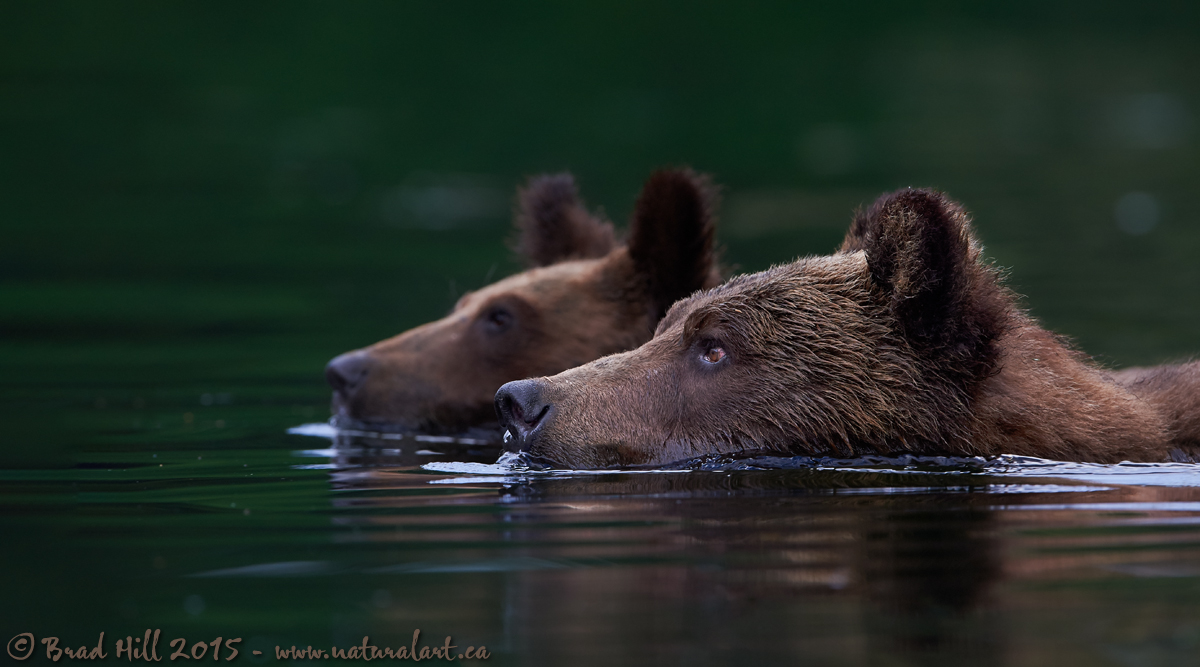
This was a moment I'll remember for a long time. We had been watching this female grizzly and her two cubs foraging on the edge of a channel in the Khutzeymateen estuary when the three of them apparently decided the grass was greener (and tastier) on the other side of the channel. At the time the tide was rising and was approaching its highest point, and had functionally stopped the flow of the river, producing calm waters. The three bears chose to swim a route that brought them quite close to our boat. Just as they were passing us both mom and the cub swimming beside her stopped swimming and went into "all sensors deployed" mode - with their erect ears, focused eyes, and collective noses all pointing at the distant shore. When I captured this shot the bears had pretty much stopped their forward motion, but the incoming tidal current still produced a small standing wave in front of their noses and ripples along the sides of their faces. After I had captured a few swimming-in-profile shots I looked along the bears eye-lines and, sure enough, saw another bear walking in our direction, though at the time it was hundreds of meters away (but obviously close enough to cause these two bears some concern).
Subject: Female Grizzly (
Ursus arctos) with cub
Location: Khutzeymateen Grizzly Sanctuary, northern BC Coast, Canada
Camera: Nikon D4
Lens: Nikkor 600mm f4 VR - hand-held from floating zodiac. VR on and in "Normal" mode.
Exposure: 1/400s @ f8; ISO 3600. -0.67 stop compensation compensation from matrix-metered exposure setting.
Crop: Full frame horizontally, with about 10% crop from bottom...
A lot more info about this shot - including both a veritable laundry list of things going through my mind while I witnessed this scene through the viewfinder and a 2400 pixel version of the shot - is available right here on my website:
http://www.naturalart.ca/galleries/latest/.
Comments and critiques welcomed - probably best to view the larger version prior to doing so!
Cheers...
Brad
PS: Like all wildlife images on my website and that I post on NPN, the subject is fully wild and completely unconstrained. Besides the potential impact of my presence, nothing has been done to intentionally alter or affect the ongoing behavior of the subject and, of course, there has been no use of any form of bait or other form of wildlife attractants (including vocalizations)

Comments
9 commentsMax
PS: on a side note, please check your inbox. I've emailed you re possible confusion on my part re trip dates. Thanks, Richard
Jagdeep Rajput
Almost seems like you have an OOF foreground, sharp subject, and OOF background, though!
Stunner.
Thanks for the feedback on this one - always appreciated.
Note to John: On multiple out-of-focus zones: This is an issue I've thought about and analyzed over and over again - all in an effort to see what works for me (and when). Ultimately it comes down to this - what I personally find distracting and unappealing is when an image contains 3 distinct edge-to-edge bands of focus (which is, of course, an OOF foreground band, a band of focus in the middle, and then an OOF background band. When the 3 focal zones become indistinct - like they can with a featureless and continuous homogenous foreground and background (as above) and they are not readily perceived as distinct bands, then I'm fine with multiple out-of-focus zones. In these situations there is the appearance that the subject is the ONLY thing in focus in the frame, not that there is a distinct edge-to-edge band of focus in the middle of the frame. I have found that this situation occurs a lot when the subjects (including waterfowl of course) are in water that doesn't have floating objects on it or on featureless snow. I think the key is to somehow "break" the focus band from stretching right across the frame. I'll provide an example of a different way to break the focus band in a coming post.
Cheers...
Brad
Grt, Ingrid.