Enter Stage Right...
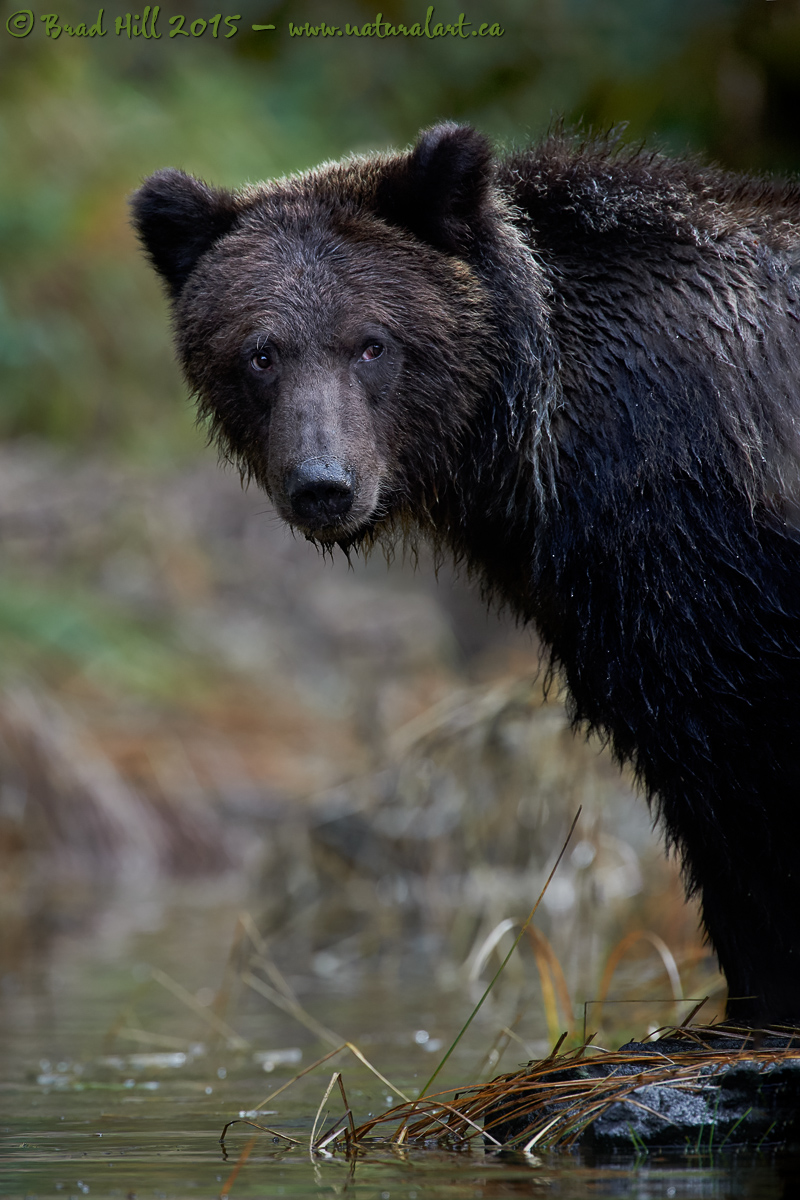
I know this one won't be everyone's cup of tea, but for me it's one of those shots that has grown on me since I first processed it. I can't really pinpoint why, but when it's sitting on a "light table" style view on my computer with a bunch of other bear images, my eyes almost always come back to this shot. And, it's almost "opposite" from the normal lighting regime I tend to like (i.e., with the background being somewhat darker than the subject). And I suppose part of it might just be because this was just such a great grizzly to be around (and photograph) - he was incredibly gentle and was just so, so comfortable with our presence. Quality time with a great bear - what could be better?
This shot has value in illustrating a few technical points. First, it was shot with the "new" 400mm f2.8E VR - with the TC-20EIII (2x) teleconverter. So an 800mm shot. This lens - as well as its precursor - pairs up incredibly well with teleconverters (or TC's). This one was hand-held from a floating zodiac, and I doubt too many will be thinking it's overall soft or unsharp. Definitely one of those situations where I would have loved to have Nikon's 800mm f5.6 VR prime with me to shoot some comparison shots, but I didn't. C'est la vie.
Second - but still related to the teleconverter - is something I've noticed for a long time when shooting TC's: often the TC has LESS effect on the sharpness of the image than it does on the quality of the out-of-focus zones (the bokeh) of the host lens. The 400mm f2.8 VR (both versions) has amazingly good bokeh when shot "native" (sans TC). But add a TC (either the 1.4x or the 2x) and those out-of-focus zones become a little more "nervous" or jittery. On many shots it's not too noticeable, but that subtle shift in bokeh is there.
There's no doubt that if I opened up the aperture more (say to f5.6, or wide open) the out-of-focus background would have been rendered more smoothly, but when shot wide open the subject wouldn't have been quite as sharp (images shot with TC's are almost sharper when shot stopped down a little from wide open) and I may have run into depth-of-field issues on the bear (or the grasses below it). TC's can be very useful tools, but it's always best to fully understand their limitations and what to watch for (and what to avoid doing) when shooting with them...
Subject: Male grizzly (
Ursus arctos) entering the stage!
Location: Great Bear Rainforest, BC, Canada
Camera: Nikon D4s
Lens: Nikkor 400mm f2.8E VR with 2x TC (800mm) - hand-held from floating zodiac. VR on and in "Sport" mode.
Exposure: 1/800s @ f7.1; ISO 2250. No compensation compensation from matrix-metered exposure setting.
Crop: None - this is full frame.
A lot more details about this image - including including a much higher resolution version (2400 pixel) - can be found here on my website:
http://www.naturalart.ca/galleries/latest/.
Comments and critiques welcomed - probably best to view the larger version prior to doing so!
Cheers...
Brad
PS: Like all wildlife images on my website and that I post on NPN, the subject is fully wild and completely unconstrained. Besides the potential impact of my presence, nothing has been done to intentionally alter or affect the ongoing behavior of the subject and, of course, there has been no use of any form of bait or other form of wildlife attractants (including vocalizations)

Comments
8 commentsProcessing looks very good. I can see the slight jittery effect of TC, but it feels quite alright and the background is just enough suggested to pull one into the frame a bit. I find the brighter background works great, in no way diminishing the feel for place. The 2x on the 400 2.8 looks fantastic.
Hmmm, just thinking about it again...I think if we could see all of the front foot there would be lessened sense of him leaning unbalanced, but of course that is entirely situational.
Max
I think this is great. I love the look! He's not looking AT you, he's looking back past you, at something. That little bit of light on top of his head really sets things off. Wonderfully done, and he cooperated awfully well.
Thanks also for the TC technical info - it's useful!
I too like this Capture very much ! I am not a fan of tc's , mostly because my lenses are zoom and I feel they give me much less sharpness than I prefer.
He is a very dark specimen, where the backlit head rim shows him off nicely and the lighter snout come together and draw your eye into it's sharply defined eye area! The whole scene has a quietness about it with the grounded base being sharp and defined to see the quiet waters.
Must have been the first trip, can not remember this scene!
Thanks for sharing
Bill