Lunging for Lunch
When people who haven't visited the area hear the term "The Great Bear Rainforest" they often conjure up images of a rainy forest just teeming with bears. In some respects that's not incorrect, but in a way it sells the Great Bear Rainforest short - the forest there is filled with far more than bears, and the narrow inlets of the area are absolutely alive with amazing creatures as well. In recent years Humpback Whales have rebounded phenomenally, and each year they're becoming better and better at "stealing the show" from the bears as the key attraction!
In the Great Bear you tend to see humpbacks using one of two ways to surface feed - bubble-netting and lunging. Bubble-netting is a complex, learned behavior where one or more whales swim in a circle under a school of bait-fish while releasing bubbles from their blowhole, which forms a curtain around the feed and keeps it constrained. The whales then swim upward in the middle of the bubble-net and grab a mouthful of feed at the surface. It's an amazing spectacle to behold! So cool...
With lunge-feeding the whales simply come up from below a school of feed and, at the surface, lunge forward and use their massive mouths to trap the fish before straining the water out through their fine baleen plates (which filter the fish out).
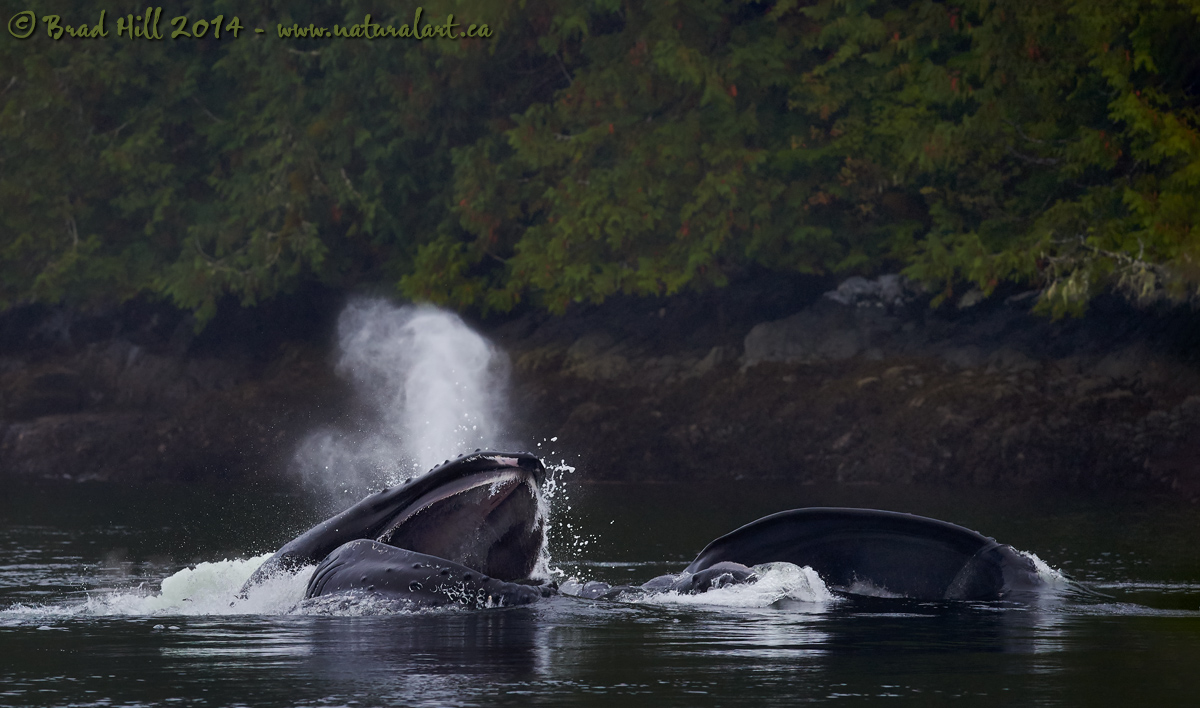
This shot shows a pair of humpbacks lunge-feeding on small "bait fish"(herring and other small fish) in a narrow inlet. These two whales had begun constructing a bubble-net but part way through the process they aborted the net and simply lunged forward - and directly toward us - with mouths agape. The whale on the left is "blowing its stack" (exhaling from its blowhole) and the baleen plates on its upper jaw are clearly visible. The whale on the right is lying sideways in the water with it's large "bucket" (lower jaw) filling with water and fish. I loved the natural high-contrast scene provided by the dark colors of the whales and the near white splashing water. And, I think this may be the only frontal-view lunge-feeding while blowing shot I've ever managed to capture!
Subject: Humpback Whales (
Megaptera novaeagnliae) lunge-feeding along a narrow coastal inlet
Location: Great Bear Rainforest, BC, Canada
Camera: Nikon D4s
Lens: Nikkor AF-S 400mm f2.8E VR - hand-held from sailboat. VR on and in Sport mode.
Exposure: 1/1250s @ f4.5; ISO 2000. -1. stop compensation from "recommended" matrix-metered exposure setting.
Crop: Moderate - this is about 85% of full frame
More about this image (including processing details) can be found here...
http://www.naturalart.ca/galleries/latest/
Comments and critiques welcomed - probably best to view the larger version prior to doing so!
Cheers...
Brad

Comments
4 commentsAMAZING Encounter to witness !!:)
Well captured, with the Blow showing off so well without being blown.( GET IT?)
It's great to read your interpretation of the developing scene & fully understand the Impressive Image Capture.
The Trip was filled with Amazing encounters of Whales , doing their thing, But difficult to fully appreciate without being there. You & Captain Chris went out of your way to position the Mother Ship into Best opportunities positions!!:)
I understand that some Professionals who offer Photo Tours/Adventures are much more interested in themselves getting Images & only allow the paying people along to subsidize their trip. Not in your case, By far I find your Very Generous attitude to assistance, Tips & generally help to be OUTSTANDING! THANK YOU... BRAD
ps... Can I now get a Discount on my next Adventure :) :)
Cheers
Bill
NOTE to others: I did not pay Bill to add this comment (much to his chagrin I suspect).
Cheers...
Brad
Does this mean that I have to pay a premium for next year's trip?
Thanks for the honest feedback! You must be looking at the image that differs significantly in brightness from my monitors (and my iPhone and iPad) - I can see lots of dark-on-dark detail on all the parts you describe. The only place I can't see detail is at the back of the mouth (descending into the throat) on the whale on the right - and I couldn't see that while in the field either. The image was captured when ambient lighting WAS very low...
But you bring up a very good point - even with the most carefully calibrated monitors you simply can't control what others see on their monitors. I used to worry about this more than I do now - time was if I had an image that was taken under real low light conditions (and thus should be dark) I'd brighten the image so that folks with dim monitors could see detail. But then, of course, those with monitors calibrated the same as mine would be looking at an image that's too bright! Can't win for trying! Anyway...I'm going to stick with my "check it on 5 displays/devices (two of which are calibrated) and then just go with it approach!"
Oh...and I'll send you a bill for your new and improved (from my perspective) photo tour price!
Cheers...
Brad
PS: You know me...when I was working on white-on-white detail on the blow and splashing water I was doing it highly selectively and not touching the darks - I adjusted those independently of the whites - and as I wanted them to look (on my devices).