Gallery: WildlifePosted July 23, 2014107 views12 comments
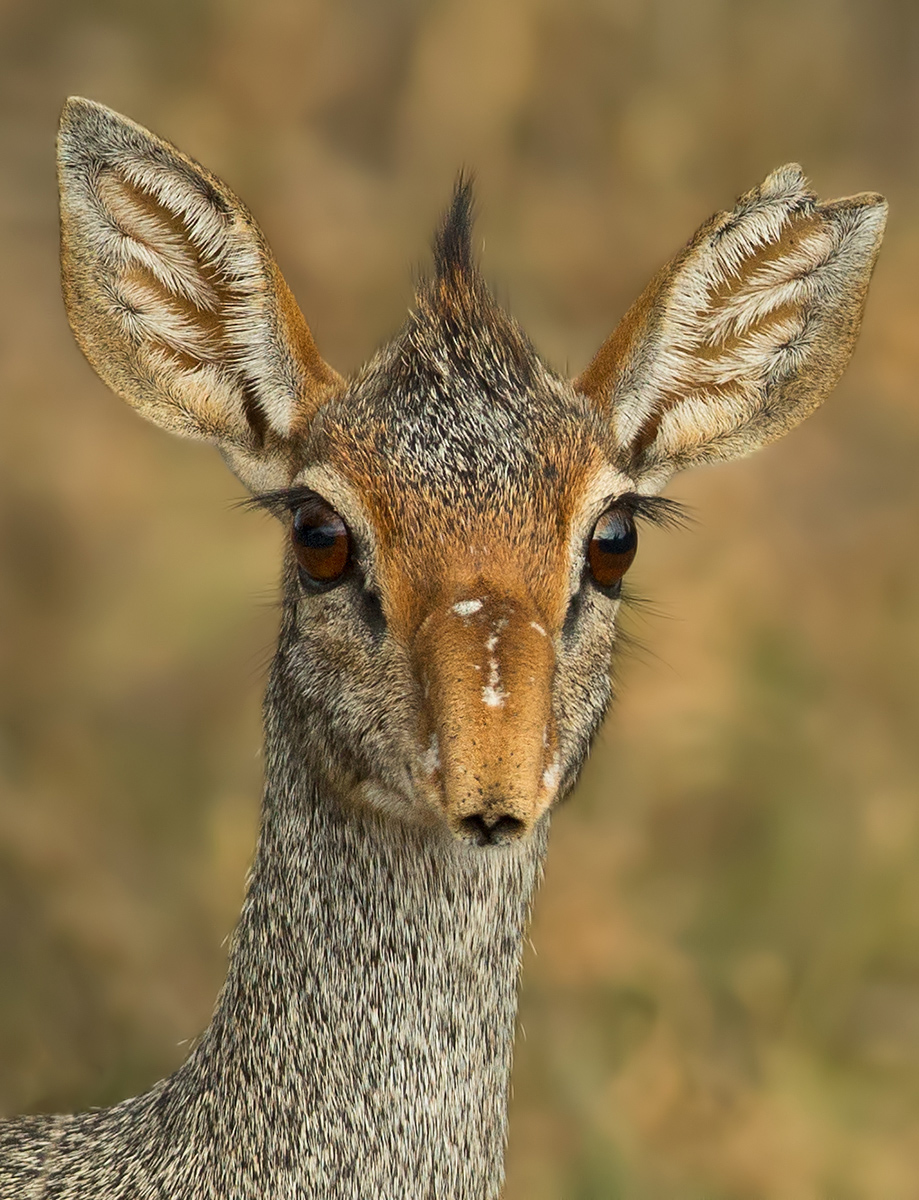
This is apparently a Gunther's Dikdik,what the difference is I have no idea
EOS 1DX
200-400 mm F4 with 1.4 EX at 560 mm
F5.6
ISO 1600
1/2500
Comments
12 comments
Comment posted by Jerry Austin on July 23, 2014 at 11:44 AM
I am loving this. I really like close ups that show detail. This certainly fills the bill. Unusual looking little fellow. The spiked hair, big eyes and funky nose make for one funky little dude. Really like the notched ear. Shows he's been in a scrap or two. Very nice.
Registered on January 6, 2012, 651 Posts, 3448 Comments
Comment posted by Nate Chappell on July 23, 2014 at 2:33 PM
A very neat detailed portrait of this species Ken, really shows off that strange nose and big ears. I could see going a bit looser on the crop but this sure emphasizes the details.
Registered on February 1, 2006, 1158 Posts, 19528 Comments
Comment posted by Ken Watkins on July 24, 2014 at 9:29 AM
Jerry and Nate,
Thanks very much
Registered on December 15, 2010, 1537 Posts, 4877 Comments
Comment posted by Brad Hill on July 24, 2014 at 11:34 AM
Hey Ken,
The incredibly unique snout, massive eyes, eye-catching pattern of fur and hair in the ears, and that little peak on the top of the head combine to make this one fascinating creature. I see Nate's point of perhaps it being a bit tight...but that's a personal preference issue.
When I look at the larger version the image seems just a tad soft (or lacking that extra bit of sharpness that can make an image pop) - not sure if it's an equipment thing (maybe that integrated 1.4x TC pulls a little sharpness off at maximum focal length or - like all TC's - it works the best when stopped down a bit from wide open?) or maybe it's a post-processing thing?
Cheers...
Brad
Registered on May 29, 2007, 431 Posts, 6061 Comments
Comment posted by Ken Watkins on July 24, 2014 at 11:51 AM
Brad,
The "problem" here is insufficient DOF
Registered on December 15, 2010, 1537 Posts, 4877 Comments
Comment posted by Brad Hill on July 24, 2014 at 12:14 PM
Hey Ken,
I don't know about that - with DoF inadequacy (sounds like a disease, eh?) you see some areas that are tack sharp and then softening in front of and behind it. Here I'm seeing a slight (and it's very slight...not major) softness - or at least a lack of any area with biting edge sharpness - throughout the head. At that shutter speed it's likely not camera shake...so I'm betting it's the TC...but only very rigorous testing would prove the point one way or the other...anecdotal observations without comparative shots don't really help. I'm also betting if you stopped down 2/3 to a full stop almost all the TC-induced softening would go away (haven't met a TC yet that doesn't improve a LITTLE when you stop down a bit).
But I'm basing all this off a comparatively small image (1200 pixels) that has been processed and thus isn't necessarily 100% reliable in reproducing what was going on when the photons hit your image sensor!
Brad
Registered on May 29, 2007, 431 Posts, 6061 Comments
Comment posted by Philip Hodgkins on July 24, 2014 at 4:02 PM
Now that is a weird looking animal, very unique. Super detail and eye contact, well set apart from that nice bg. I don't know what difference it makes either, but it probably did to Gunther!
Registered on July 24, 2006, 2741 Posts, 12349 Comments
Comment posted by Ken Watkins on July 25, 2014 at 2:44 AM
Brad,
I really have no idea as to what you are suggesting, but I will give it a try
Philip,
I am sure Gunther had a good ruler
Registered on December 15, 2010, 1537 Posts, 4877 Comments
Comment posted by Brad Hill on July 25, 2014 at 9:26 AM
Ken,
Stopping down more (not shooting a TC with aperture wide open if you want maximally sharp images).
Brad
Registered on May 29, 2007, 431 Posts, 6061 Comments
Comment posted by Ken Watkins on July 25, 2014 at 9:40 AM
Brad,
Thanks for your explanation, that is what I thought effected DOF
Registered on December 15, 2010, 1537 Posts, 4877 Comments
Comment posted by Brad Hill on July 25, 2014 at 10:34 AM
Ken,
Of course aperture affects DoF. But, DoF is affected by a lot of other things - focal length, relative ratio of distance to subject AND distance to background from subject (which is the MOST important variable), etc. If you stop down a focal length of 560mm by 2/3 to a full stop from wide open (to get close to maximum sharpness out of a TC), you won't come even close to bringing the background into focus in a shot like you have here. I have shots of wildlife taken with a 600mm lens at f11 that have totally blurred, smooth backgrounds. It's about choosing the optimal aperture that balances DoF concerns with maximum sharpness of the lens and/or lens/TC combination in use.
Brad
Registered on May 29, 2007, 431 Posts, 6061 Comments
Comment posted by Lon Sharp on July 27, 2014 at 6:50 PM
Ken and Brad,
Even when you might both be discussing points that are somewhat "old ground" to you , this is a kind of ultra-helpful clarifying for others that read this forum! It is much of what makes NPN a cut above the rest!
Registered on December 9, 2007, 258 Posts, 9892 Comments

Comments
12 commentsThanks very much
The incredibly unique snout, massive eyes, eye-catching pattern of fur and hair in the ears, and that little peak on the top of the head combine to make this one fascinating creature. I see Nate's point of perhaps it being a bit tight...but that's a personal preference issue.
When I look at the larger version the image seems just a tad soft (or lacking that extra bit of sharpness that can make an image pop) - not sure if it's an equipment thing (maybe that integrated 1.4x TC pulls a little sharpness off at maximum focal length or - like all TC's - it works the best when stopped down a bit from wide open?) or maybe it's a post-processing thing?
Cheers...
Brad
The "problem" here is insufficient DOF
I don't know about that - with DoF inadequacy (sounds like a disease, eh?) you see some areas that are tack sharp and then softening in front of and behind it. Here I'm seeing a slight (and it's very slight...not major) softness - or at least a lack of any area with biting edge sharpness - throughout the head. At that shutter speed it's likely not camera shake...so I'm betting it's the TC...but only very rigorous testing would prove the point one way or the other...anecdotal observations without comparative shots don't really help. I'm also betting if you stopped down 2/3 to a full stop almost all the TC-induced softening would go away (haven't met a TC yet that doesn't improve a LITTLE when you stop down a bit).
But I'm basing all this off a comparatively small image (1200 pixels) that has been processed and thus isn't necessarily 100% reliable in reproducing what was going on when the photons hit your image sensor!
Brad
I really have no idea as to what you are suggesting, but I will give it a try
Philip,
I am sure Gunther had a good ruler
Stopping down more (not shooting a TC with aperture wide open if you want maximally sharp images).
Brad
Thanks for your explanation, that is what I thought effected DOF
Of course aperture affects DoF. But, DoF is affected by a lot of other things - focal length, relative ratio of distance to subject AND distance to background from subject (which is the MOST important variable), etc. If you stop down a focal length of 560mm by 2/3 to a full stop from wide open (to get close to maximum sharpness out of a TC), you won't come even close to bringing the background into focus in a shot like you have here. I have shots of wildlife taken with a 600mm lens at f11 that have totally blurred, smooth backgrounds. It's about choosing the optimal aperture that balances DoF concerns with maximum sharpness of the lens and/or lens/TC combination in use.
Brad
Even when you might both be discussing points that are somewhat "old ground" to you , this is a kind of ultra-helpful clarifying for others that read this forum! It is much of what makes NPN a cut above the rest!